
Shortening of the working week has reduced GDP by 223 billion
The shortening of the working week has not delivered the intended results. The average number of working hours has fallen from 39.5 to 35.9 hours per week, equivalent to ISK 223 billion in lost GDP in 2025, even when account is taken of the lower productivity of the lost working hours. Furthermore, over half of state institutions have shortened their opening hours. The shortening should be reviewed in light of these findings.

GDP matters greatly for living standards. It measures the value created in the economy and largely determines society's capacity to sustain wages, services and investment. Recently it has been emphasised that GDP per capita has stagnated in recent years. That, however, is not the whole story, because Icelanders now work much less than before.
The shortening of the working week was a pilot project aimed at increasing job satisfaction, quality of life and productivity without increased cost or reduced services.[1] Implementation began in January 2020, but since then the average number of weekly working hours has fallen from 39.5 hours per week down to 35.9.
The global pandemic and the infection prevention measures that accompanied it make it difficult to analyse the true effects of the shortening of the working week. Now that the effects of the pandemic are no longer felt and the labour market has returned to normal, the outcome of the project can be analysed.
The shortening of the working week has cost 223 billion
Productivity per working hour has increased, but at the same time the number of working hours has fallen substantially. In 2025 the average productivity in Iceland was about ISK 8,500 per hour but would be ISK 8,200 without the shortening.[2] This estimate takes account of the fact that the working hours that disappeared were on average less productive than the working hours that remain. The conclusion is that if the shortening of the working week had not been implemented, GDP would be about ISK 223bn higher this year (figure 1).
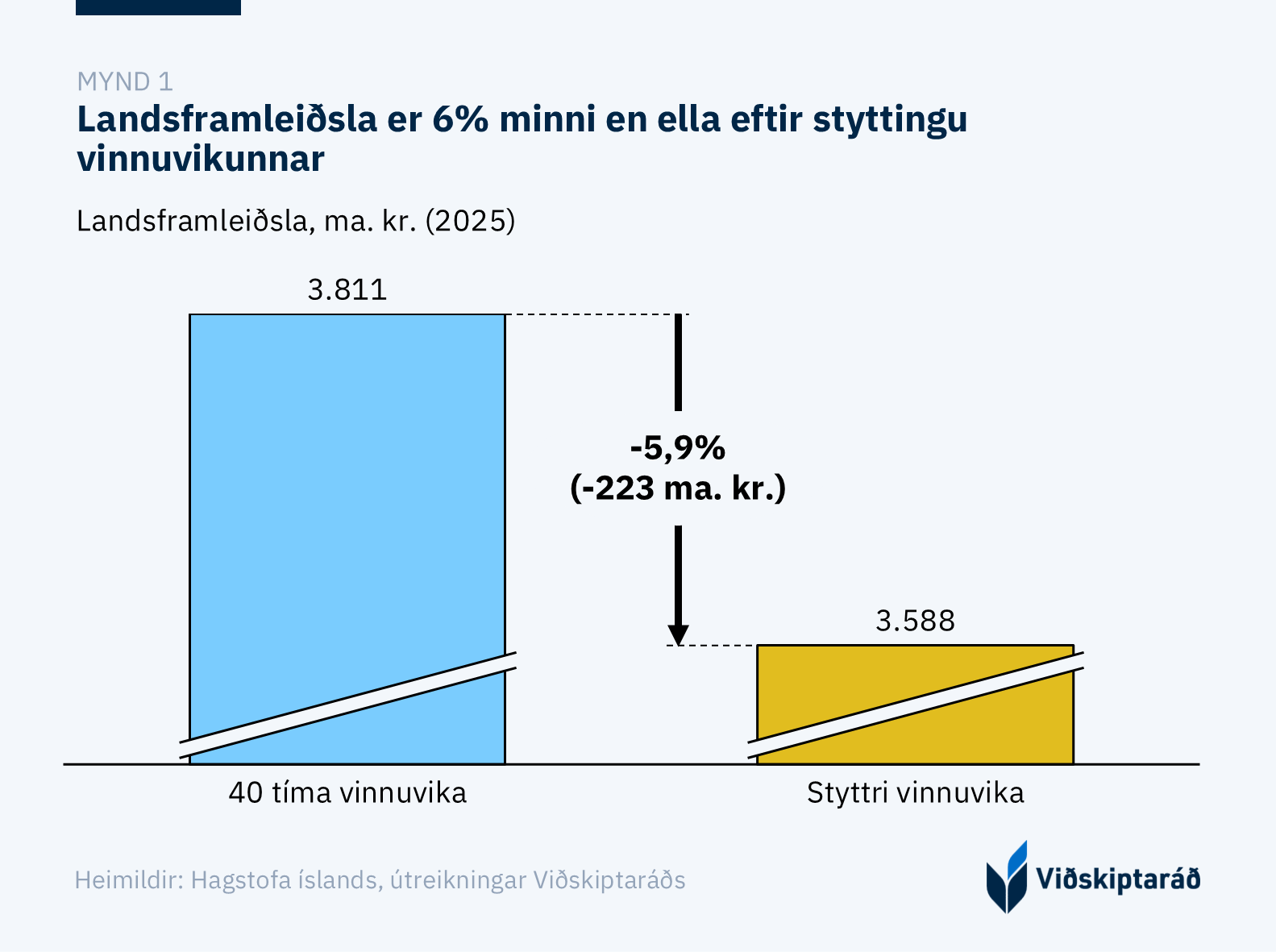
The average number of hours worked was taken and multiplied by the number of people employed. In estimating the cost of the shortening of the working week, Viðskiptaráð used hours worked in 2019 and assumed that productivity per working hour would continue to follow the conventional growth from the years 2014-2019. Account was also taken of the contraction in productivity in 2024 when estimating expected productivity if the shortening of the working week had not been implemented.
Productivity increase unclear due to pandemic
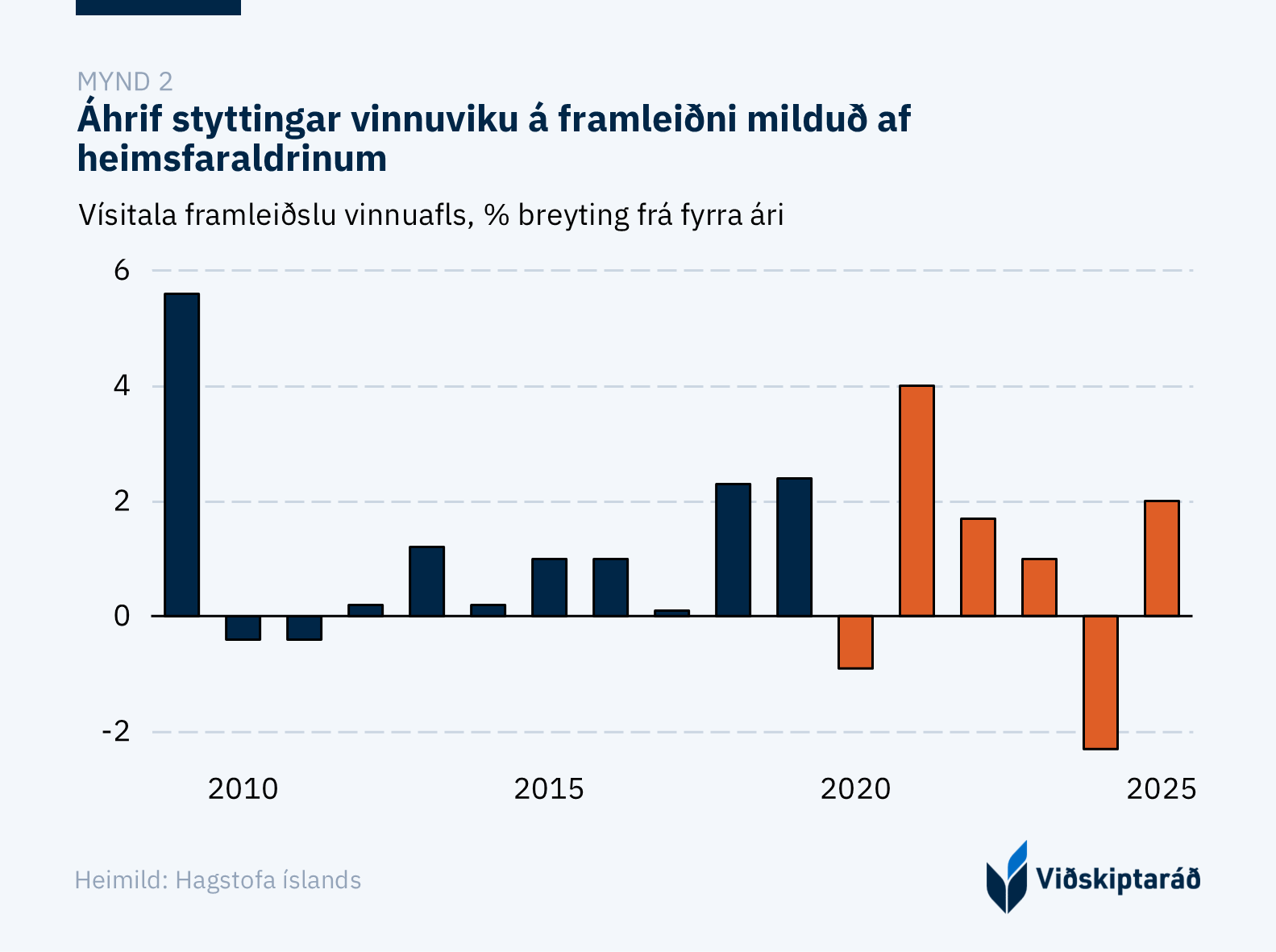
The expectations accompanying the shortening of the working week were that, with shorter working hours, productivity would increase during the time people were at work. In 2020, when the shortening of the working week was implemented, there was a slight decrease in productivity per working hour (figure 2). That decrease can in all likelihood be attributed to the global pandemic and the effects it had on the labour market. In 2021 there was a considerable increase in productivity per working hour, which can also largely be attributed to unusual conditions in the labour market. Since that time, the increase in productivity has been fairly modest, and was indeed negative in 2024.
Services of public institutions reduced
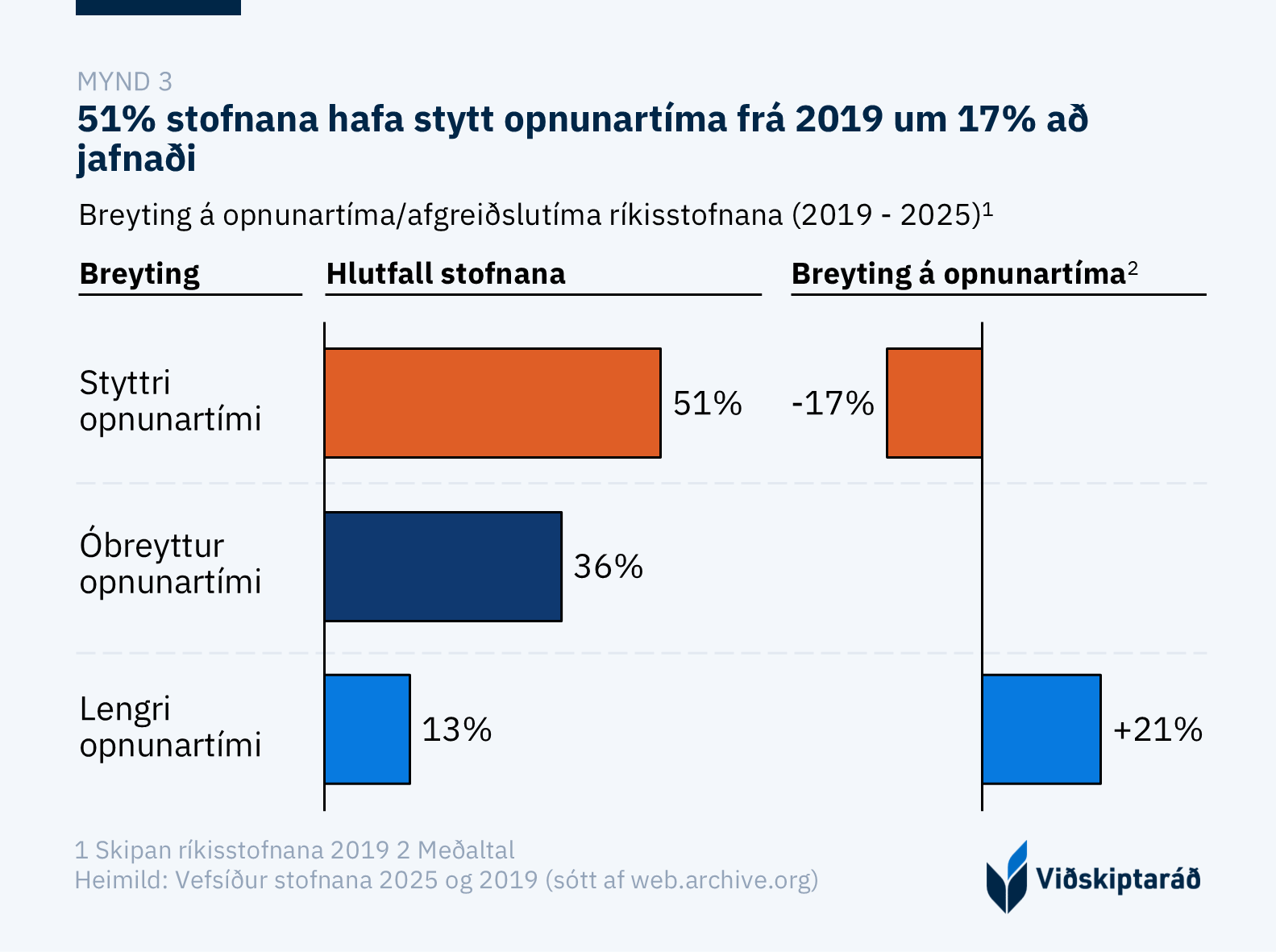
Viðskiptaráð's surveys of the opening hours of institutions also indicate that the shortening of the working week has led to widespread reductions in services. Over half of state institutions had shortened their opening hours since 2019 by an average of 17% (figure 3).[3]
To get to the heart of the matter, it is helpful to take an example. Preschools cannot staff a preschool for 40 hours a week with employees who work only 36 hours a week. The reduction in the work of preschool staff has thereby increased staffing difficulties and led to more frequent closures.[4] In order to maintain unchanged opening hours for preschools, an increase in expenditure is therefore necessary for hiring. This is at odds with the premises of the shortening of the working week.
Review timely
The shortening of the working week is a pilot project that has led both to reduced services and increased costs, contrary to the project's objectives. The cost appears both in direct expenditure due to staffing difficulties and in lower GDP due to fewer working hours per capita.
There is reason to review the implementation of the shortening of the working week. The findings indicate that the premises of the project have collapsed: value creation has contracted, services have been reduced, and the intended benefit for living standards is not visible.
References
[1] RÚV (2021). "Shortening should not reduce services". URL: https://www.ruv.is/frettir/innlent/2021-01-20-stytting-a-ekki-ad-draga-ur-thjonustu
[2] Price-adjusted to 2020, as in the data of Statistics Iceland. URL: https://px.hagstofa.is/pxis/pxweb/is/Efnahagur/Efnahagur__thjodhagsreikningar__landsframl__1_landsframleidsla/THJ01103.px
[3] Viðskiptaráð (2025). "Half of institutions have shortened opening hours". URL: https://vi.is/stadreyndir/opnunartimi-stofnana
[4] Anna Margrét Ólafsdóttir, Hafdís Svansdóttir and Jónína Einarsdóttir (2025). "On the shortening of the working week in the preschools of the City of Reykjavík, a call for correction". URL: https://www.visir.is/g/20252726037d/um-styttingu-vinnuvikunnar-i-leikskolum-reykjavikurborgar-akall-um-leidrettingu
This article was automatically translated from the Icelandic original.
Related Content

New fund does not solve the problem

Increased regulation of the .is national domain needs explanation

Carbon tariff an undesirable response to a flawed system

State investments need clearer cost-benefit analysis

The Icelandic Economy 2026