
Iceland falls seven places in competitiveness year-on-year
Iceland falls seven places year-on-year in competitiveness and now sits in 22nd place out of 70 countries in 2026. Iceland's competitiveness declines across every main factor of the assessment by the IMD business school in Switzerland, which carries out an annual review of national competitiveness.

Iceland now sits in 22nd place in competitiveness in 2026, falling seven places year-on-year according to IMD's assessment of the competitiveness of 70 countries. The assessment is one of the most comprehensive of its kind and measures countries' ability to create value and sustain good living standards over the longer term.
Iceland's largest decline since 2010
Iceland's competitiveness falls seven places year-on-year, from 15th to 22nd place (figure 1). Iceland has not ranked lower in the assessment for nine years, since 2017. Iceland's competitiveness has improved since 2010 and gained on the other Nordic countries, which have consistently ranked among the most competitive in the world. Despite the large year-on-year decline, there is not much between Iceland and the other Nordic countries, as their competitiveness is contracting too. Finland falls 5 places, Norway 6 places, Sweden 1 place and Denmark falls 2 places.
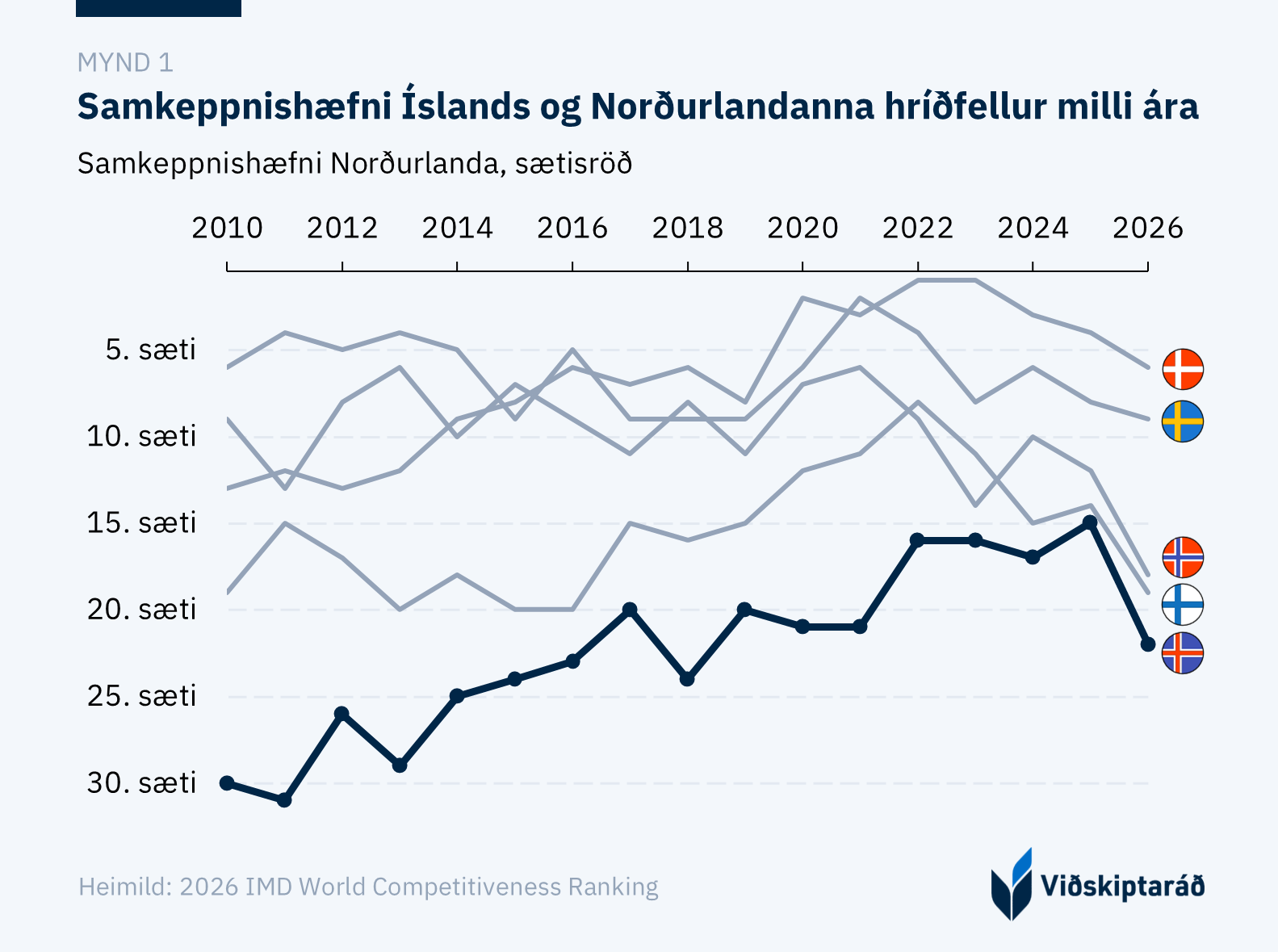
Singapore now the most competitive country in the world
Singapore is now the most competitive country in the world, taking the top spot from Switzerland, which led the list in 2025 (figure 2). Hong Kong is in second place, up one spot year-on-year. Switzerland is in third, down two places year-on-year. After Switzerland come Taiwan in fourth and the United Arab Emirates in fifth.
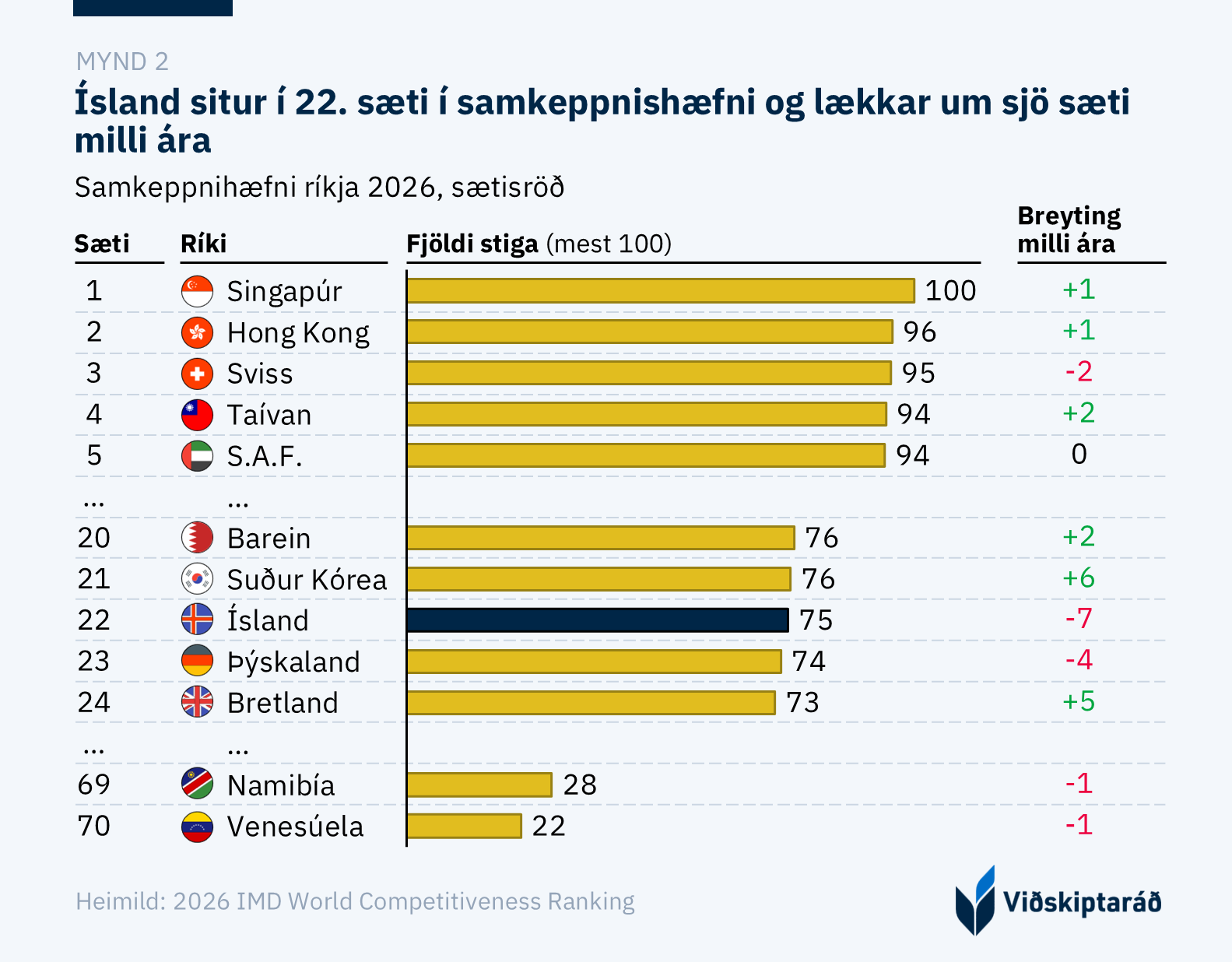
Iceland ranks 22nd among the world's most competitive countries. Above Iceland are, among others, South Korea in 21st and Bahrain in 20th. After Iceland come Germany in 23rd, down four places year-on-year, and the United Kingdom in 24th, up five places from last year.
This year, Namibia and Venezuela bring up the rear among the most competitive countries in IMD's assessment. Namibia is second from bottom, as last year, with 28 points out of a possible 100. Venezuela sits at the bottom, as it has for the past two years, with just 22 points.
Iceland declines across every main competitiveness factor
Iceland declines in all four main competitiveness factors year-on-year, by between 4 and 9 places. Iceland falls most in economic performance, dropping from 52nd to 61st place. It performed best on that measure in 2016, when Iceland ranked 29th. Iceland falls five places in business efficiency and in infrastructure, and four places in government efficiency. Iceland still stands relatively well on these latter three measures, despite the decline.
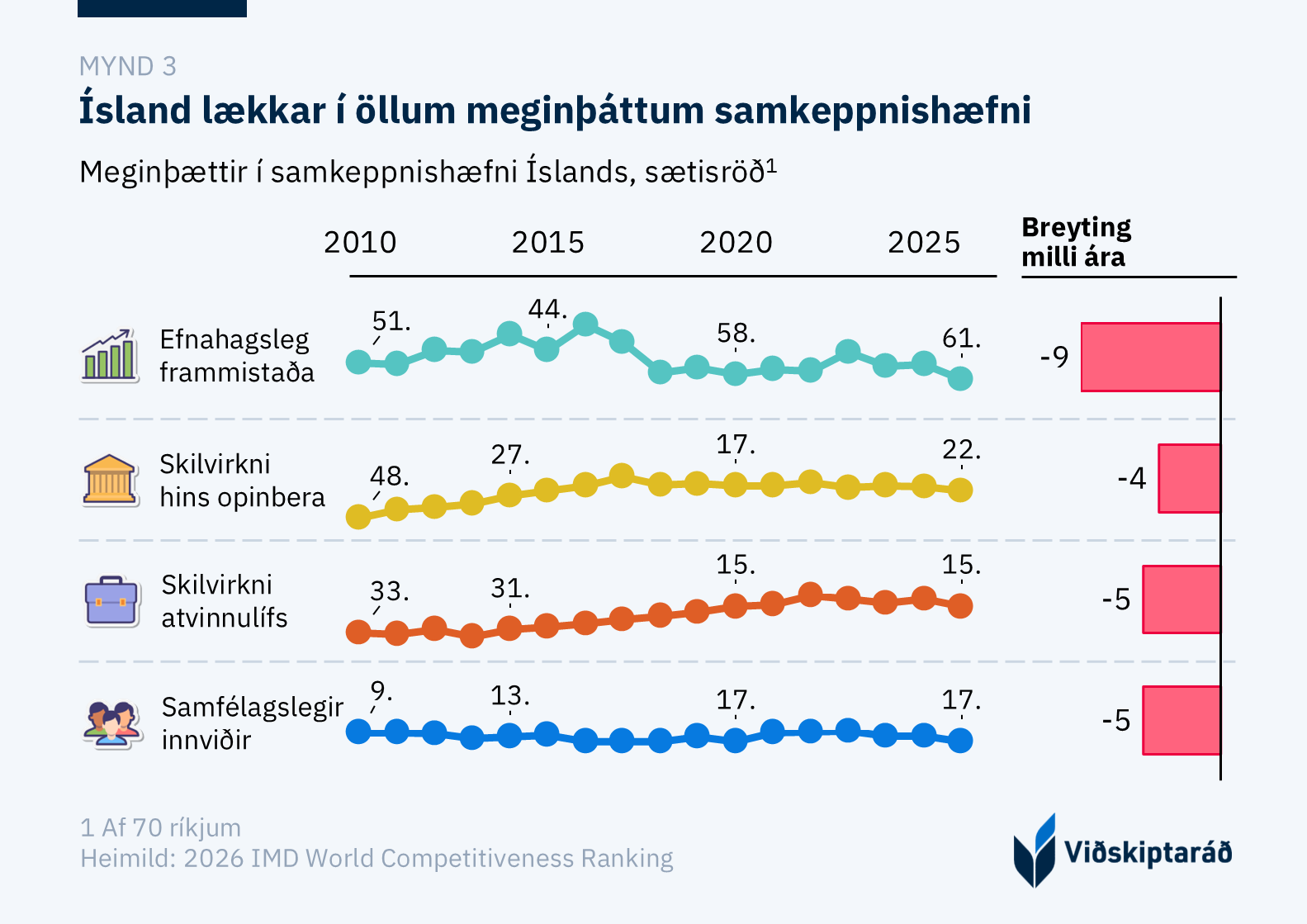
Over the longer term, the improvement in Iceland's competitiveness over the past 15 years is mainly explained by major progress in two of the assessment's four main factors. First, government efficiency, which has risen 26 places over the period. Second, business efficiency, which has risen 18 places over the same period. Iceland still stands well when it comes to infrastructure, despite having fallen 8 places since 2010.
Labour market, employment levels and the institutional framework of business drive the large decline
IMD's competitiveness assessment is based on four main factors, each comprising five sub-factors. Each of these 20 sub-factors then comprises individual criteria totalling around 300. A country's overall score on the measure is finally obtained by weighting all 20 sub-factors equally.
The labour market is the sub-factor in which Iceland declines most year-on-year. Iceland moves there from 20th to 48th place, weighed down most by lower competitiveness in the remuneration of skilled labour on the one hand and of trade- and vocationally-trained workers on the other, along with poorer availability of on-the-job training and a smaller supply of foreign university-educated labour. [1]
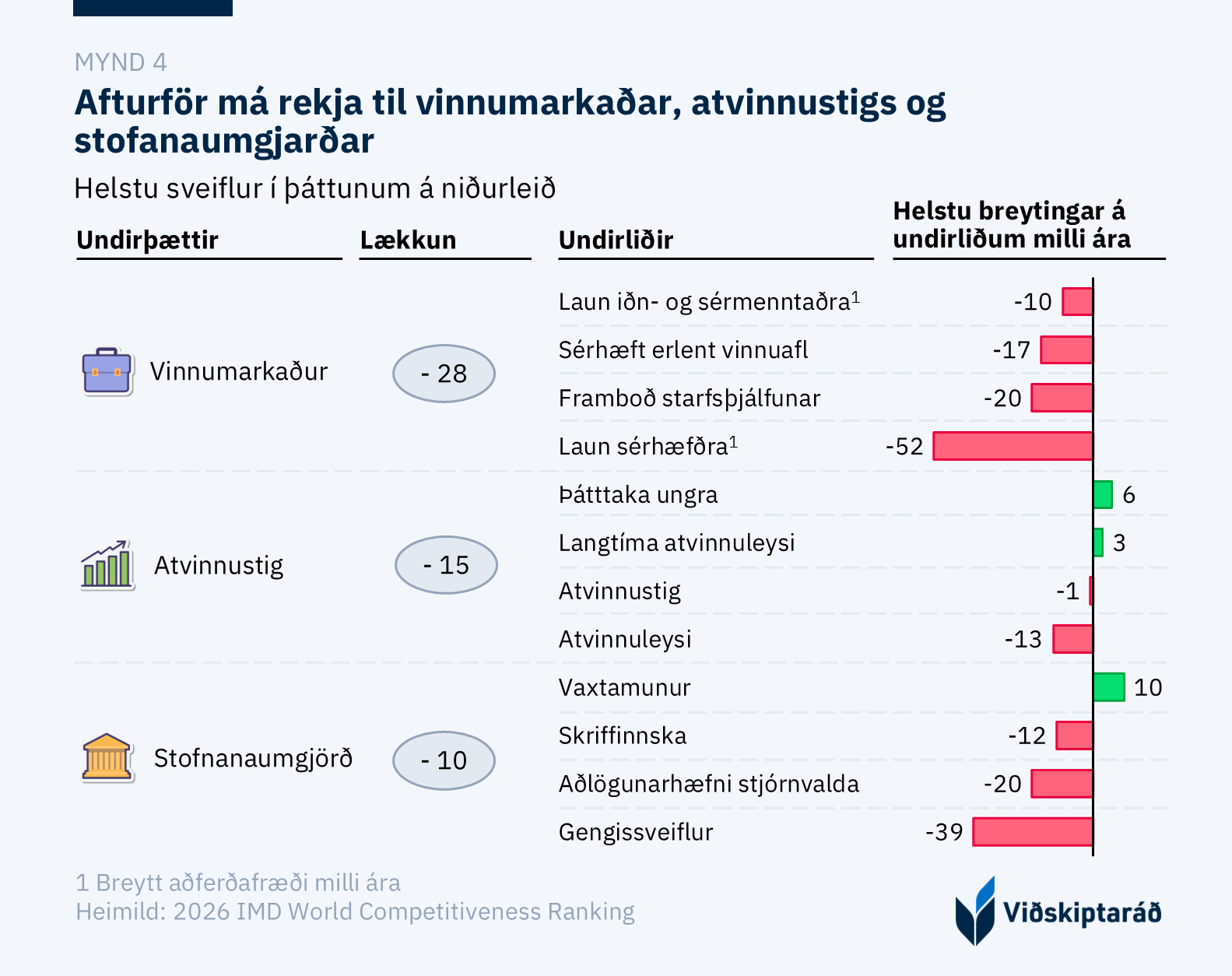
On employment levels, it is mainly rising unemployment that causes Iceland to fall 15 places on the measure. Iceland's position improves when it comes to long-term unemployment and also youth participation in society, where one criterion measures the share of people aged 15–24 not in education, employment or training. That share is lowest in Iceland.
In the institutional framework, it is mainly exchange-rate volatility, the adaptability of government policy and bureaucracy that drive the decline in that sub-factor. It should be noted that the decline due to increased exchange-rate volatility is explained almost entirely by the fact that last year the króna measured more stable than the euro — so Iceland ranked above all euro-using countries — while this year the króna measures less stable than the euro, so we move below all euro-using countries.
Four proposals for improved competitiveness
The Iceland Chamber of Commerce has formulated proposals in four priority areas, all of which would improve Iceland's competitiveness over the longer term and thereby increase prosperity (figure 5):
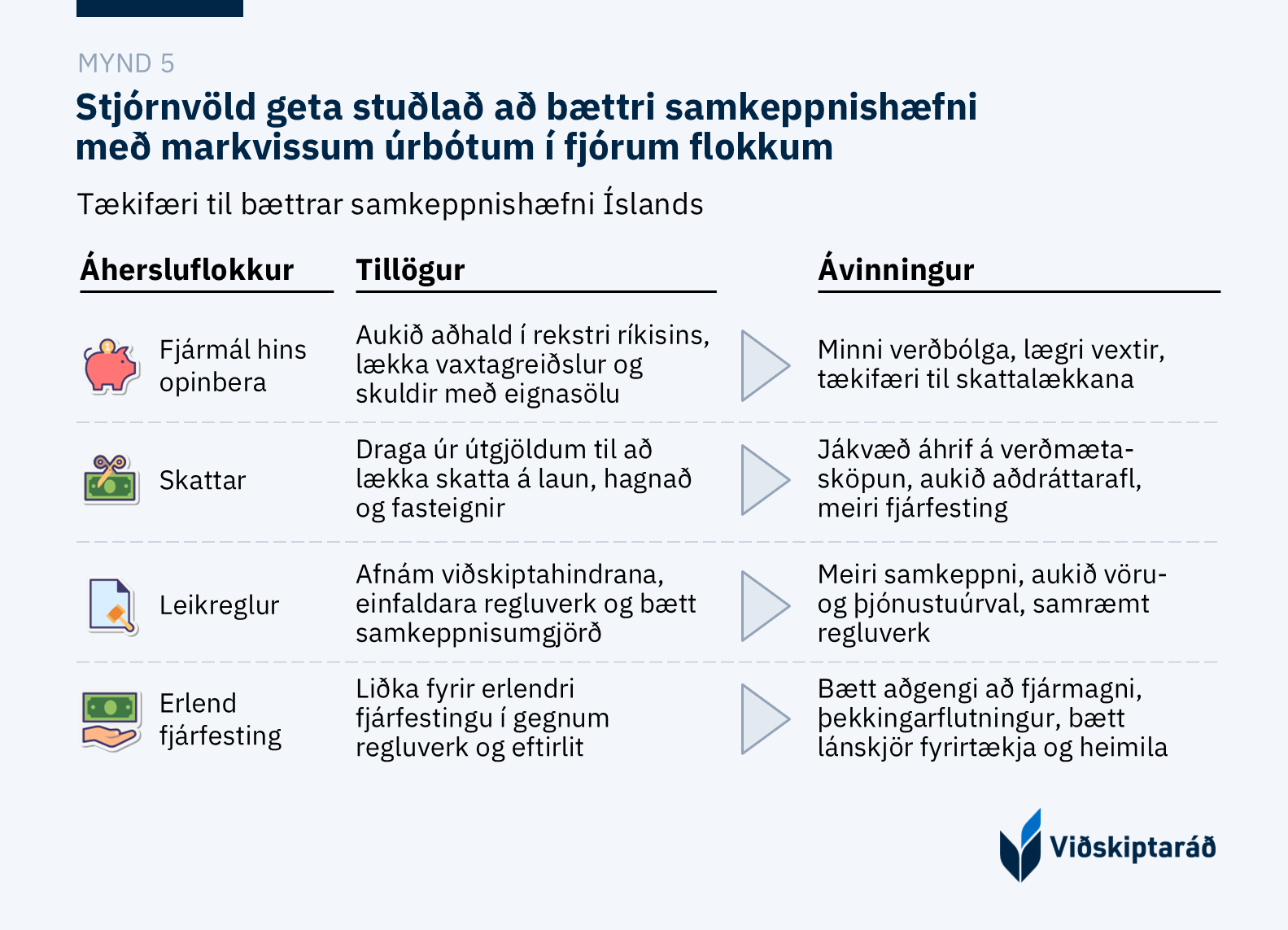
- Public finances: The government should increase restraint in state operations, reduce debt and thereby lower interest costs. The Treasury should also reduce its debt burden through asset sales. A concerted effort on public finances would lead to lower inflation and interest rates.
- Taxes: By reducing expenditure, scope can be created to lower taxes. This would have a positive effect on incentives for value creation, which increases investment and production in the economy.
- Rules of the game: By removing trade barriers, simplifying regulation and improving the competition framework, the government could foster greater product variety and competition in Iceland.
- Foreign investment: The government should specifically facilitate foreign investment through simpler regulation and efficient oversight. This would ensure better access to capital, greater transfer of knowledge to the country and improved lending terms.
Appendix: IMD survey
Business efficiency higher in Iceland than in the other Nordic countries
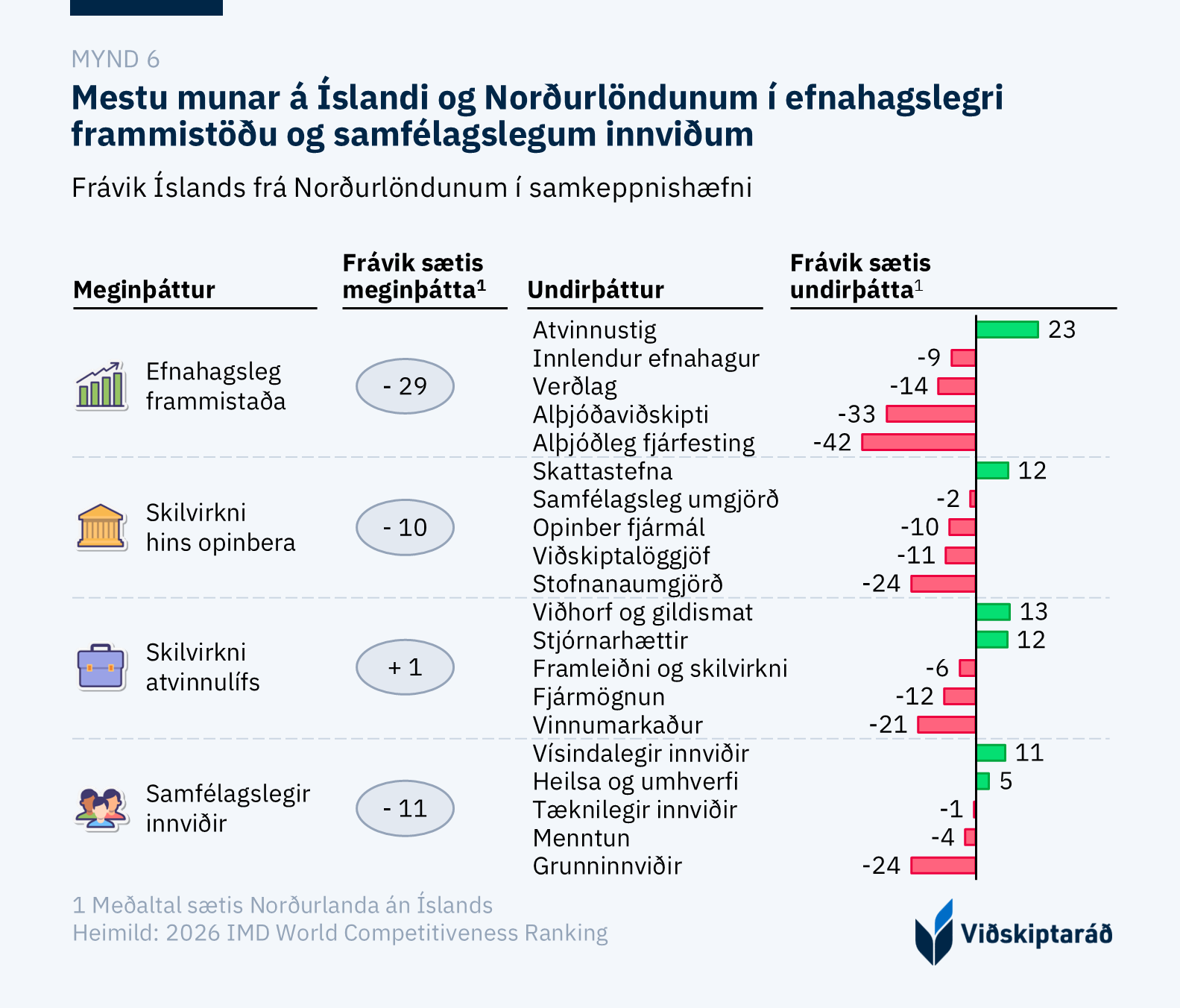
Iceland stands ahead of the other Nordic countries when it comes to business efficiency (figure 6), but behind on the other main factors. Iceland is one place above the other Nordic countries in business efficiency, where higher scores in attitudes and values and in management practices weigh most. The other Nordic countries are more competitive when it comes to productivity and efficiency, finance and the labour market. In the case of government efficiency, Iceland is 10 places below the other Nordic countries. Despite that, tax policy in Iceland is more competitive than in the other Nordic countries, while the societal framework, business legislation, public finances and the institutional framework are assessed as more competitive in the other Nordic countries.
Iceland is 11 places below the other Nordic countries in infrastructure, where the Nordic countries, Iceland included, consistently score very highly. Iceland stands ahead of the other Nordic countries when it comes to scientific infrastructure and health and environment, but is less competitive on technological infrastructure, education and basic infrastructure. Iceland is 29 places below the other Nordic countries in economic performance and ranks below them in every sub-factor except employment.
About the IMD business school competitiveness assessment in Switzerland
The IMD business school in Switzerland has run a research centre on the competitiveness of the world's nations since 1989. The centre annually assesses the competitiveness of around 70 countries, with the aim of giving governments, businesses and institutions information about the strengths and weaknesses of their economies. The Iceland Chamber of Commerce has conducted the assessment on Iceland's behalf since the country first took part in 2004.
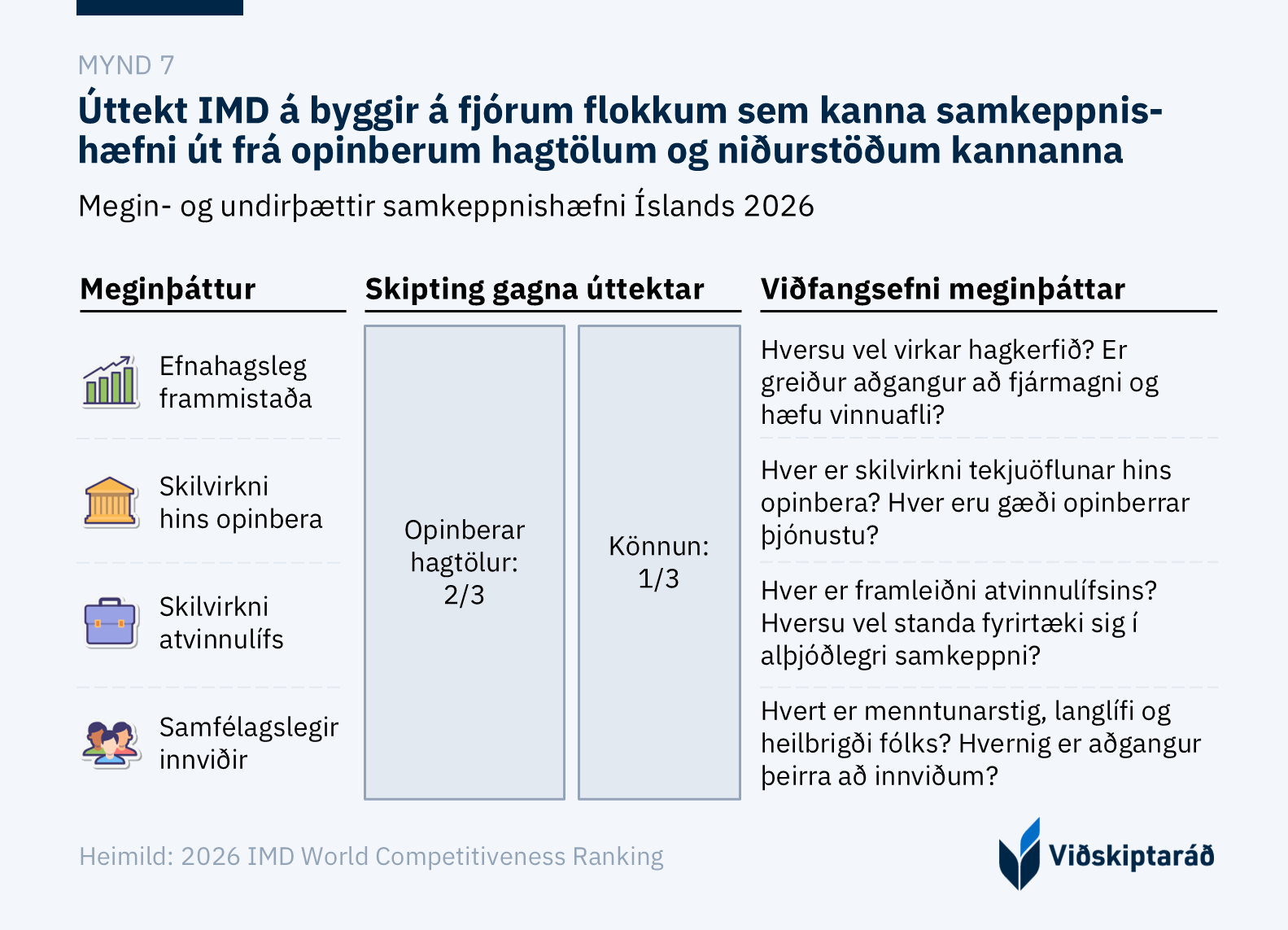
IMD produces the assessment in cooperation with the governments and associations of participating countries. It is based on four main factors and comprises over 300 individual criteria, two-thirds of which take the form of data collected by IMD and its partners in each country (figure 7). One-third is based on an international executive survey in which around 6,200 executives of companies and other organisations take part.
References
[1] It should be noted that a change in IMD's measurement method causes a large decline in remuneration for skilled work and a decline in trade- and vocationally-trained work. The changed measurement method applies to all countries, however, so the effect is equivalent across countries.
This article was automatically translated from the Icelandic original.
Related Content

On a Yellow Card

The Icelandic Economy 2026

How did the government perform this winter?

The Icelandic Economy 2025

The Icelandic Economy Q4 2023