
How did the government perform this winter?
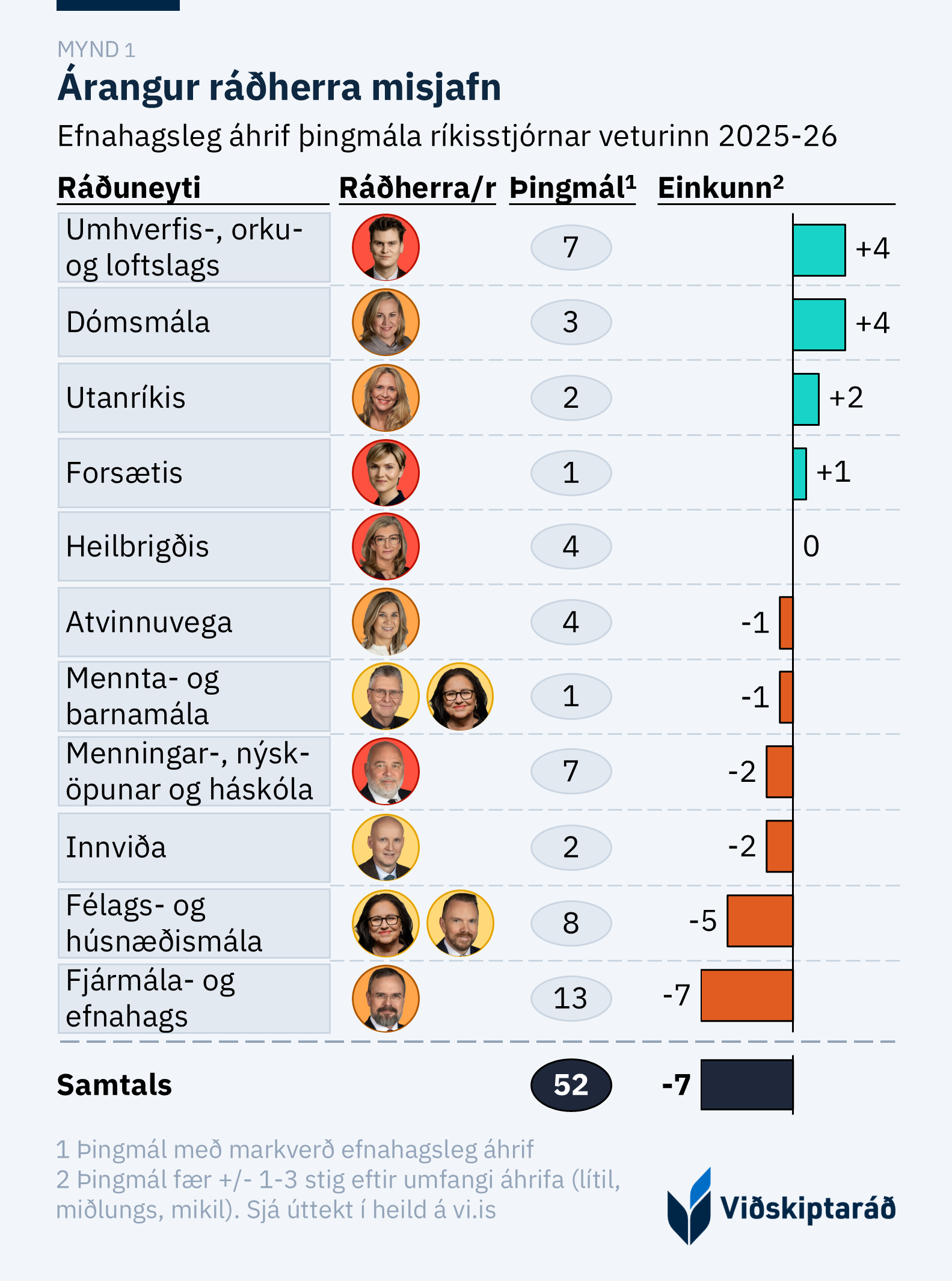
The Iceland Chamber of Commerce has reviewed the economic impact of the government's legislative bills during the parliamentary session that has just ended. In total, 52 bills had significant economic effects, and their overall impact is somewhat negative. The impact varied by ministry, but the bills introduced by Jóhanns Páll Jóhannsson, Minister for the Environment, Energy and Climate, and Þorbjörg Sigríður Gunnlaugsdóttir, Minister of Justice, produced the most positive effects.
Links

During the parliamentary session just concluded, the government put forward 141 legislative bills. Of those, 112 were passed, many in the final days of the session. Of these, 52 bills had significant economic effects — either positive or negative — according to a new analysis by the Iceland Chamber of Commerce.
Abolition of equal pay certification, regulatory simplification and institutional mergers most positive; linking benefits to the wage index most negative
In total, 26 bills had significant positive effects. Three stood out and were considered to have the most positive impact: the abolition of equal pay certification, the simplification of processes in the energy sector, and the merger of the Planning Agency with the Housing and Construction Authority. Other examples of positive measures include transferring energy development options to the utilisation category under the Master Plan, shortening the benefit period for unemployment insurance, the merger of district commissioner offices, and other institutional mergers.
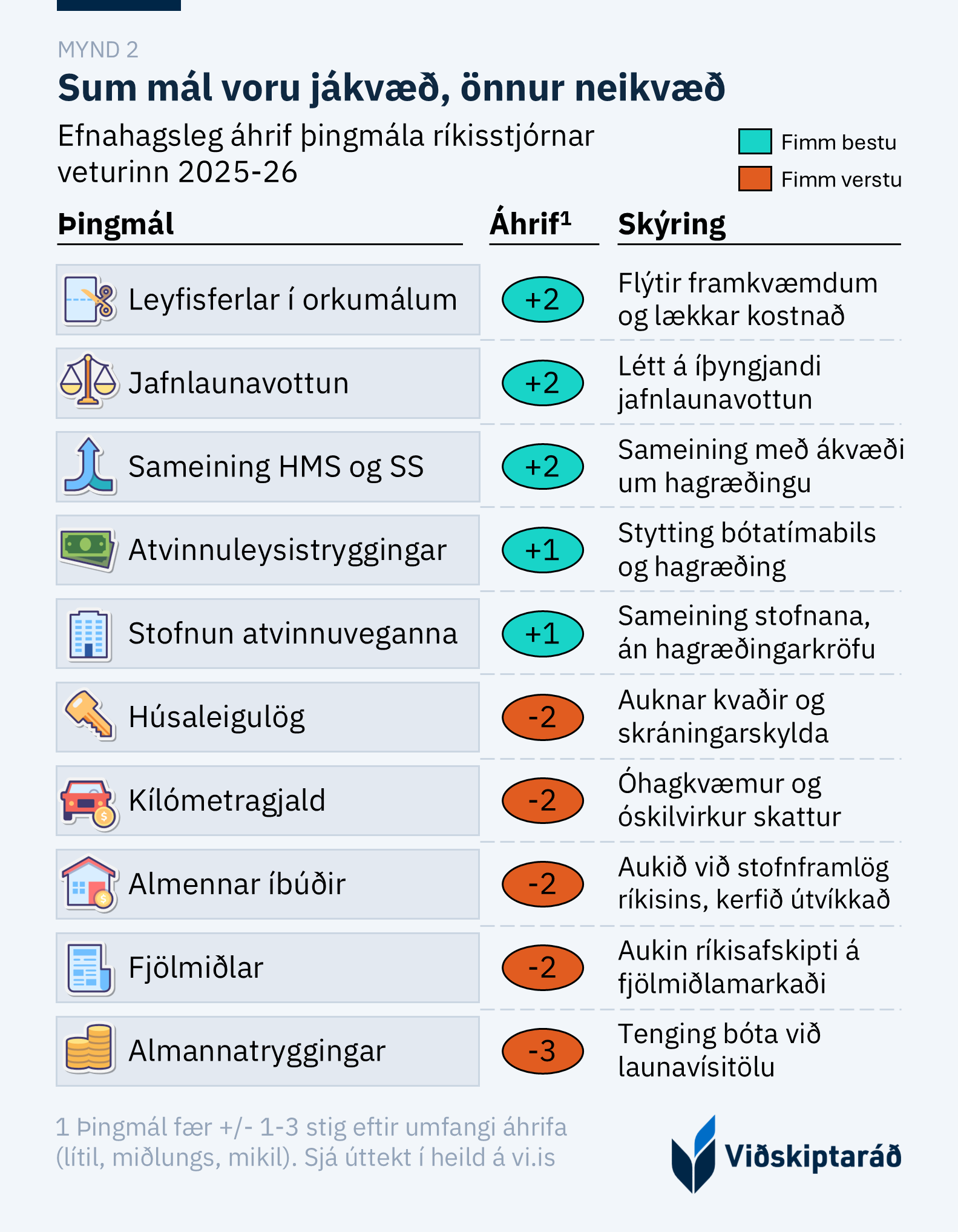
An equal number of bills — 26 — were assessed as having significant negative effects. Linking benefits to the wage index carried the greatest weight and was the only measure to receive the lowest possible score in the impact assessment. Other bills with moderately negative economic effects included increases in government capital grants to non-profit rental companies, restrictions on rent increases, mandatory registration of rental agreements, and a per-kilometre levy. The impact of the budget and fiscal plan was also assessed as moderately negative due to substantial spending increases, higher purchase taxes on vehicles, and a negative lending balance.
In the review, the Iceland Chamber of Commerce examined all government legislative bills that were passed during the parliamentary session just concluded. When assessing the impact, the Chamber first determined whether the bill had any effect on business or economic life. If so, it assigned the bill a score between 1 and 3, with a positive or negative sign depending on whether the economic effects were assessed as minor, moderate, or significant. Parliamentary committee bills were excluded from the review.
The majority of the bills were assessed as neutral in terms of economic impact. Examples of such measures include the approval of the state accounts and amendments to the general penal code — matters considered independent of business and economic life. However, some bills received a neutral rating due to neutral net effects or unclear economic impacts. Examples of such bills include the establishment of an infrastructure company and the classification of wind energy projects under the Nature Conservation and Energy Utilisation Plan Act.
The overall outcome of the parliamentary session just concluded is that the economic impact of the government's legislative bills was somewhat negative, amounting to a total of 7 points across all bills on the scale described above. This represents a reversal from the previous year, when the effects were assessed as broadly somewhat positive.
Various opportunities to do better
The Iceland Chamber of Commerce encourages the government to reintroduce those legislative bills assessed as having positive economic effects, whilst reviewing those with negative effects before resubmitting them at the autumn parliamentary session.

Among the positive bills that did not pass, the most notable are the Minister of Finance's bill on abolishing the warning obligation for public servants and a bill on income tax and withholding of public levies, aimed at facilitating foreign investment. Bills that would have had negative effects also lapsed, including an additional tax on streaming services and increased obligations on pharmaceutical companies.
The Chamber will repeat this assessment following the next parliamentary session and will again evaluate the impact of all the government's legislative bills. It is the Chamber's hope that the outcome of that assessment will be more positive, as both businesses and individuals have a great deal at stake in ensuring that the authorities support the Icelandic economy and create favourable conditions for increased value creation.
This article was automatically translated from the Icelandic original.
Related Content

State investments need clearer cost-benefit analysis

The Icelandic Economy 2026
Warning over added burdens on companies from the energy efficiency directive

On a Yellow Card

Is a new fiscal plan on track?