
Streamlining in arrears
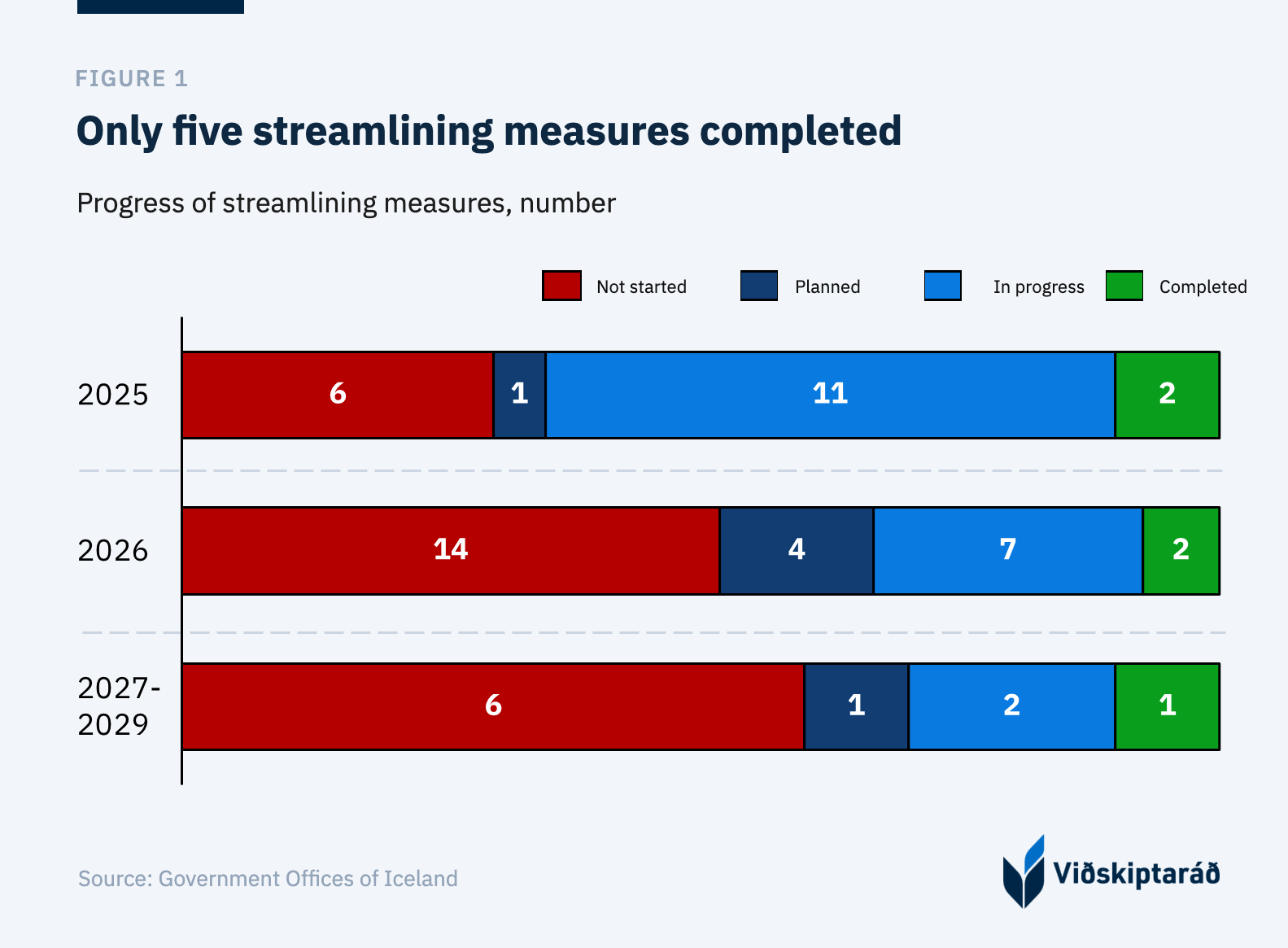
A government-appointed working group proposed 57 streamlining measures in spring 2025, after the government invited efficiency proposals from the public. Of the 57 proposed measures, 5 have been implemented, 20 are in progress, 6 are planned, and work has not begun on 26. It is important that the government continues to review state operations and puts the streamlining measures into action.

NOTE: Based on the status of the streamlining measures on 4 June at 6:00 AM
At the beginning of 2025, the government launched a public consultation on efficiency in state operations, inviting the public, ministries and heads of government agencies to submit proposals for streamlining and reform. Around 4,000 submissions were received, containing over 10,000 proposals.
A working group was subsequently appointed and tasked with preparing proposals for the government based on the submissions. The group's work was presented on 4 March 2025. It put forward 57 proposals, estimated to be capable of saving the state ISK 71 billion over the period 2026–2030. The financial impact of all the proposals has not been assessed, so the savings could be greater.
Now, just over a year after the working group's proposals were put forward, the Iceland Chamber of Commerce has reviewed them and classified them by progress. The proposals are divided into four categories. First, proposals that have been adopted are classified as “Completed”. Those that are either before Parliament awaiting approval or listed as under way within the administration in the fiscal plan are classified as “In progress”. Proposals the government has announced plans to implement are classified as “Planned”. Finally, proposals where no implementation plans have been announced are classified as “Not started”.
5 streamlining measures completed
Of the 57 streamlining measures proposed by the working group, the government has completed 5, 20 are in progress, 6 are planned, and work has not begun on 26 (figure 1). Of the 20 measures scheduled for 2025, 2 have been adopted, 11 are in progress, plans for one have been announced and 6 have not been started. Most measures were due to be implemented in 2026, but the authorities have completed 2 of the 27 measures scheduled for this year. A further 4 are planned, 7 are in progress and 14 have not been started.
Limited results despite ambitious plans
Examples of measures the government has completed include enshrining a fiscal stability rule in law and easing the equal-pay certification requirement, by raising the size thresholds for companies subject to the obligation and introducing reporting in place of certification (figure 2). The merger of funds within ministries, the alignment of public-employment legislation, the merger of small agencies and the establishment of the State Service Centre are in progress. The alignment of public-employment law with the general labour market awaits parliamentary approval through a bill abolishing the formal-warning requirement, and it is uncertain whether it will pass.
Work has begun on the other three measures, meaning some steps have been taken towards completing them without their being fully finished. One example is the State Service Centre. It was to be created through the merger of the district commissioners' offices, which Parliament approved, after which Registers Iceland was to be merged into the new agency and the merits of also merging the Directorate of Immigration into it examined. That part remains unfinished.
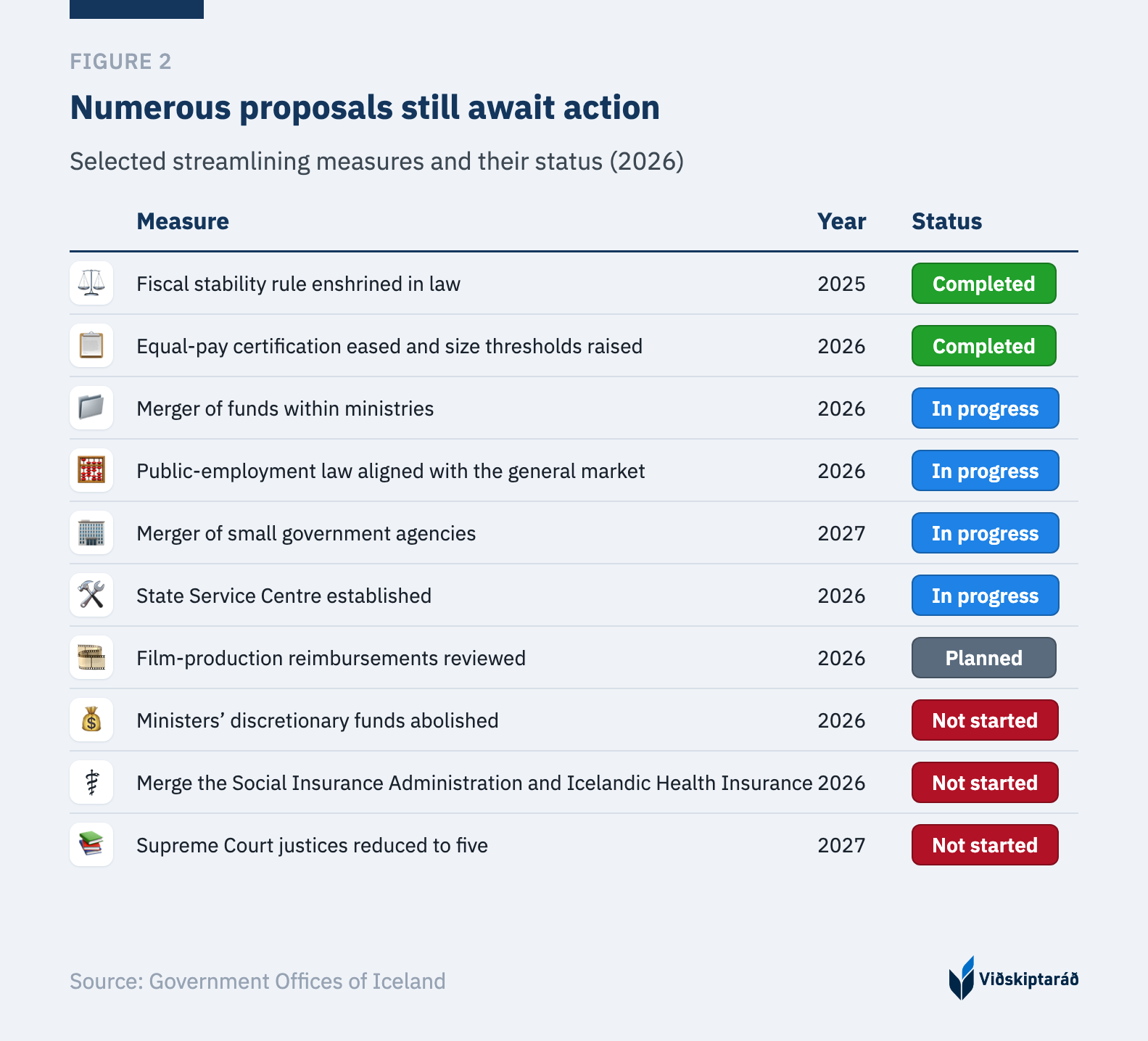
The fiscal plan states that reimbursements for film production are to be reviewed, so that measure is planned. The authorities have not begun work on abolishing ministers' discretionary funds, merging the Social Insurance Administration and Icelandic Health Insurance, or reducing the number of Supreme Court justices to five.
Numerous streamlining measures in arrears
The Chamber has also compiled a list of the measures that are “in arrears” or scheduled for this year but not yet completed (figure 3). These include many important measures that would be beneficial — most notably a review of public funding for political parties, a reduction in the number of committees and increased shared operations within the government offices, a strengthening of the office of the State Mediator, and the merger of the Competition Authority, the Media Commission, the Electronic Communications Office and the Consumer Agency.
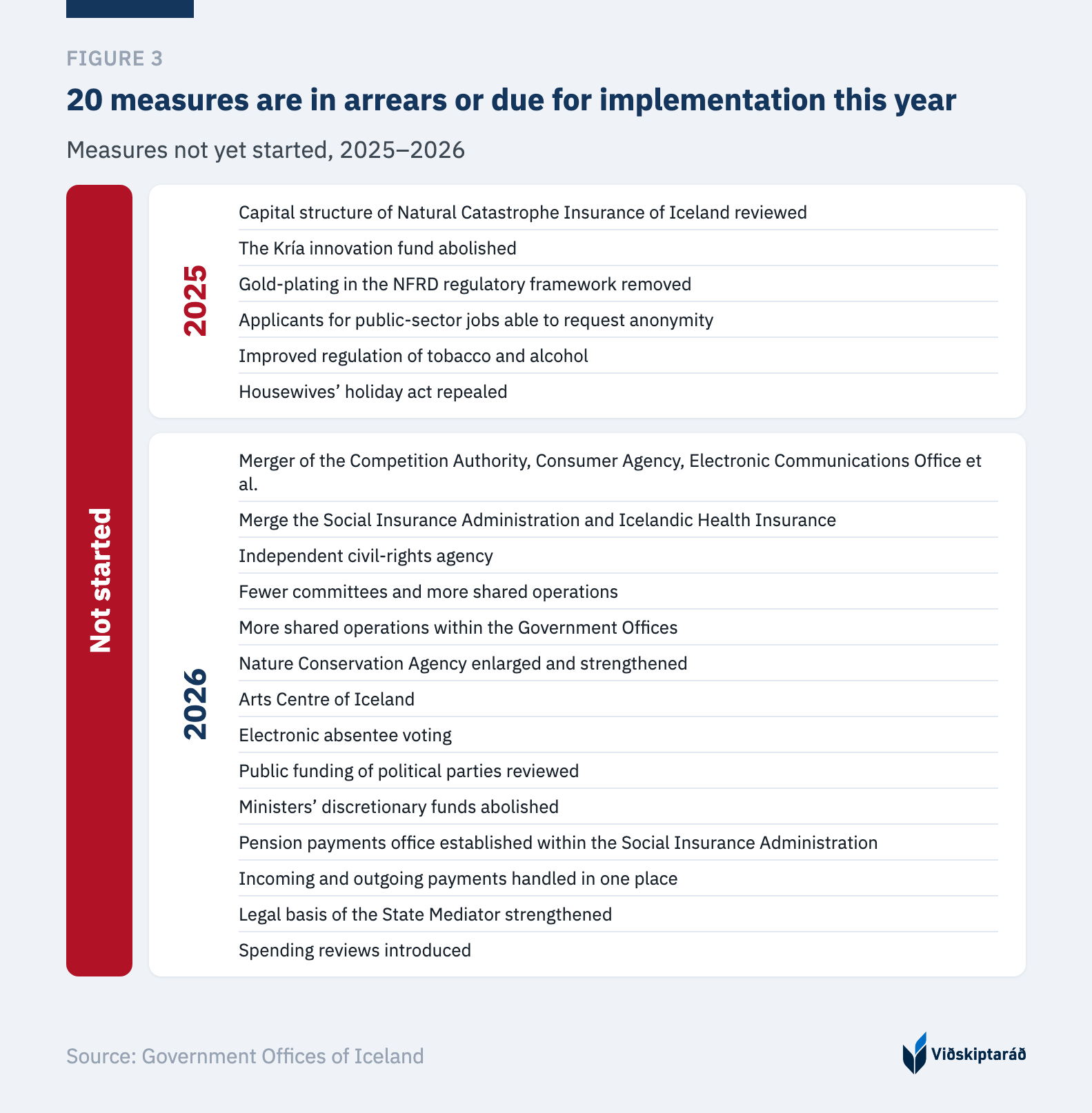
Reviewing, reassessing and improving state operations with better use of tax revenue in mind is a continuous task. It was positive that the government called for efficiency proposals for public-sector operations at the start of the electoral term. However, the Chamber's review shows that a large share of the proposed streamlining measures have either been delayed or not been implemented. If the goals of greater fiscal restraint and more efficient state operations are to be achieved, clearer prioritisation, faster implementation and stronger follow-through on the reforms already announced are needed.
It is important that streamlining does not remain mere plans on paper, and that implementation is not limited to declarations but delivers real changes in public-sector operations and better use of taxpayers' money.
-----
Bills awaiting consideration by Parliament that count among the government's streamlining measures:
| Measure | Status |
|---|---|
| Simplification of regulation and more efficient supervision of public health and pollution control | In progress |
| Abolition of the formal-warning requirement for public employees | In progress |
| Merger of the Food and Veterinary Authority (MAST), the Directorate of Fisheries and the Catch Value Pricing Office | In progress |
| Greater efficiency and humanity in processing applications for international protection | In progress |
This article was automatically translated from the Icelandic original.
Related Content

State investments need clearer cost-benefit analysis

Increased regulation of the .is national domain needs explanation

New fund does not solve the problem

A Supersized Pension System

R&D support system must be simple and predictable