
Free but unavailable: access to healthcare
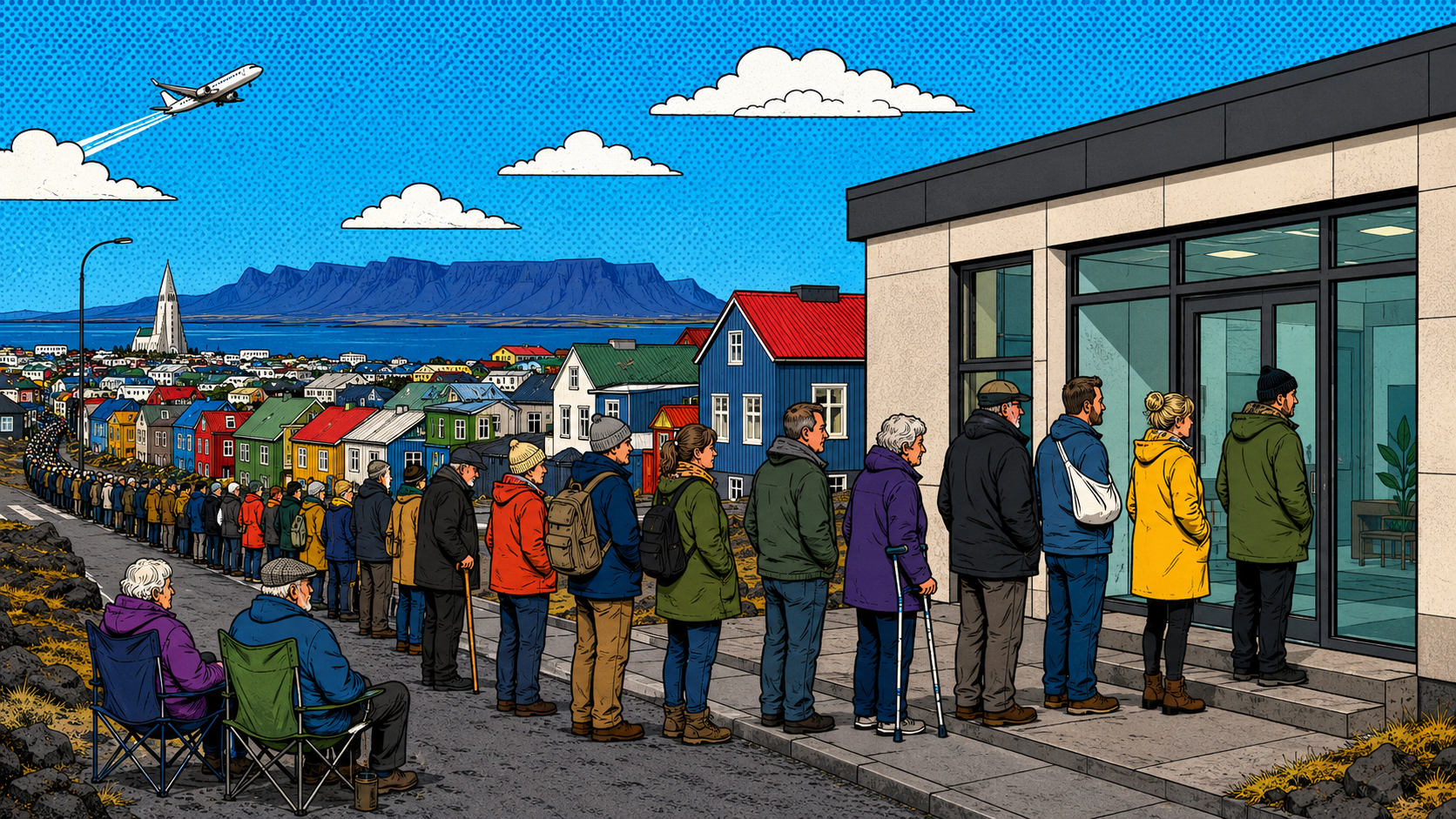
More than ten thousand people are waiting for surgery in Iceland, and more than a third of them have been waiting for over a year. The service is free at the point of delivery, but the cost is paid in time, and those who can pay for it themselves or fly abroad avoid the queue. Viðskiptaráð proposes that people be given the same right to buy the service at home as they already have to buy it abroad.
Summary
- In September 2025, 10,129 people were waiting for one of the 21 procedures measured by the Directorate of Health. Seven years earlier, the figure was 3,361. The waiting list has nearly tripled, and has almost doubled per capita.
- Seven out of ten wait longer than 90 days, even though the Directorate of Health's target is a maximum of two out of ten. Nearly four out of ten have been waiting for more than a full year.
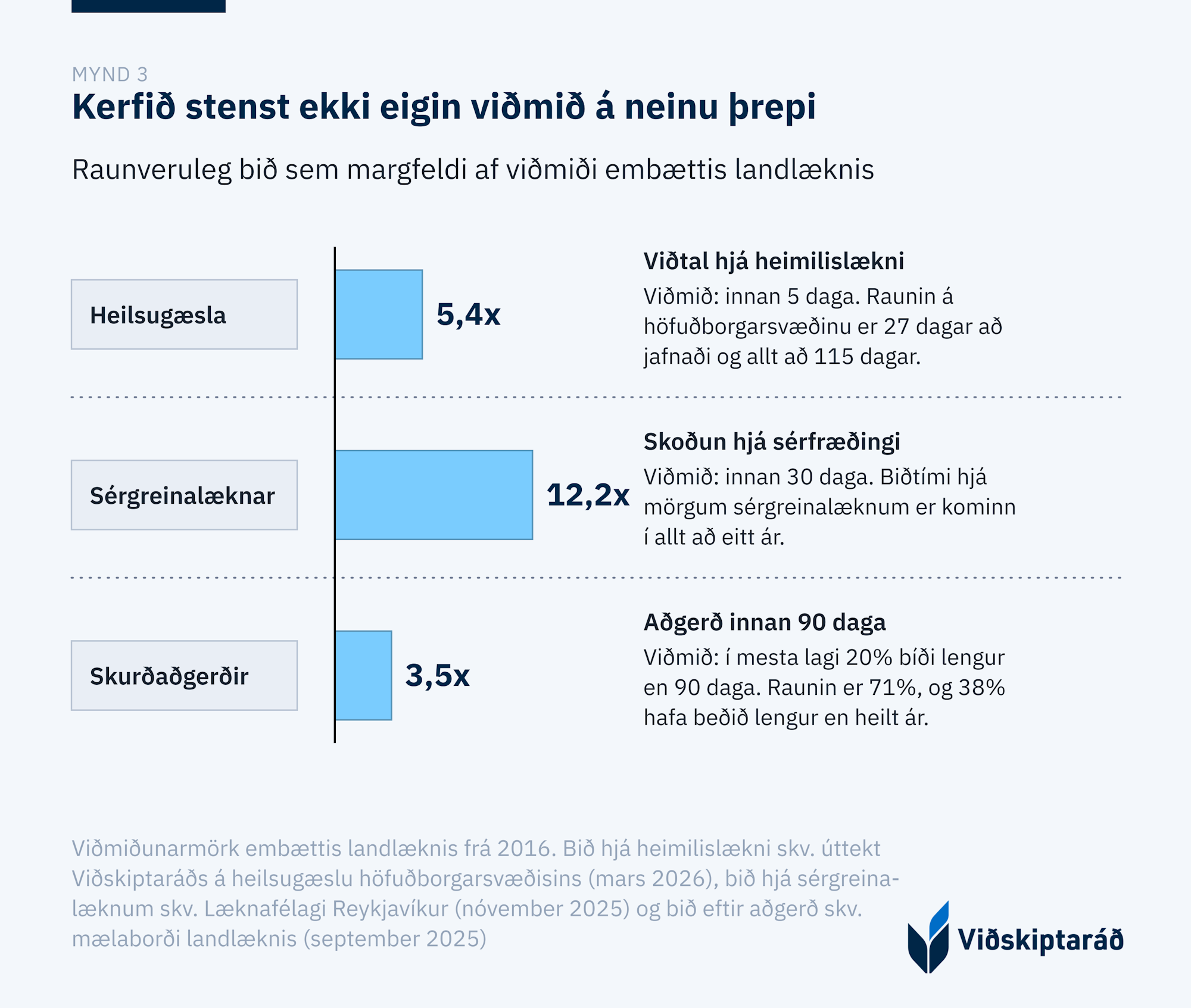
- The wait for a GP appointment in the capital area is 27 days on average, against a five-day target, and up to a year for specialists, against a 30-day target.
- Of the 168 new medicines approved by the European Union between 2021 and 2024, 48 are available in Iceland, compared with 93 in Denmark. Of new cancer medicines, 27% are available here, against 68% in Denmark.
- Iceland Health Insurance pays an average of ISK 2.4 million to send a patient abroad for joint replacement surgery, but ISK 1.3 million for the same procedure at a private clinic at home. A patient outside the contract pays ISK 1.5 million out of pocket.
- Viðskiptaráð proposes that the right to reimbursement follow the patient domestically just as it does abroad, that all elective services be procured through open tender, and that the purchaser and provider of the service be kept separate.
When an Icelander has waited longer than 90 days for a procedure they need, they acquire a right. Not a right to be seen at home, but a right to travel abroad and have Iceland Health Insurance pay for the procedure, the travel and the accommodation. The same patient has no comparable right to have the same procedure done at a private clinic in Ármúli, even though it is cheaper for the state and available to them immediately. A lawyer for the Icelandic Medical Association put the paradox into words when the rules took effect: an insured patient might have the right to necessary treatment abroad but not at home, even though it was available through private healthcare.[1]
This is not a technicality. It is emblematic of a system that claims to give everyone the same service regardless of means, but in practice allocates it according to who can wait, who can pay and who can fly.
The wait is the price
Imagine a shop that promises to sell bread for zero krónur. That doesn't make the bread free: the flour, the baker and the oven still cost just as much as before. The only thing that changes is how the bread is allocated. Instead of price determining who buys, a queue forms, and whoever has the least time to spare goes home empty-handed. The queue is the price, just paid in a different currency. Economics calls this rationing.
Iceland's healthcare system is not free. It costs about nine per cent of GDP and nearly a third of government spending.[2] What is free is the point of delivery, and where price does not determine allocation, something else does. In Iceland, that something is time.
In September 2025, 10,129 people were waiting for one of the 21 procedures the Directorate of Health measures twice a year. In October 2018, the figure was 3,361.[3] Over the same period, the population grew by just over twelve per cent, so this is not a population story: per thousand inhabitants, the number on waiting lists rose from just under ten to just under 26. The number who had waited longer than a full year rose from 338 to 3,854, an elevenfold increase.
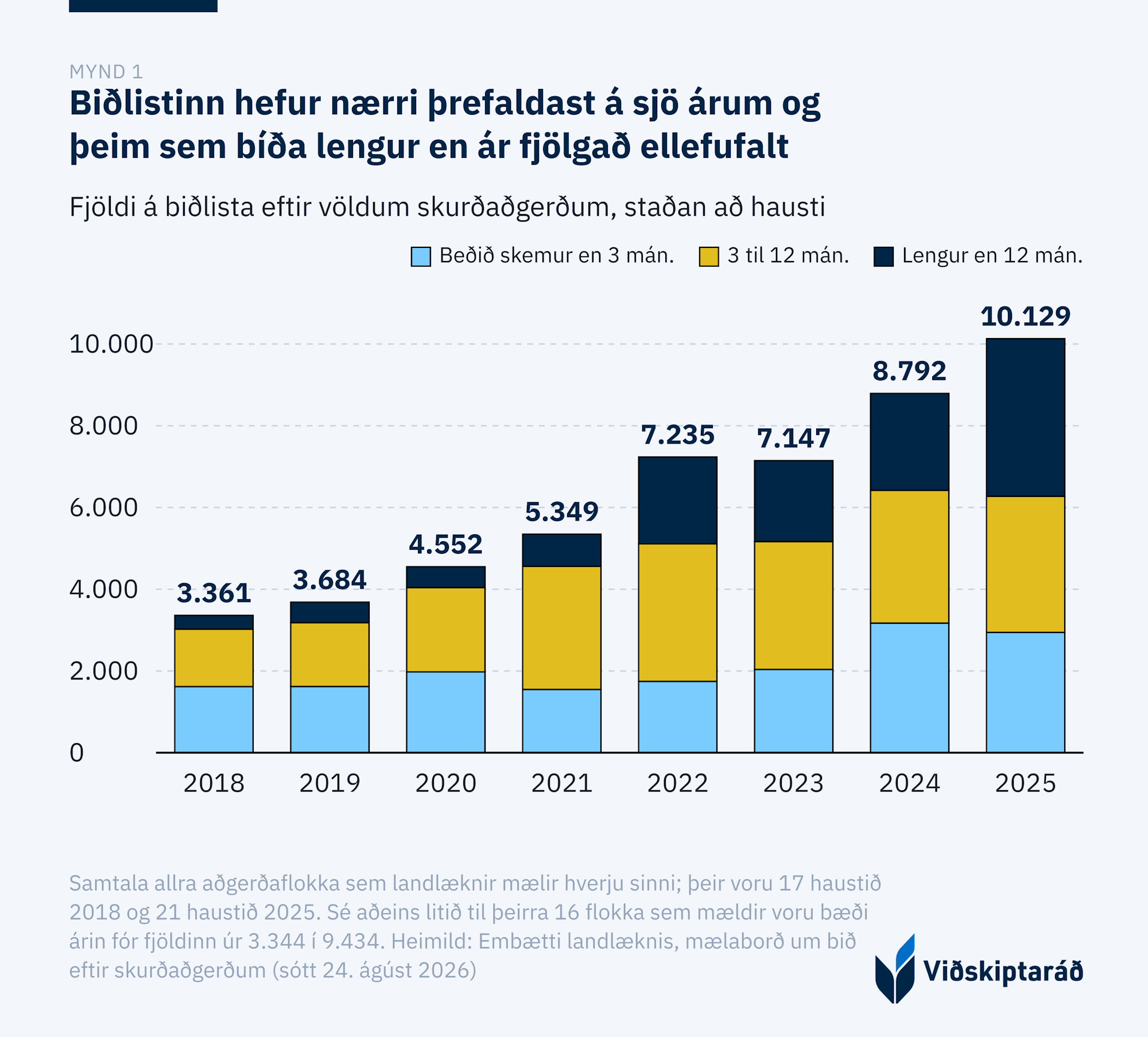
The Directorate of Health set a target for acceptable waiting times in 2016: a procedure or specialist treatment within 90 days of diagnosis, with the government's action plan aiming for 80% to be seen within that limit.[4] In September 2025, 71% had waited longer than 90 days. The system is three times over its own target, and has been continuously since 2021.
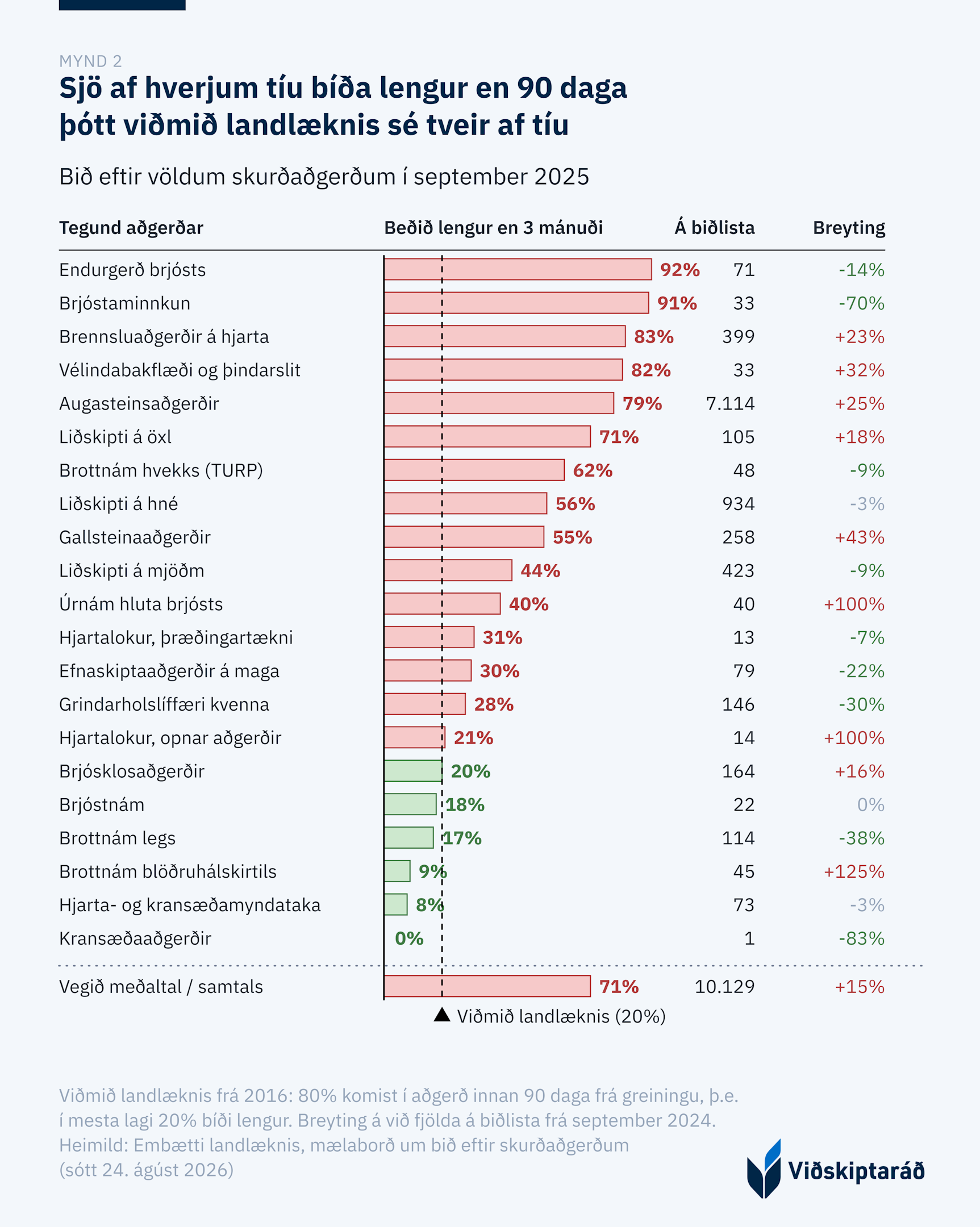
The chart also shows that this is not a uniform story. Where the government deliberately purchased capacity, waiting times fell significantly: the actual wait for knee replacement surgery fell from 39.6 weeks to 14.1, and for hip replacement from 31.9 weeks to 12.6, over four years.[3] Where nothing was done, it grew longer. Cataract surgery now accounts for seven-tenths of the entire waiting list: 7,114 eyes were waiting in September 2025, almost half of them for more than a year. That is four times the number in 2021.
The price tag on that queue is not high. Iceland Health Insurance values a unit price for private cataract surgery at ISK 168,993.[5] The entire waiting list, all 7,114 eyes, would cost around ISK 1.2 billion at that price. That is less than a quarter of one per cent of state healthcare spending. Total funding for waiting-list procedures in 2025 was ISK 1.3 billion for all procedure categories combined.[5]
Not just in the operating theatre
The wait begins long before that. The Directorate of Health also sets a target for people to get an appointment with a GP within five days and an examination by a specialist within 30 days.[4] A Viðskiptaráð review of primary care in the capital area earlier this year found that the average wait for a GP appointment is 27 days, and up to 115 days at individual clinics. Only two of nineteen clinics meet the target.[6] The chair of the Reykjavík Medical Association said in November 2025 that waiting times for many specialists had reached up to a year.[7]
For specialists, something else was added on top. From 2019 to 2023, self-employed specialists had no contract with Iceland Health Insurance, and many of them charged patients extra fees to make up for the lost income.[8] For six years, the state failed to reach an agreement with them, and to secure a contract, Iceland Health Insurance had to depart significantly from its original aims.[8] The average cost of a visit to a specialist rose from ISK 17,244 in 2016 to ISK 32,087 in 2024.[8] While there was no contract in place, reimbursement was not formally withdrawn, but in practice it was cut.
Where a queue won't do, the answer is no
In some areas, rationing by queue is not possible. A medicine is either on the reimbursement list or it isn't. That is where you can see how the system behaves once time is no longer available as a rationing tool.
The European federation of pharmaceutical manufacturers and the analytics firm IQVIA measure annually how many new medicines with centralised EU marketing authorisation have become available to patients in each country. Of the 168 medicines approved between 2021 and 2024, 48 were available in Iceland at the start of 2026, or 29%. In Denmark the figure was 93, in Sweden 82, in Finland 74 and in Norway 59. The EU average was 76.[9]
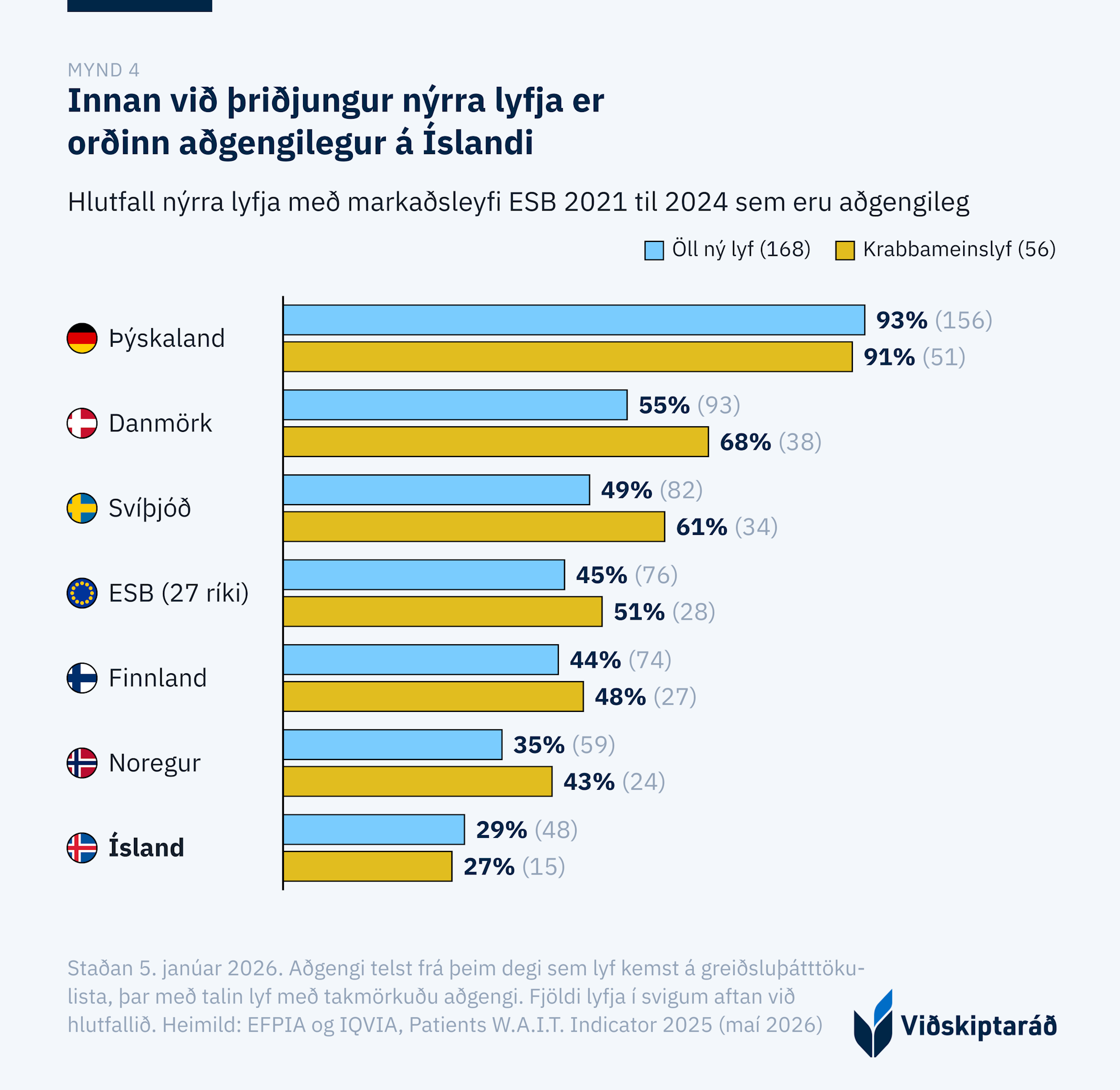
The gap is sharpest where the stakes are highest. Of 56 new cancer medicines, 15 are available in Iceland, 27%, against 38 in Denmark and 34 in Sweden. Iceland sits between Hungary and Lithuania on this measure. Of 66 new medicines for rare diseases, 12 are available here, 18%, against 29 in Denmark.[9]
The figure of 48, however, overstates the level of access. Of these 48 medicines, only 21% carry full public reimbursement. The remaining 79% are only available through individual exemptions that a doctor must apply for on a per-patient basis. That is the highest exemption rate recorded for any country in the survey.[9] In practice, then, only around ten of the 168 new medicines are generally accessible in Iceland. The median time from marketing authorisation to access is 507 days here, against 268 days in Denmark and 372 in Sweden.[9]
This has a context. Iceland does not carry out its own health technology assessments but relies instead on those of other Nordic countries, and public reimbursement for retail medicines is 41%, against an EU average of 62%. Nearly half of everything Icelandic households pay out of pocket for healthcare goes on medicines, roughly twice the share seen elsewhere in Europe.[10] The rationing is there too, it is just visible on a receipt rather than on a calendar.
Plenty of money, plenty of doctors, too few beds
None of this stems from Iceland lacking money or people. Icelanders spend $6,770 per capita on healthcare, against an OECD average of $5,967. There are 4.5 doctors per thousand inhabitants here, against an average of 3.9, and 15.2 nurses, against 9.2. There are 70 imaging units per million inhabitants, against 51.[2]
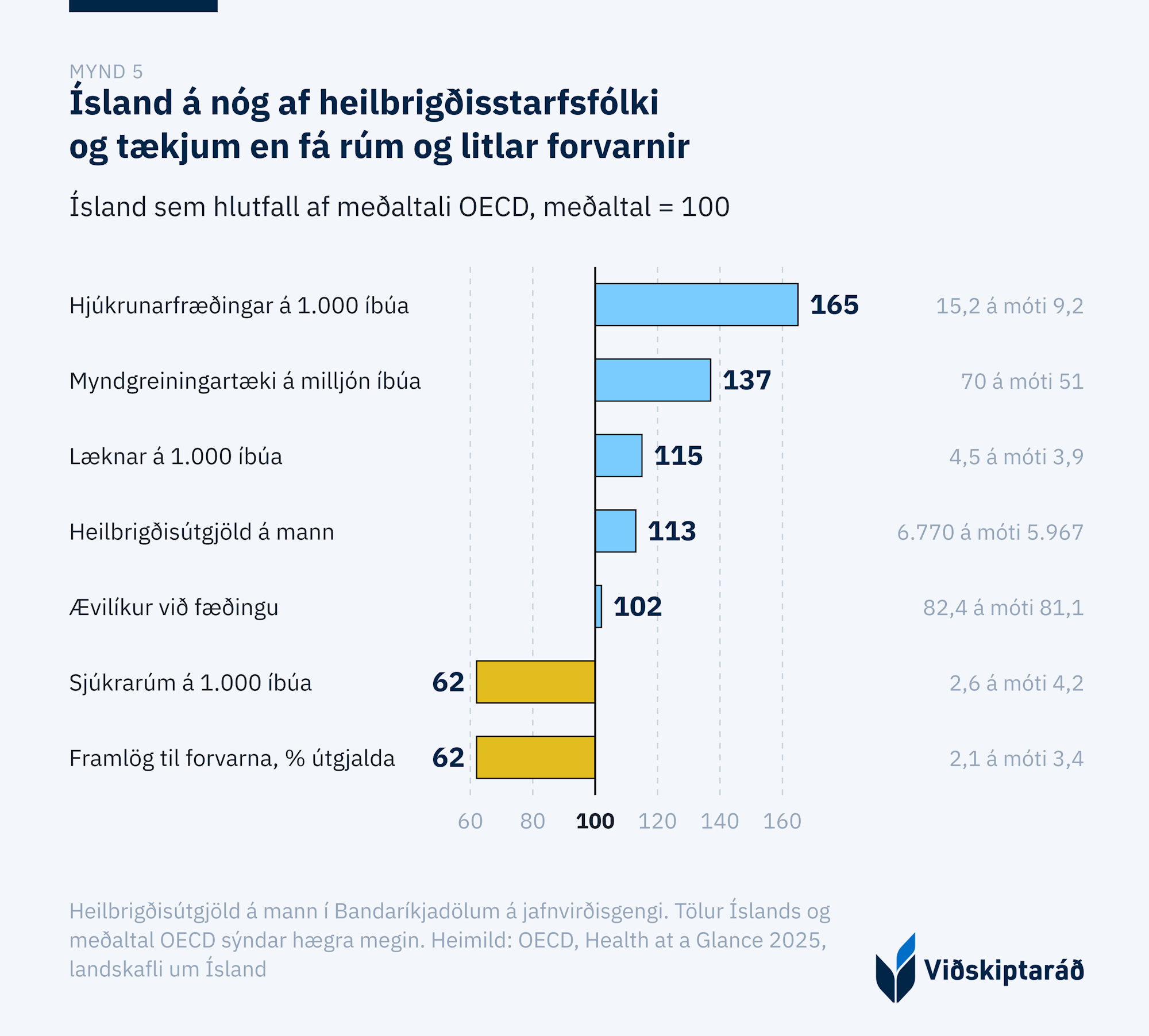
Where Iceland falls short is, on one hand, in beds, and on the other, in what patients themselves experience. There are 2.6 hospital beds per thousand inhabitants, against an OECD average of 4.2, about half the EU average, and hospital discharges are a third lower than in Europe.[11] Spending on prevention is 2.1% of healthcare expenditure, against an average of 3.4%.[2] In the OECD's PaRIS survey in 2023 and 2024, only around a third of chronically ill Icelanders said they felt able to manage their own health or rated the coordination of their care as good, against around 60% on average in comparable countries, and their trust in the system measured below average.[11] Fewer than half of patients with three or more chronic conditions had their medication reviewed during the year.
Iceland performs well on outcomes driven by clinical quality: life expectancy is 1.3 years above the OECD average, mortality from treatable diseases is 49 per hundred thousand, against 77, and mortality within 30 days of a heart attack is 2.5%, against 6.5%.[2] The problem is not what happens once a patient is seen. It is getting seen in the first place.
The two-tier system already exists
Iceland already has a two-tier healthcare system. It was never decided; it simply came about.
A knee replacement costs ISK 1,525,000 at Klíníkin in Ármúli if the patient pays for it themselves.[12] Iceland Health Insurance bought the same procedure from the same clinics in 2024 for ISK 1,237,000, equivalent to just under ISK 1.3 million at 2025 prices.[5] And if the patient has waited long enough, they can go to Sweden at Iceland Health Insurance's expense: the institution's average payment for such trips, including travel and accommodation, came to ISK 2.4 million per case at 2025 prices.[13]
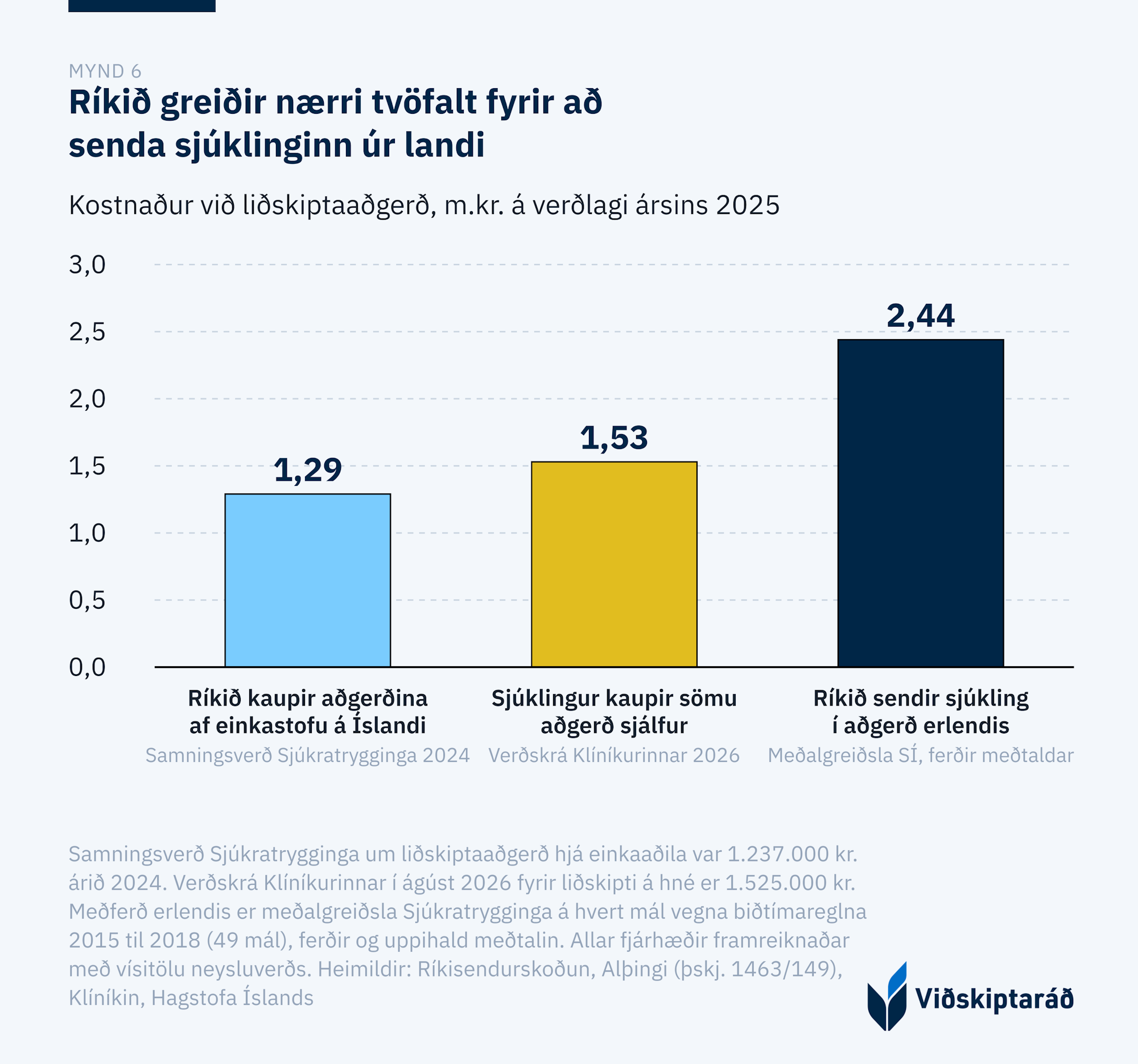
The logic does not add up. The state pays nearly twice as much to send the patient out of the country as it would to buy the procedure from a domestic provider with a free operating theatre. Iceland Health Insurance has pointed this out itself, noting in a memo to the Ministry of Health that one of the aims should be to avoid a situation where the same provider is sometimes giving insured patients procedures with state reimbursement and sometimes without it.[5] That is a precise description of a two-tier system: the same surgeon, the same operating theatre, the same day, but one patient pays nothing and the other pays one and a half million, and the only thing that separates them is which side of the quota they happened to fall on.
Those who argue against a two-tier system on grounds of equality are defending a system that is already two-tier, and defending it in the worst possible way: access to the faster route is not determined by transparent rules but by who has the money for a plane ticket, who knows how to apply for an exemption, and who knows someone. Data from the EU's statistical office show how this falls: in the lowest income fifth in Iceland, 4.5% said they had gone without medical care they needed because of cost, against none in the top fifth.[14] A system that is called equal access but allocates according to time, connections and airfares is not equal. It is simply opaque.
Buyer and seller in one and the same person
Behind this lies a structure the OECD sums up in a few words: the state is at once the principal owner and the principal payer of the healthcare service.[11] Iceland Health Insurance is meant to purchase services on behalf of taxpayers, but the largest provider, Landspítali (the National University Hospital), is owned by that same state and answers to the same minister.
The National Audit Office examined this in June 2025 and its conclusion was unequivocal. Iceland Health Insurance has not become the strong purchaser the 2008 legislation intended, the institution lacks the expertise and staff to carry out needs and cost analyses, and oversight of contract implementation has been patchy and at times barely present. The oversight division was shut down. Providers frequently hold the upper hand over the institution.[8] A decision was taken in 2018 to put imaging services out to tender, and it still had not happened when the review was carried out seven years later.[8]
The result is that decisions about capacity are driven by something other than waiting lists. In 2026, the Klíníkin's quota for endometriosis surgery was cut from 170 to 111, even though the Directorate of Health estimates the need at 300 to 350 procedures a year.[15] On the other hand, Landspítali has pointed out that when private operating capacity opens up, it draws on hospital staff it cannot compete with on pay, and that the result can be more supply for less sick patients and less for the sickest.[8] That concern is legitimate, and it should be addressed through staffing and pricing, not by holding capacity down.
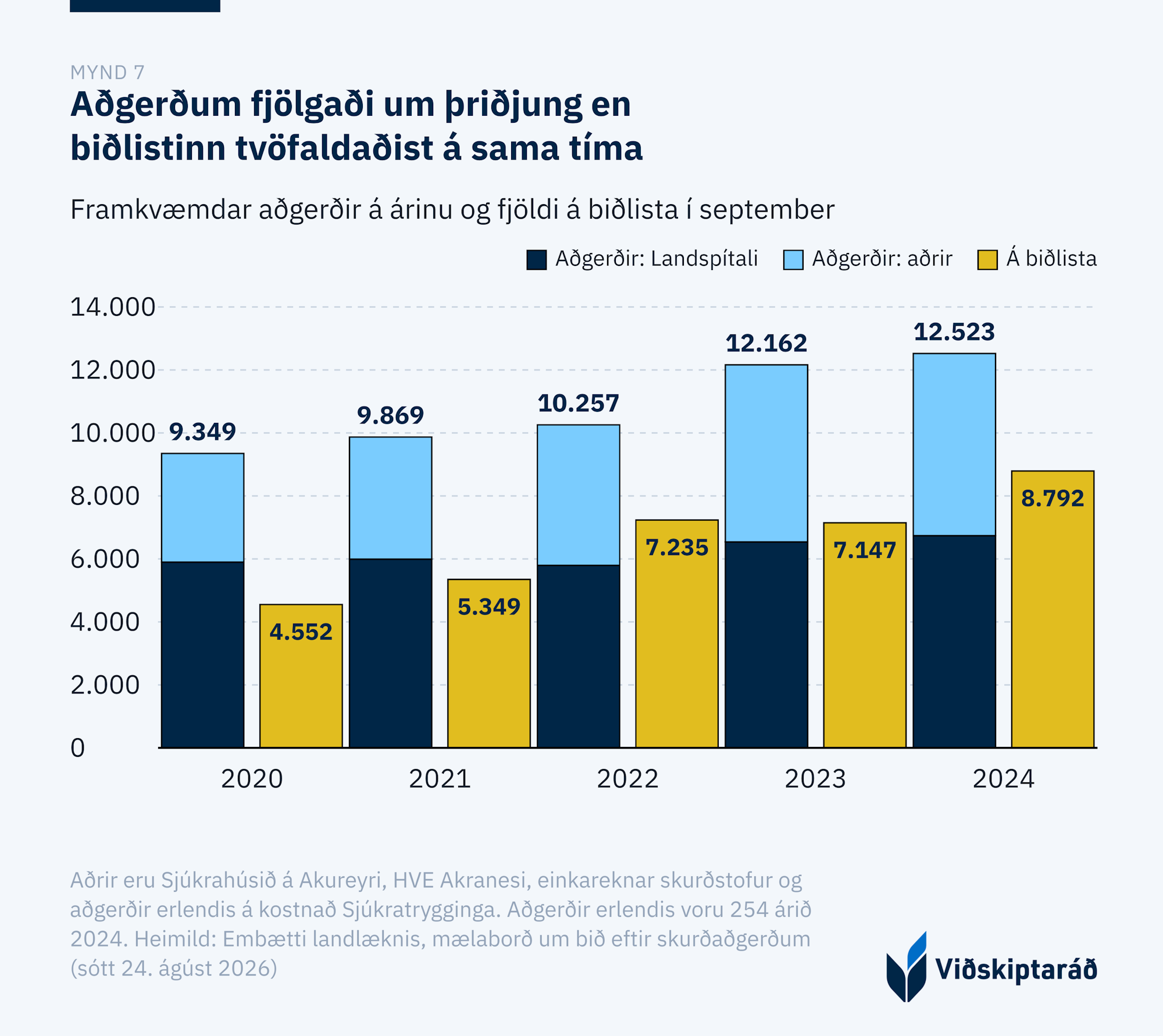
Supply has, admittedly, increased. Procedures carried out in the measured categories rose from 9,349 in 2020 to 12,523 in 2024, up by a third. Over the same period, the waiting list grew by 123%. The system is running just to stand still. It is worth noting where the increase came from: Landspítali's share fell from 63% of procedures to 54%, while private clinics rose from 2,271 procedures to 3,608, and procedures abroad funded by Iceland Health Insurance rose from none to 254.[3]
Finally, the institutional framework is fragmented. The Ministry of Health sets policy, Iceland Health Insurance buys the service, the Directorate of Health measures waiting lists and oversees quality, the Icelandic Medicines Agency decides on medicine reimbursement, and seven healthcare regions run the service. None of these bodies alone is accountable for how long people wait, and the National Audit Office notes that the cooperation between Iceland Health Insurance and the Directorate of Health needs to be better defined.[8] When responsibility is spread this thin, it amounts to none at all.
Viðskiptaráð's proposals
1. The right to reimbursement should follow the patient domestically just as it does abroad. If a patient has waited longer than 90 days, they already have the right to have a procedure paid for in another EEA state. The same right should apply at home: a patient should be able to turn to any approved provider domestically and receive reimbursement equal to what the state would otherwise have paid. This would cost the state less than the current arrangement, not more. If a patient wants more than the standard provides for, for example a shorter wait or a different provider, they should be free to pay the difference themselves or through supplementary insurance, as is the practice in Denmark and the United Kingdom.
2. All elective services should be purchased through open, long-term tenders, regardless of ownership structure. Purchasing of healthcare should be based on a published needs assessment, consistent quality requirements and contracts of at least five years, so that providers can invest and hire staff. Short-term, year-to-year add-ons, as have been the practice for waiting-list procedures, guarantee neither price nor quality. Uncertainty over Iceland Health Insurance's tendering obligations should be resolved through legislative amendment rather than left to the courts.
3. Separate the purchaser from the provider. Iceland Health Insurance should become a genuine purchaser with the analytical capacity the National Audit Office finds lacking, and funding to public institutions should flow through the same channel as funding to others, on the basis of services delivered and measured outcomes. Landspítali's board should be given genuine governance powers along the Nordic model, and the hospital's individual operating units should be funded and measured independently, so that comparison becomes possible where none exists today.
4. Set a measurable target for access to medicines. Iceland should set itself a target for the share of new medicines that become available within a set time of marketing authorisation, publish its progress annually, and make full use of Nordic cooperation on health technology assessment and joint price agreements. A system in which 79% of new medicines are only obtainable through individual exemptions is not a transparent system but rationing without written rules.
5. Consolidate healthcare administration and turn waiting times into a measure of accountability. The number of bodies responsible for policy, purchasing and oversight should be reduced, responsibility for waiting times should be clearly defined, and funding should be partly tied to meeting the Directorate of Health's 90-day target. The Directorate's dashboard already exists. All that is missing is someone accountable for the figures it shows.
None of this involves reducing public funding for healthcare. On the contrary, it rests on the state continuing to pay for the service while ceasing to dictate where it is delivered. The difference between the Icelandic system and the Danish one is not that the Danes pay less from public funds, but that they buy the service from independent providers, and have done for a long time.
It is possible to keep the promise that means should not determine access to healthcare. But that promise is not kept by banning people from paying. It is kept by ensuring the queue is so short that no one needs to.
References
[1] Dögg Pálsdóttir, "The right of insured patients to healthcare abroad," Læknablaðið vol. 102, no. 12 (2016): link.
[2] OECD, Health at a Glance 2025: Iceland (2025): link.
[3] Directorate of Health, Wait times for surgery, dashboard (data retrieved 24 August 2026, last updated 21 April 2026): link.
[4] Directorate of Health, Reference limits for waiting times for healthcare (2016): link.
[5] National Audit Office, Iceland Health Insurance as a contracting and oversight body (June 2025), chapters 3.2 and 3.3: link.
[6] Viðskiptaráð Íslands, "Systemic ailment: the framework and performance of primary care" (March 2026): link.
[7] RÚV, "Waiting times for specialists now up to a year" (26 November 2025): link.
[8] National Audit Office, Iceland Health Insurance as a contracting and oversight body (June 2025), findings and chapters 2 and 4.
[9] EFPIA and IQVIA, Patients W.A.I.T. Indicator 2025 Survey (May 2026): link.
[10] OECD and European Observatory on Health Systems and Policies, Iceland: Country Health Profile 2025, chapter 6: link.
[11] OECD and European Observatory on Health Systems and Policies, Iceland: Country Health Profile 2025, chapters 4 and 5.
[12] Klíníkin Ármúla, Price list (retrieved 24 August 2026): link.
[13] Minister of Health's response to a parliamentary question on the cost of medical procedures, document 1463, case 760, 149th legislative session (2019): link. Adjusted using Statistics Iceland's consumer price index.
[14] Eurostat, Self-reported unmet needs for medical examination (hlth_silc_08), Iceland 2020: link.
[15] Minister of Health's speech on the reduction of endometriosis procedures at Klíníkin, 157th legislative session (18 March 2026): link.
This article was automatically translated from the Icelandic original.
Related Content
A Supersized Pension System

Equal operating conditions in primary care a prerequisite for better services

An oversized piggy bank: the scale and agency problem of the pension system

The Icelandic Economy 2026

Stuck in a long queue: the trunk road network around the capital region