
Tariff protection explains high grocery prices
The Iceland Chamber of Commerce has reviewed the Icelandic Competition Authority's discussion paper on grocery prices. High import tariffs — particularly on meat, dairy products, and eggs — play a substantial part in higher prices in Iceland. To bring food prices down, attention must turn to the domestic decisions that shape price formation, including tariff protection, taxes, and operating costs.
The Iceland Chamber of Commerce has reviewed the Icelandic Competition Authority's discussion paper on grocery prices in Iceland.
The discussion paper aims to shed light on grocery prices in Iceland and price developments in comparison with other countries in Europe, chiefly the Nordic countries along with Switzerland and Ireland. In the Iceland Chamber of Commerce's assessment, the paper's conclusions are too one-sided in that they rest on price comparison without the necessary context of the underlying market conditions in Iceland. The Chamber's main points are as follows:
- High tariffs and geographical challenges play a substantial part in grocery prices.
- Oligopoly in a small market is not in itself a problem: Assessing the competitive position is not confined to the number of companies in a market. Consumers' interests depend on competition between the companies that are present being effective.
- Labour cost per hour worked is considerably higher in Iceland than is generally the case in comparator countries.
- Domestic decisions and public levies: the operating costs of grocery retailers drive high prices rather than excess margins.
- Icelandic households on average spend a lower share of their disposable income on groceries than households in Europe.
Tariff protection explains high prices
The Competition Authority's review directs its focus chiefly at the fact that the prices of eggs, dairy products, and meat are considerably higher in Iceland than in other countries. These are precisely the product categories that enjoy the greatest tariff protection in Iceland (Figure 1).
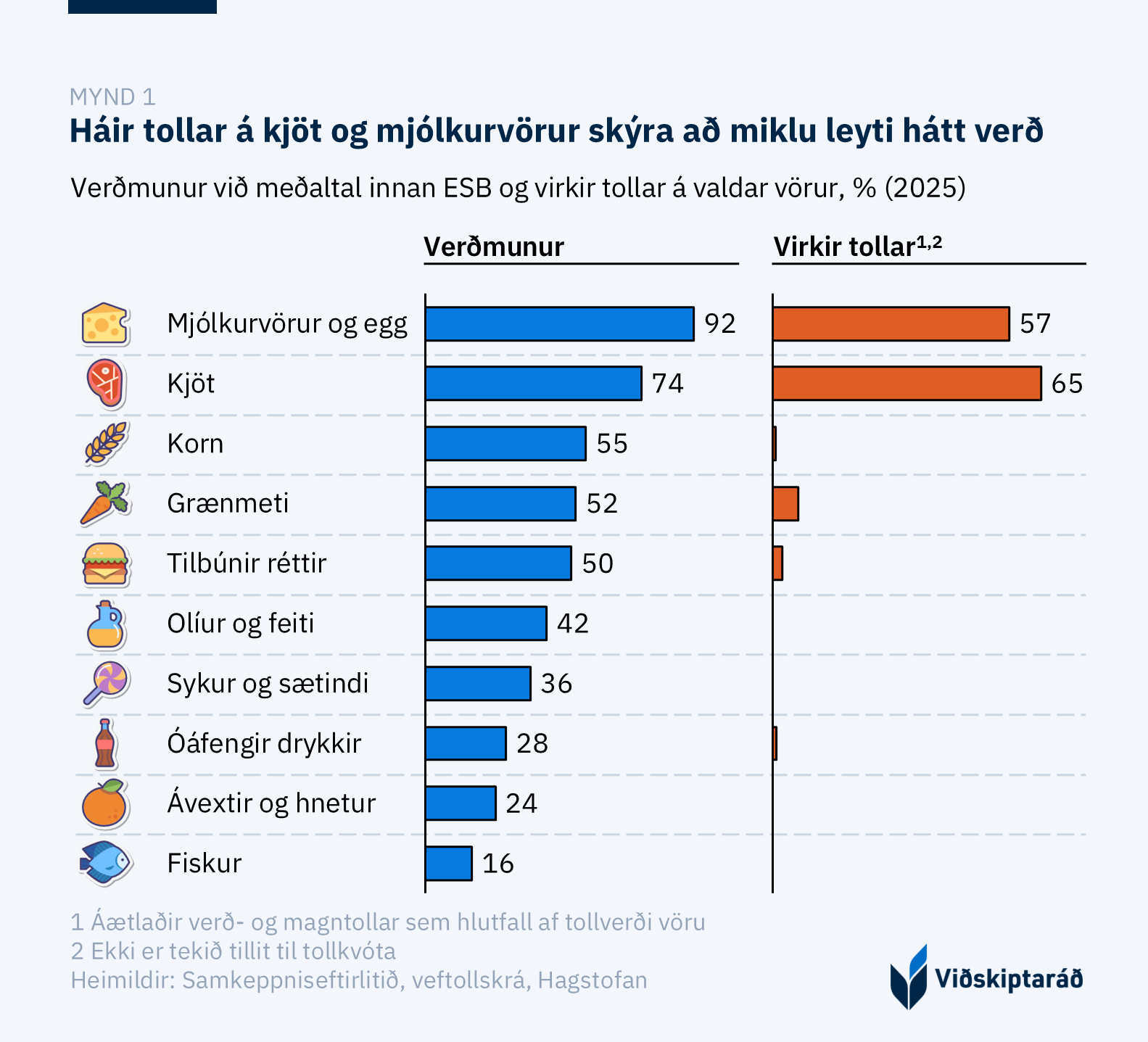
According to Iceland Chamber of Commerce calculations, the effective tariff on dairy products and eggs is 57%, while meat products carry an effective tariff of 65%. The effective tariff is calculated as the ratio of tariffs to the import price of the product. The calculation is based on imports in 2025 and does not take tariff quotas into account. Abolishing tariffs on milk and eggs would thus lower their prices by 36%, while meat products would fall by 39%. The cost to households of tariffs on these product categories therefore amounts to around ISK 40,000 a year. Households' savings from abolishing these tariffs would be somewhat greater still, since the knock-on effects of tariffs are felt in the prices of domestic goods. Abolishing tariffs would moreover create the basis for further food imports, which would lead to price reductions.
It is also worth noting that VAT is applied on top of tariffs, thereby amplifying their effect on prices. VAT on food is generally 11% in Iceland, while it varies among EU member states. It is generally no lower than 5%, however. Both tariffs and VAT arise from domestic decisions, and it is therefore for the authorities to lower or remove these barriers.
In addition to direct tariffs, Iceland bears a geographical tariff, determined by the country's location rather than by law. Imported goods generally have to travel a longer distance to reach the shelves of Icelandic grocery stores than European ones. This added cost has an unavoidable effect on prices.
Economies of scale a prerequisite for competitiveness
In many industries it is natural that few companies operate in the market. The reason is not necessarily a lack of competition but the cost structure of the sector. Establishing a company often requires substantial fixed costs. In the case of grocery retailers, for example, investment is needed in retail space, inventory, and technical infrastructure. For the cost per unit to fall, a company needs to serve more customers. It can therefore be more efficient for a few companies to run large, well-utilised systems than for many smaller companies to build comparable infrastructure. Economies of scale are thus a prerequisite for stores being able to offer competitive prices, good service, and a varied range of goods.
Consumers' interests are not maximised by increasing the number of operators but through effective competition in the market, where companies are able to benefit from economies of scale that ultimately translate into greater consumer benefit.
Looking at the Nordic countries, the composition of the grocery market is similar there to that in Iceland, with a comparable number of grocery chains holding a similar market share. In the other Nordic countries, the three largest companies hold around or above 90% market share in their own country (Figure 2).
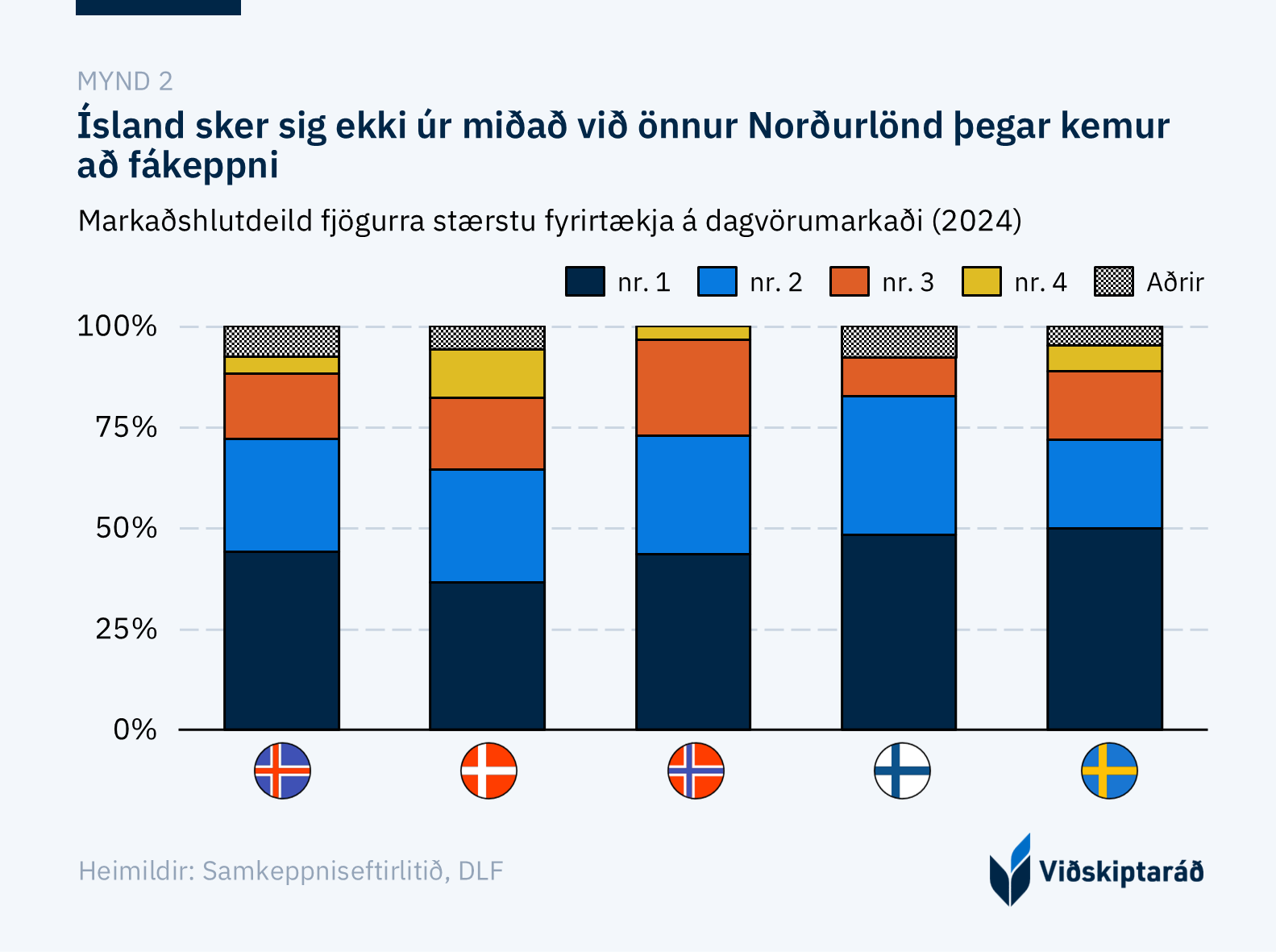
There are therefore no grounds for claiming that the competitive environment in the Icelandic grocery market differs from what is found widely across the Nordic countries. In fact, the operating surplus of grocery retailers in Iceland as a share of turnover is around average when compared with comparator countries (Figure 3).
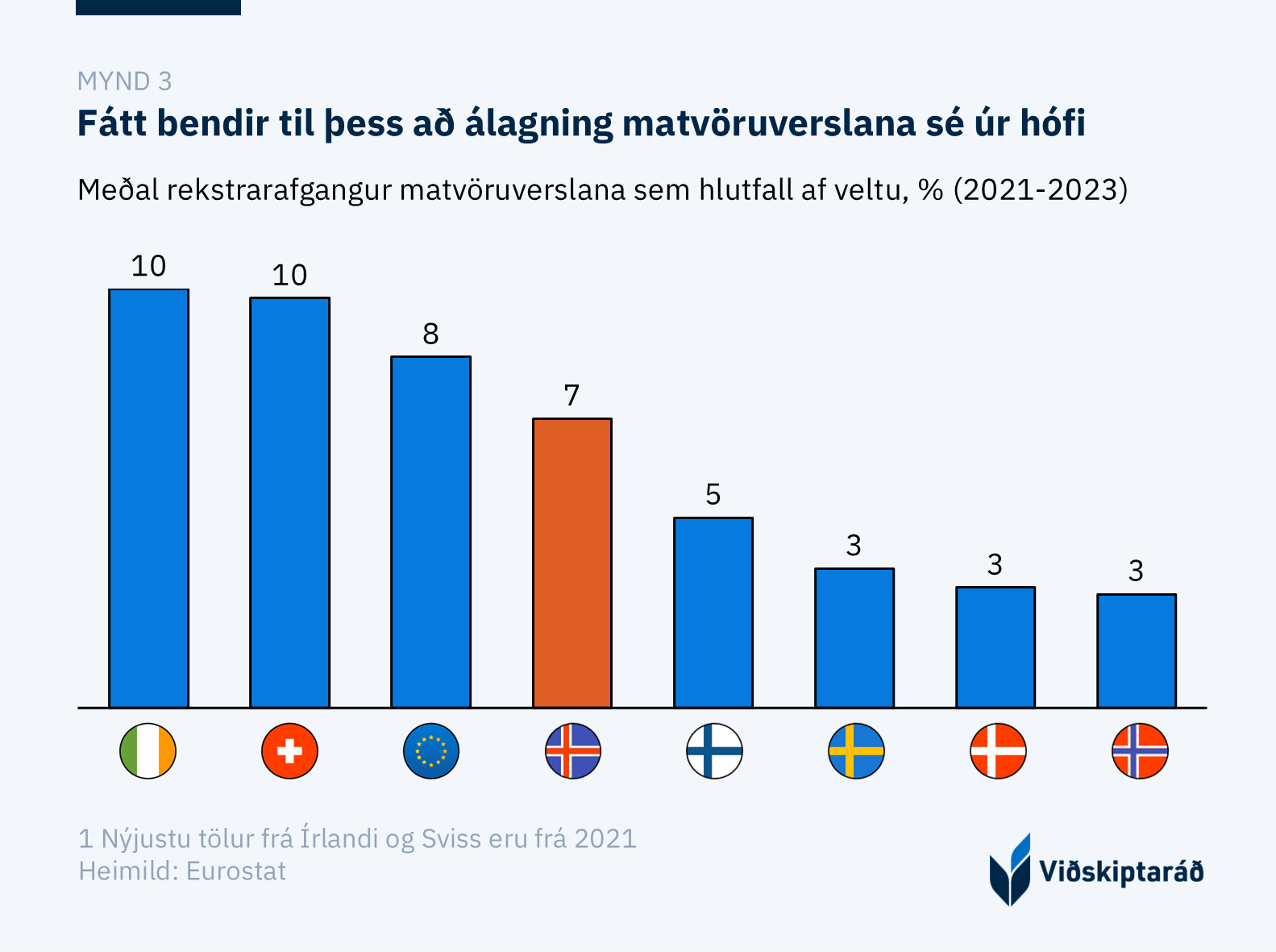
This does not suggest that Icelandic grocery retailers are exploiting their market position improperly; rather, their pricing reflects actual operating costs rather than a capacity for excess margins arising from limited competition.
The explanation for these results lies first and foremost on the cost side of the business, not in market structure. Labour costs are a significant element of grocery retailers' operating costs, and the labour cost per hour worked is considerably higher in Iceland than is generally the case in comparator countries (Figure 4). Since such a significant cost item is considerably higher in Iceland than in comparator countries, it inevitably affects prices.
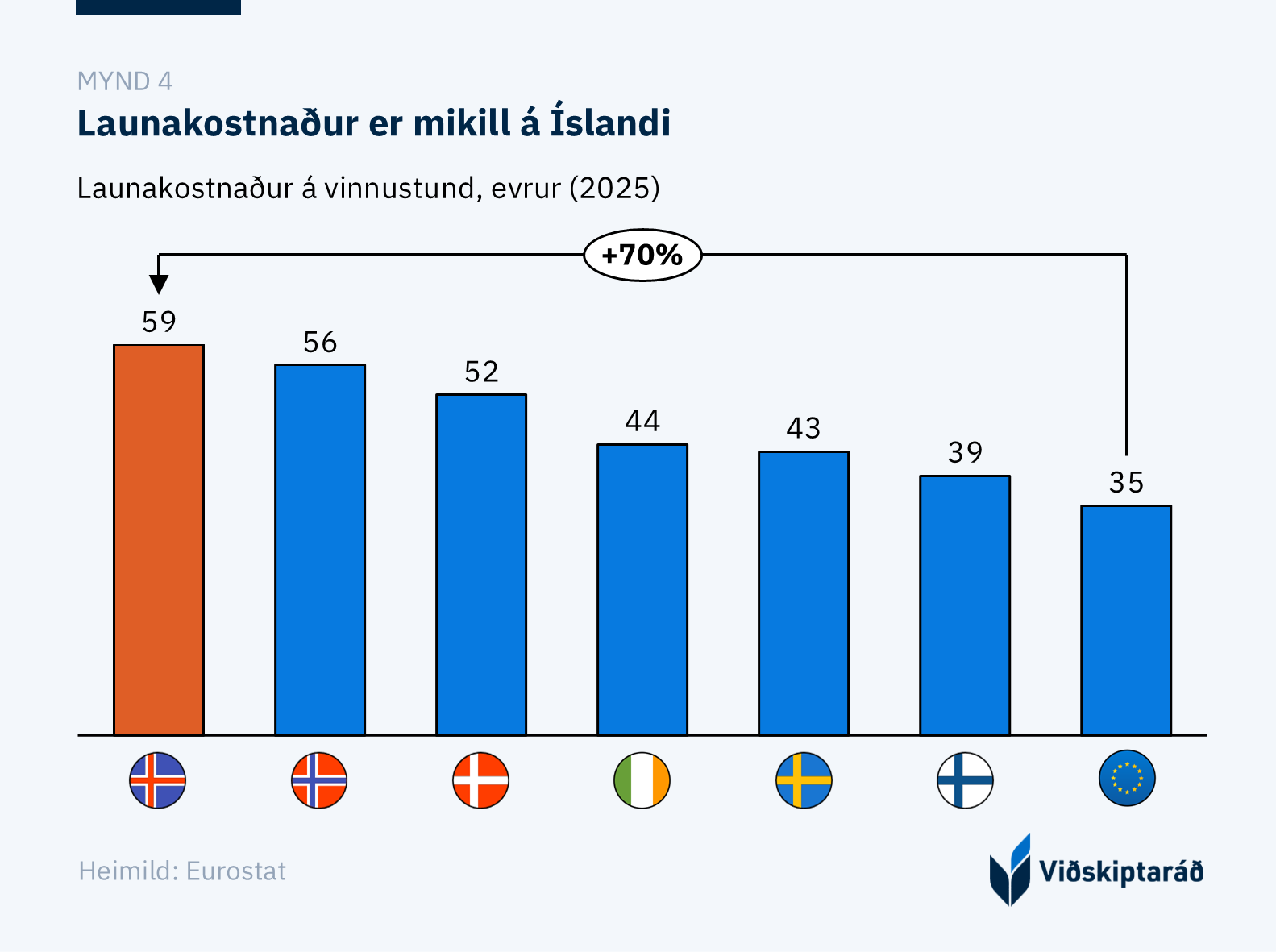
The cost to an employer of paying an employee's wages is also substantial. The cost to an employer of paying an employee a monthly wage of ISK 826,000 — the median wage for people in full-time work in 2025 — amounts to ISK 1.2 million. After tax, municipal and income tax, and pension contributions, the employee receives ISK 596,600 in take-home pay. For every two krónur that go towards an employee's labour cost, one króna ends up in their pocket while the other goes to taxes, pension savings, and other wage-related levies.
Comparison without context
Finally, care should be taken not to draw overly broad conclusions about the position of Icelandic households from price comparison alone, since such a comparison tells only half the story. What matters above all is the purchasing power of wages — that is, how much can be bought with each króna a consumer earns.
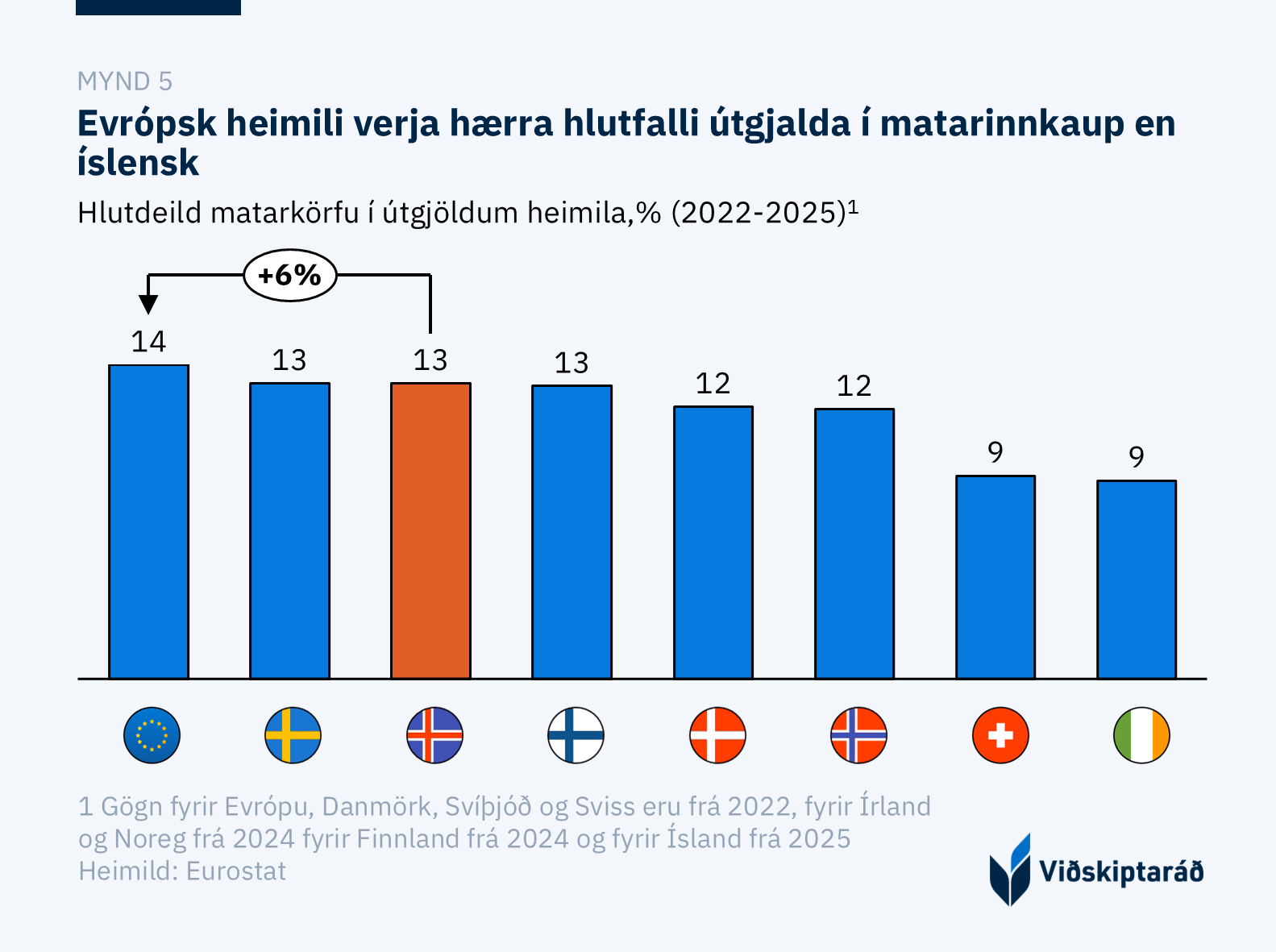
It is also worth looking at how heavily the food basket weighs proportionally in household expenditure (Figure 5). In the case of Icelandic households it accounts for 13% on average, compared with 14% within the European Union. This indicates that price comparison alone does not give an adequate picture of the position of consumers in Iceland.
Proposals for improvement
Many individual factors thus feed into high food prices, and overly simple conclusions from price comparison alone should be avoided. As set out above, high grocery prices in Iceland are explained in large part by decisions taken domestically, by a geographical position that increases transport costs, and by high wage levels. The financial results of grocery retailers do not suggest that the companies are exploiting their market position improperly, and market concentration is similar to that found in the other Nordic countries.
Improvements will not come through greater intervention in the operations of grocery retailers. On the contrary, they are best placed to offer the most favourable prices when their operating and tariff environment is stable and favourable. To promote that objective, the Iceland Chamber of Commerce puts forward three proposals, all of which are conducive to lowering grocery prices:
- Abolition of tariff protection: The most effective way to lower grocery prices, particularly on meat, milk, and eggs, is to abolish import tariffs.
- Lower taxes on wages: Only one in every two krónur that companies pay in wages ends up in the employee's pocket. By lowering taxes, levies, and mandatory pension contributions, the state can ease the burden of high labour costs.
- A more flexible regulatory environment: The regulatory environment in the grocery market should be simplified so that companies are able to make use of economies of scale, without reducing effective competition, to the benefit of consumers.
Abolishing tariff protection, reducing the wage wedge, and reviewing the regulatory environment of the grocery market would create the conditions for lower and more stable prices over the longer term, to the benefit of consumers and business alike. The Iceland Chamber of Commerce urges the authorities to consider these proposals and emphasises that the debate on grocery prices should rest on a comprehensive analysis of the many factors affecting price formation, rather than on simple comparison that is liable to give a distorted overall picture of the state of the grocery market in Iceland.
This article was automatically translated from the Icelandic original.
Related Content
Intervention in pricing decisions can reduce competition
Video: The Icelandic economy in 60 seconds

Competition is about more than numbers
Carbon tariff an undesirable response to a flawed system

The Icelandic Economy 2026