R&D support system must be simple and predictable
The Iceland Chamber of Commerce has reviewed the plans for amending the act on support for innovation companies. The Chamber supports, among other things, the plans for a longer validity period for confirmation of research and development projects and for granting Rannís the power to approve applications in part. It warns, however, of the steadily falling approval rate for applications, and emphasises that the support system must rest on clear rules, predictable administration, and consistent implementation that companies can rely on.

The Iceland Chamber of Commerce has reviewed the Minister of Finance and Economic Affairs' plans for amendments to Act No. 152/2009 on support for innovation companies. The plans constitute the second phase of the review of the research and development support system and aim to strengthen support for innovation, increase the clarity of the legislation, and improve its implementation. The Iceland Chamber of Commerce refers to its earlier consultation responses on comparable matters as applicable.[1]
To ensure economic stability, the number of pillars of the economy that are not dependent on natural resources must grow. A robust and predictable support system for research and development is an important element in creating an environment that encourages innovation and in building a diverse and competitive business sector. Knowledge-driven innovation contributes to higher productivity, exports, and improved living standards, and it is therefore important that the authorities maintain a stable incentive system that supports companies in making long-term investments in research and development.
Support for research and development effective in the OECD's assessment
The OECD report evaluating the effects of the research and development tax credit in Iceland shows that R&D tax incentives have a positive effect on corporate investment, employment levels, and wages.
The report's findings indicate that the support has had an encouraging and positive effect on further investment in the field, and has also had a positive effect on employment levels and average wages. The OECD estimates that the additional investment attributable to the support measure amounts to roughly three times the value of the tax credit.[2]
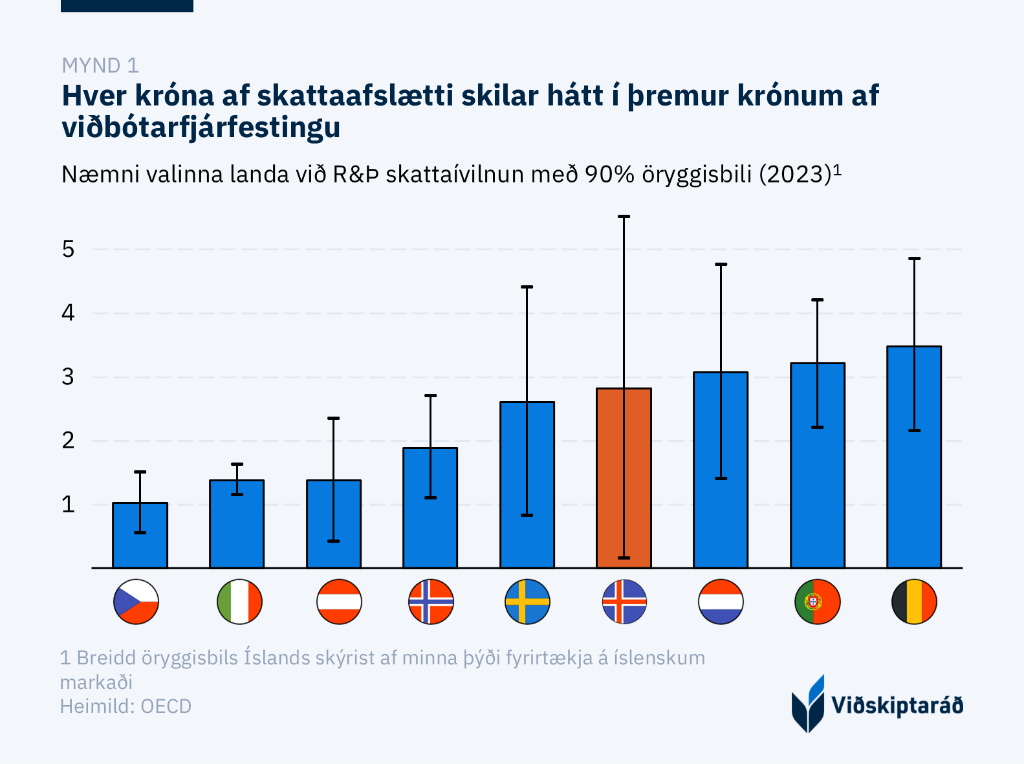
The support is crucial for the competitiveness of Icelandic business and ensures that Iceland does not fall behind in international competition, investment, and specialist expertise in research and development. It is therefore important that any changes to the system strengthen incentives for research and development rather than undermine them.
Comments on individual points
The plans provide for the title of the act to be changed so that it is clear that the support covers all companies engaged in research and development, irrespective of whether they qualify as innovation companies. The Iceland Chamber of Commerce supports that change, as it better reflects the purpose of the legislation and promotes greater equality of treatment. It is likewise positive that confirmation of research and development projects may be valid for up to four years, and the Chamber sees grounds for permitting an even longer validity period for long-term projects such as deep tech and pharmaceutical development. That change is conducive to reducing the administrative burden, cutting the number of repeat applications, and increasing predictability for companies. The Chamber also emphasises that flexibility within the system must continue to be assured, since research and development projects are by their nature uncertain undertakings. It works against the objective of the system if companies lose support merely by changing their technical approach or emphasis within the same objective, and changes within a project should therefore be permitted without a new application provided its underlying objectives remain in place.
The plans propose granting Rannís the power to approve applications in part where only part of a project meets the statutory conditions. In the Iceland Chamber of Commerce's assessment, that change will increase flexibility in processing and reduce the number of applications refused on narrow grounds. Provision is also made for a dedicated administrative appeal route in respect of Rannís's decisions. Such an appeal route would strengthen applicants' legal certainty, promote more consistent implementation of the legislation, and increase trust in the support system — particularly since decisions on eligibility often involve matters of judgement. The Chamber emphasises that the appeal route must be efficient, inexpensive, and independent of both Rannís and Iceland Revenue and Customs.
The plans further propose that the conditions concerning companies in financial difficulty be reviewed within the limits permitted by EEA rules, and that it be more clearly delimited which cost items qualify for support. The Iceland Chamber of Commerce endorses these points and considers it essential that the conditions on companies in financial difficulty be reviewed at the earliest opportunity and broadened within the framework EEA rules allow. A clearer delimitation of eligible costs may likewise be conducive to greater equality of treatment and predictability. The Chamber warns, however, against such clarification leading in practice to a narrowing of eligible costs. Cost items such as rent, depreciation, and bought-in specialist services can be an inseparable part of research and development projects and should therefore not automatically fall outside the support system.
Finally, the plans propose bringing the application deadline for the tax deduction forward by one year. The Iceland Chamber of Commerce has reservations about that change. Although the objective is to strengthen the incentive effect of the support system, there is a risk that the change will simultaneously reduce companies' flexibility and lead to applications being submitted before projects have taken sufficiently clear shape. Since such a change could nonetheless increase the system's incentive effect, in that companies would know in advance whether projects fall under the support measure, the Chamber considers it worth examining the possibility of a middle course through two formal application windows each year: one before the start of the financial year and one early in the financial year, for example in March or April, with support applying from the date of application or the date of approval. This would reduce bottlenecks at Rannís while giving companies room to respond quickly to new technical or market opportunities.
Approval rate down substantially
Although the current support system has in many respects proved its worth, the Iceland Chamber of Commerce has previously pointed out that its implementation rests to a considerable extent on discretionary decisions about what qualifies as research and development. Such assessment reduces predictability and creates uncertainty for companies making long-term investment decisions. These concerns have grown in light of the fact that the approval rate for tax deduction applications has fallen from 92% in 2020 to 61% in 2024, even though the number of applications has remained fairly stable. At the same time, corporate spending on research and development as a share of GDP has contracted, which gives grounds to examine whether the implementation of the support system has become burdensome and less predictable than before.
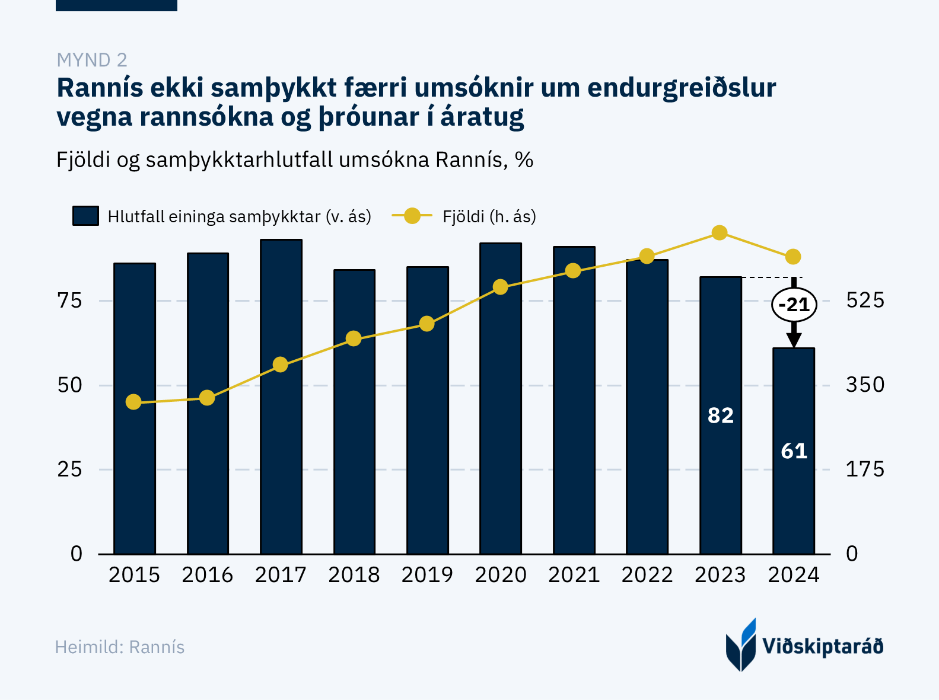
According to Rannís's explanations, the trend can be traced in part to a stricter interpretation of what qualifies as a research and development project and to increased requirements for applications. It is also striking that the agency refers to legislative changes that did not enter into force until 1 January 2025. If those changes influenced the processing of applications relating to 2024, this raises questions about retroactive and burdensome application of the law. In the Iceland Chamber of Commerce's assessment, this trend underlines the importance of the support system resting on clear rules, predictable administration, and consistent implementation that companies can rely on.
Further simplification and greater predictability
The Iceland Chamber of Commerce considers it important that work continue on simplifying the application process and that processing be efficient, transparent, and bound by clear statutory time limits by which the agency itself is bound. Companies undertaking research and development projects need to be able to rely on the support system being predictable and on the authorities' decisions resting on clear and consistent rules. In that context the Chamber also proposes abolishing the requirement that a cooperation agreement always accompany joint applications for the tax deduction, since it can give rise to substantial costs before it is clear whether a project will receive support, and thus reduce companies' incentive to collaborate.
The Iceland Chamber of Commerce further emphasises that any changes to the support system be implemented with ample notice. It may be noted that innovation and development work is generally a process spanning several years, and innovation companies therefore need to be able to rely on support and to build their long-term plans within a dependable system. This would help prevent added uncertainty in a field where there is already enough of it.
In light of the above comments, the Iceland Chamber of Commerce encourages continued work on the plans with the objective of creating a simple, predictable, and efficient support system that strengthens research, development, and the competitiveness of Icelandic business.
References
[1] Iceland Chamber of Commerce consultation response on the bill amending the act on support for innovation companies (January 2026): https://vi.is/umsagnir/nyskopunarstudningur-umsogn
[2] OECD, Evaluating the effects of the R&D tax credit in Iceland (2023). URL: https://www.oecd.org/content/dam/oecd/en/topics/policy-sub-issues/structural-reforms/country-policy-support/oecd-iceland-tax-credit-evaluation-2023.pdf
This article was automatically translated from the Icelandic original.
Related Content

State investments need clearer cost-benefit analysis

Equal operating conditions in primary care a prerequisite for better services

DORA criteria must be clear and predictable

The Icelandic Economy 2026

Warning over added burdens on companies from the energy efficiency directive