Rusted reasoning: the taxation of new vehicles
Taxes on a new petrol SUV now exceed its import price, and Iceland is among the European countries that tax new cars most heavily. Analysis by Viðskiptaráð shows that these charges have fuelled inflation and are keeping older, more polluting and more dangerous cars on the roads for longer. Viðskiptaráð proposes that excise duties and fuel charges be abolished and that charging be consolidated into a per-kilometre fee.

Summary
- Taxes on a new petrol SUV now exceed its import price, at 111%, and a fuel-efficient petrol car carries 74% tax. Iceland has joined the group of European countries that tax new cars most heavily.
- The new-year tax increase raised inflation by up to 0.6 percentage points. Inflation measured 5.3% in July; without the increase it would have been around 4.7%, the benchmark against which the review clauses of the wage agreements are measured in August and which are now in jeopardy.
- The health damage from a 25-year-old diesel car is thirteen times that of a new one, and higher charges on new cars keep old cars in circulation for longer. At the turn of the year the running costs of fuel-hungry cars fell while those of fuel-efficient cars rose.
- An older vehicle fleet costs lives: the probability of death for those involved in a fatal accident nearly doubles in the oldest cars. For each year of additional fleet age, some 35 more serious injuries and two deaths per decade can be expected.
- Electric car ownership is many times more common in the capital area than in rural regions. Targeted charges on petrol and diesel cars are therefore in effect a rural tax.
- Viðskiptaráð proposes that excise duties on vehicles and the carbon charge on fuel be abolished, that special concessions be withdrawn, that the per-kilometre fee be raised in their place, and that the tax increase of the last new year be reversed.
On 1 January 2026 the state raised charges on new cars by more than has been seen in years. The emissions threshold for the excise duty was lowered from 85 to 30 grams of CO2 per kilometre, the surcharge per gram raised from 0.28% to 0.34%, the base charge doubled from 5% to 10% and the ceiling moved from 65% to 70%.[1] At the same time a per-kilometre fee was imposed on all vehicles, fuel charges were abolished and the carbon charge was raised by 30%. The stated objective was to raise ISK 7.5 billion a year for the Treasury through higher excise duties and a further ISK 3.3 billion through the per-kilometre fee, while at the same time promoting the energy transition. The consequences were not long in coming: inflation, an impending breach of the wage agreements' assumptions, and a tax system working against its own objectives.
Tax upon tax
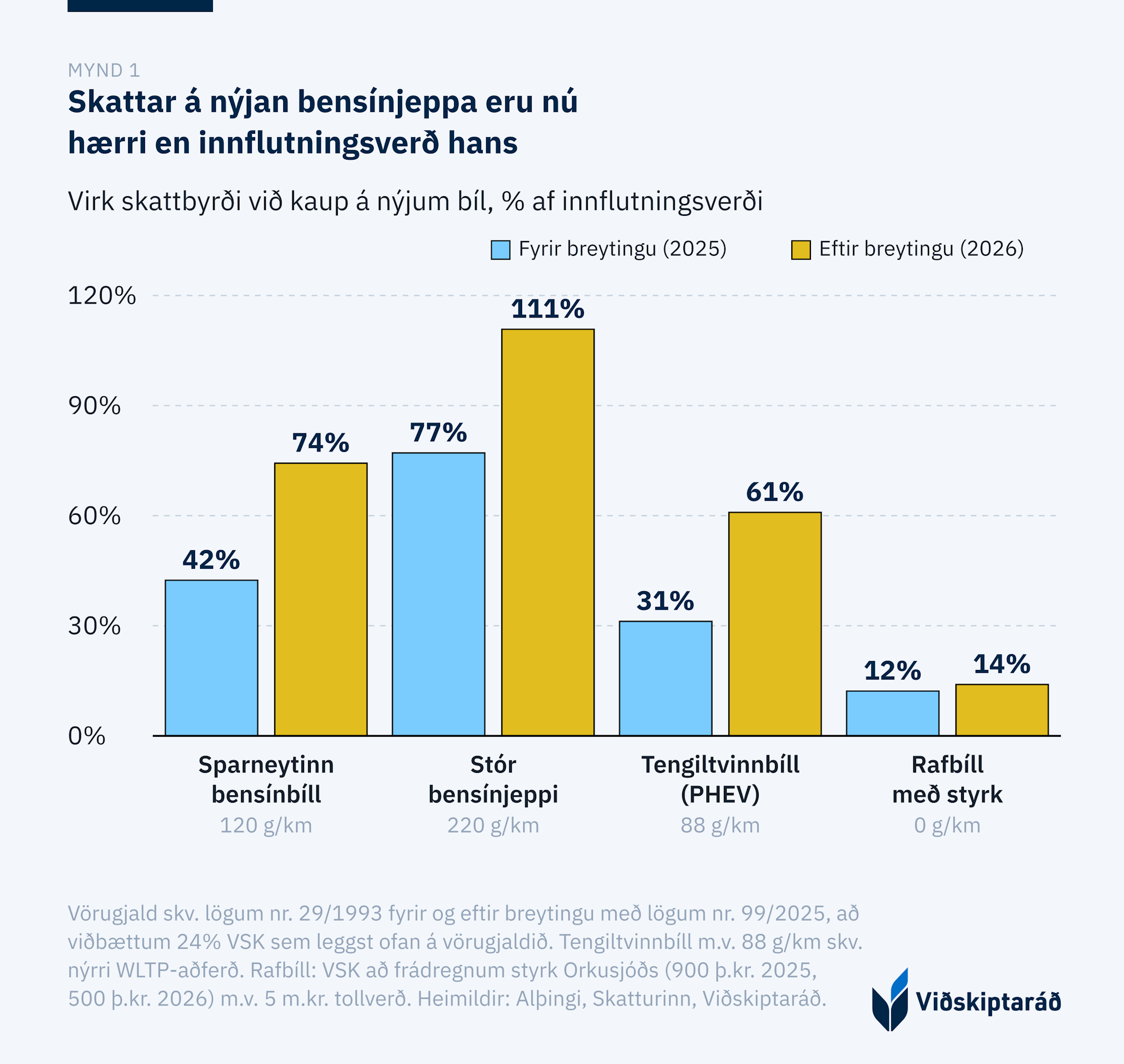
Excise duty on vehicles is calculated on a car's customs value, and value added tax is then levied on top of the price including that excise duty: tax upon tax.[2] A petrol SUV with emissions above 207 g/km carries 70% excise duty, and with value added tax the total tax take becomes 111% of the import price: the charges to the state are then higher than the import price of the car itself. A fuel-efficient petrol car carries 74% and a plug-in hybrid 61%, close to twice as much as before the change. Electric cars pay only value added tax, but since the Energy Fund's purchase grant was cut at the same time from ISK 900,000 to ISK 500,000, cheaper electric cars also rose in price at the turn of the year.[1]
The systemic change was meant to simplify charging, but it left double taxation of driving in place. Since the turn of the year all car owners pay a per-kilometre fee of ISK 6.95 per kilometre driven, conceived as a usage charge for the road network. Owners of petrol and diesel cars additionally pay a carbon charge on every litre, which was raised by 30% at the same time.[1] Once the per-kilometre fee has become general and independent of the energy source, the remaining fuel tax is no longer a road charge but pure additional taxation that overlaps with the CO2 scale of the excise duty, given that the increase in the carbon charge was justified precisely by alignment with the price of emissions allowances in the EU trading system. The outcome is paradoxical: according to Viðskiptaráð's calculations, the systemic change lowered the running costs of petrol cars consuming more than 6.6 litres per hundred kilometres but raised them for those consuming less. FÍB has pointed to the same distortion: the running costs of fuel-efficient small cars rose by 20% while those of large, fuel-hungry cars fell by almost 10%.[3]
A European record, bar two
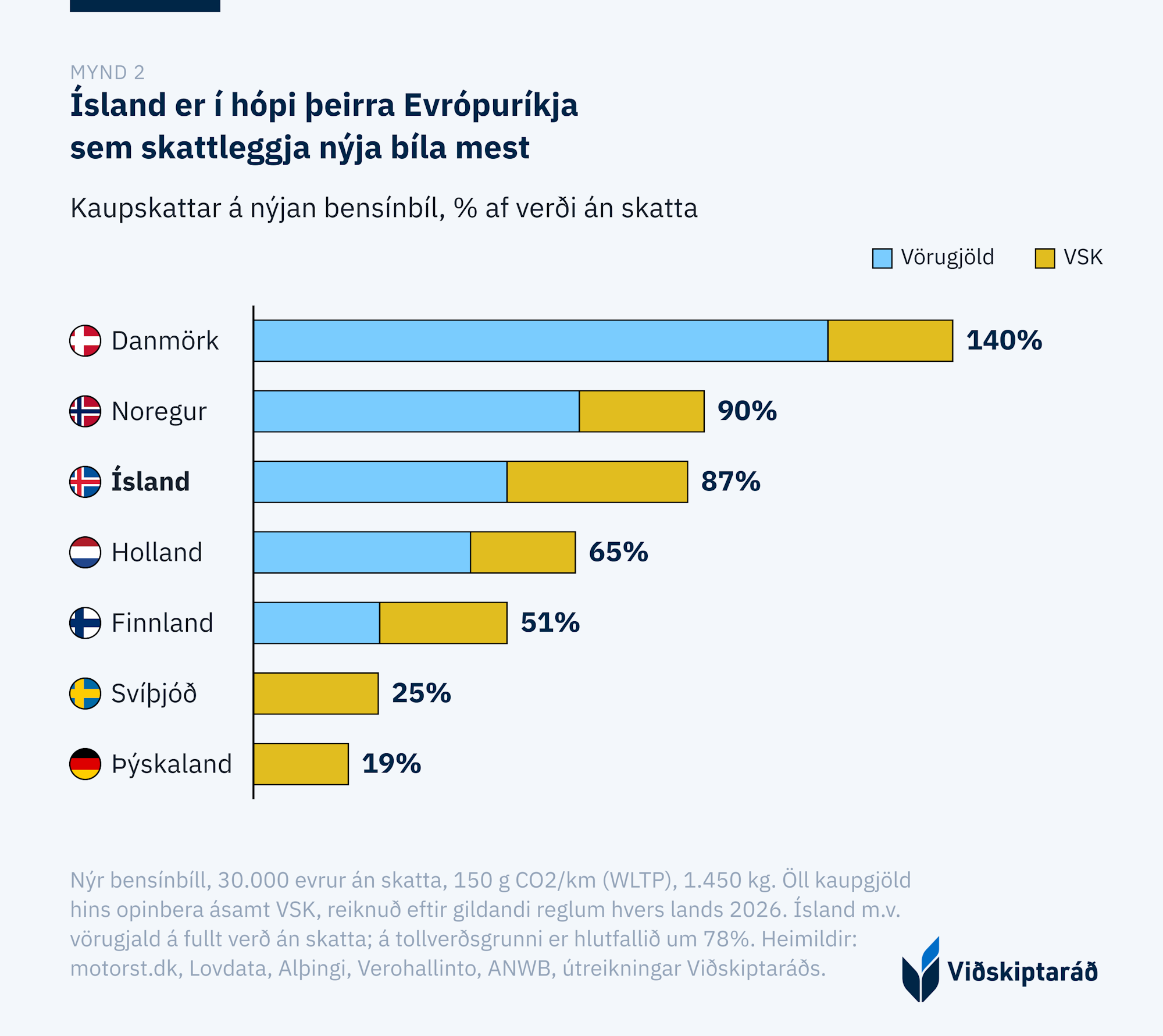
Iceland is among the European countries that tax new cars most heavily. For a comparable new petrol car, the combined purchase tax take is 140% of the pre-tax price in Denmark, 90% in Norway and 78 to 87% in Iceland, depending on whether the customs value or the full pre-tax price is used as the basis, with the Netherlands, Finland, Sweden and Germany far below.[4] The Norwegian figure is, however, based on fixed krone amounts that fall proportionally the more expensive the car, whereas the Icelandic charge is a proportion of the price. For cars above around EUR 40,000, Iceland therefore rises above Norway, leaving only Denmark ahead.
The Danish model is not one to aspire to. The Danish Economic Council, the sister institution to Iceland's Fiscal Council, has proposed that the registration charge be abolished altogether and estimates that the reform would deliver around DKK 20 billion a year to Danish society.[5] The think tank CEPOS points out that a charge of this kind works like a tariff in a country that produces no cars, and that CO2 reduction achieved through it costs around six times more than general carbon taxation.[6] Car ownership in Denmark is also well below the EU average despite high living standards, at 479 cars per 1,000 inhabitants against an EU average of 570 and 649 in Iceland.[7] At the same time Finland is looking in the opposite direction: the ministries of finance and transport have published a review of abolishing the purchase tax, which awaits a decision by the next government, and the transport minister calls the revenue from it “an insignificant sum for the Treasury” against the damage the charge causes.[8]
The damage grows with the square
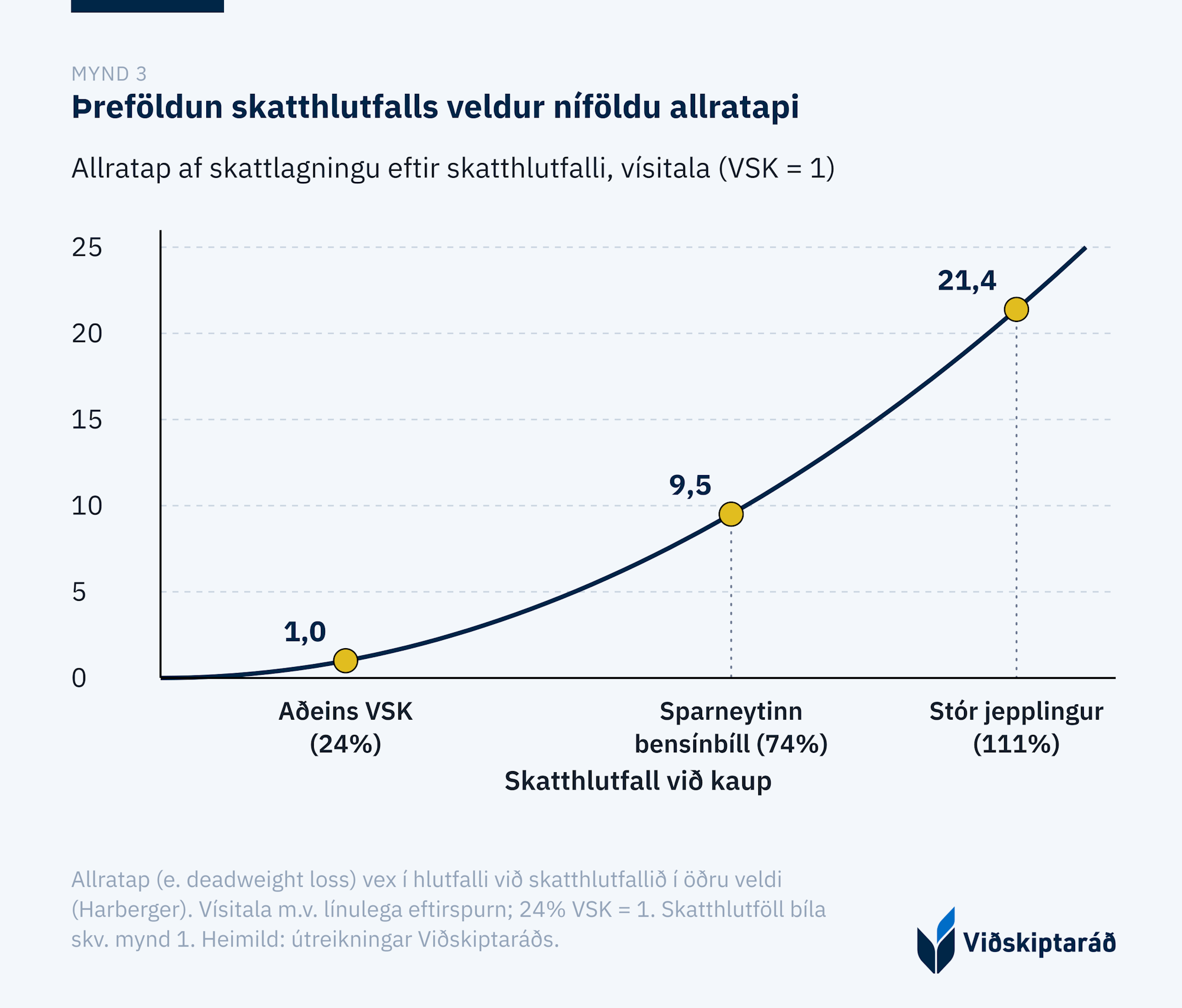
When a tax is levied on a good, the price rises and some buyers simply give up. The family that would have replaced the car at ISK 6 million makes the old one do when it costs 8. From transactions that never happen the state receives no revenue and nobody gains anything; the value is never created. This loss, over and above the kronur that reach the Treasury, is what economists call deadweight loss. It grows not linearly but with the square: a tax twice as high causes four times the loss. A general 24% value added tax is moderate charging, but a 74% total tax on a fuel-efficient petrol car causes around nine times more deadweight loss, and a 111% tax on an SUV more than twenty times more. This is not about edge cases: the transactions that disappear are precisely the purchases of new, safe and fuel-efficient cars that society says it wants more of.
The inflationary effects appeared immediately. New cars rose by 13.3% in January according to Statistics Iceland.[9] Landsbankinn estimates the total effect of the tax changes on the consumer price index at around 0.6 percentage points, of which about half a percentage point is due to the purchase taxes alone.[10] That increase sits in the twelve-month inflation rate for the rest of the year. Inflation measured 5.3% in July, while the review clauses of the wage agreements are pegged to inflation of 4.7% in August.[11] Without the tax increase, inflation would therefore have been at or below the benchmark according to Viðskiptaráð's calculations. Other factors certainly contributed to the year's inflation, not least the rise in world oil prices, but the January increase alone is large enough to determine whether the benchmark holds. The labour movement considers the assumptions already breached, the chair of the Federation of General and Special Workers says there is a “100 percent chance” that they will be breached, and the formal assessment by the review committee takes place on 1 September.[12] The Central Bank has raised its policy rate twice this year, for the first time since 2023, citing among other things increases in public charges.[13] A tax increase of almost ISK 11 billion could thus end up as a far more expensive bill for society in the form of interest rates, instability and upheaval in the labour market.
It is also doubtful that the revenue will materialise. Importers brought around 3,500 cars into the country above the normal level in the final weeks of 2025 in order to avoid the increase, and that accelerated importing kept new registrations up through the winter. Once the stock sold out, sales collapsed: in the second quarter new registrations fell by nearly a third year on year according to figures from the Icelandic Automobile Trade Association.[14] FÍB pointed out immediately that the advance purchases would bring excise duty revenue forward in time and substantially reduce Treasury revenue from excise duties in 2026.[14] The revenue projection for the increase is therefore greatly overstated: what remains is fewer new cars, an older fleet and less revenue than was intended.
Environmental arguments that bite their own tail
Higher charges on new cars are frequently justified by climate objectives. That argument does not stand up to scrutiny. The difference between new and old cars is greatest precisely in the pollution that causes the most damage. According to emission factors from European environmental agencies and the European Commission's damage assessment, the health damage caused by air pollution from a 25-year-old diesel car is thirteen times that of a new one, and from an old petrol car more than three times.[15][16] In the United States, cars older than 15 years cause 30 to 50% of all air pollution from the vehicle fleet even though they account for only about a tenth of CO2 emissions.[17]
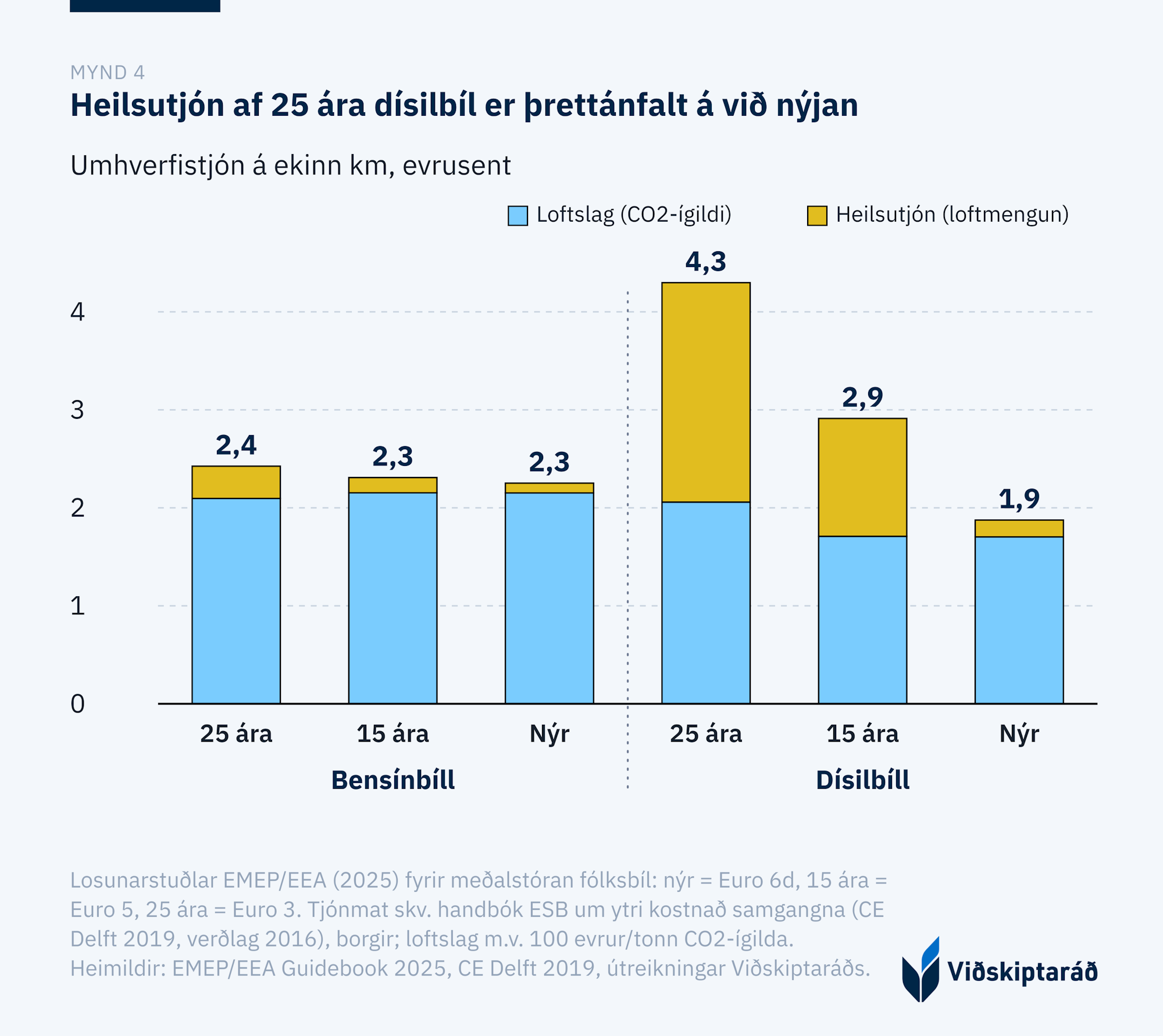
A tax that falls only on new cars slows the renewal of the fleet: it keeps up the price of used cars and postpones the scrapping of old ones. Economics calls this the Gruenspecht effect, and recent research in the Quarterly Journal of Economics reaches a clear conclusion: environmental charges levied solely on new vehicles cause a direct welfare loss, because they extend the lifetime of old and polluting cars.[17] The Icelandic change went further: it made fuel-hungry cars cheaper to run and fuel-efficient ones more expensive, as set out above, and average emissions of newly registered cars in Iceland rose by half between 2023 and 2024 when electric car concessions were scaled back.[18]
The story of plug-in hybrids is a textbook example of the weakness of such micromanagement. At first they were subsidised by hundreds of thousands of kronur because on paper they measured as close to emission-free. The reality proved otherwise: European measurement data from the cars themselves show that real-world emissions from plug-in hybrids are around five times the recorded figure and only a quarter lower than those of conventional cars, given that a large proportion of them are seldom or never plugged in.[19][20] The cars also carry an extra 250 to 320 kilos in batteries and additional equipment which the combustion engine hauls around when the battery is empty.[21] Iceland took part with full force: more than half of all VAT relief for the energy transition up to the end of 2021, ISK 12.4 billion of 23.5 billion, went to plug-in hybrids, and the Ministry of Finance itself judged at the end of 2021 that further concessions for them “would not be a cost-effective measure in climate policy”.[22] When the measurements were corrected the picture reversed: purchase charges on plug-in hybrids nearly doubled at the turn of the year and their per-kilometre fee rose from ISK 2 to 6.95 per kilometre.[1] A vehicle the state subsidised up to the end of 2022 is being specially taxed from 2026, on both occasions in the name of the environment. If the authorities wish to use economic incentives in an environmental direction, economics points to annual charges that take account of each car's age and pollution, not purchase taxes on new cars.[17]
Safety: the most expensive side effect
Cars have been transformed in terms of safety. Among those involved in a fatal accident in the United States, 27% lose their lives if they are in a car less than four years old but 50% in a car that is 18 years or older, and adjusted for other factors the probability of death is 1.7 times higher.[23] Swedish data show the same picture: the risk of death in cars that came to market between 2010 and 2019 is a third of what it was in cars from the 1980s.[24] An Australian review of 9.5 million vehicles estimates that the risk of death or serious injury is 43% lower in a 2023 model year car than in a 2001 model.[25] Does this matter in Iceland? Electronic stability control (ESC), mandatory equipment in new cars in Europe since 2014, halves the risk of serious accidents in slippery conditions.[26]
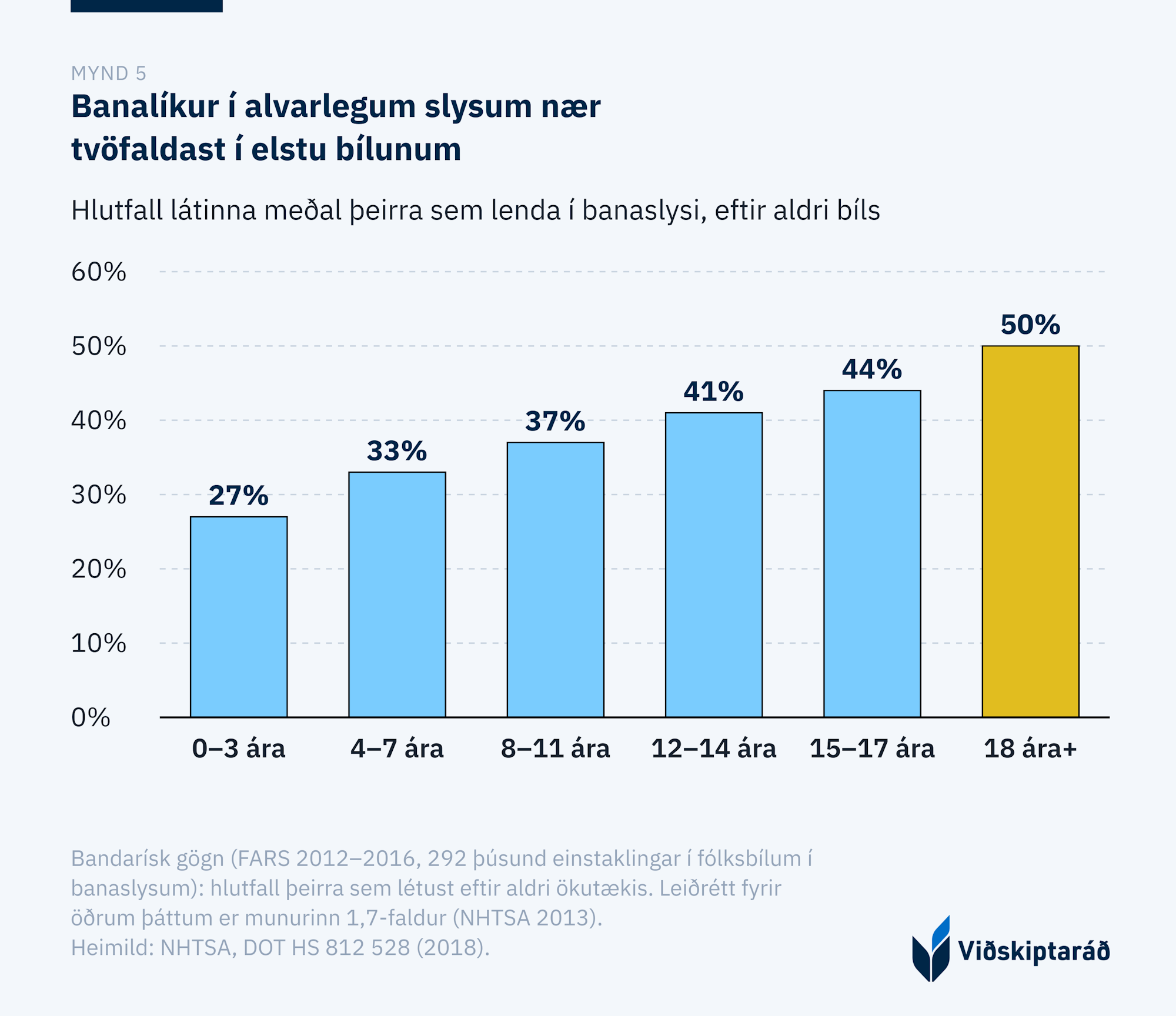
In Iceland an average of 11 to 12 people die in traffic each year and around 195 are seriously injured; the cost to society of traffic accidents is estimated at over ISK 80 billion a year.[27] The research set out above points consistently to each year in the average age of the vehicle fleet changing serious accidents by around 3%.[23][24] That sounds small but accumulates: if the charges delay renewal of the fleet by one year, then according to Viðskiptaráð's own calculations some 35 more serious injuries and two deaths per decade can be expected, a cost to society of over half a billion kronur a year. The context is striking: all the safety equipment the EU made mandatory in new cars in 2024, emergency braking, lane keeping and more, estimated to avert 25,000 deaths across the continent up to 2037, costs around EUR 516 per car, about ISK 75,000.[28] The Icelandic state levies up to more than seventy times that amount in taxes on the same car.
A rural tax
In May 2024, 8.6% of vehicles in the capital area were electric, against 1.3% in the Westfjords and Northwest Iceland.[29] That is no coincidence: distances are longer, the charging network sparser, and electric cars' range falls by 20 to 30% in winter cold.[30] The state itself acknowledges the situation: the government's grant drive launched this spring states that a fast charging station has yet to be secured in every population centre and that in some places on the national road network there are more than 100 kilometres between stations.[31]
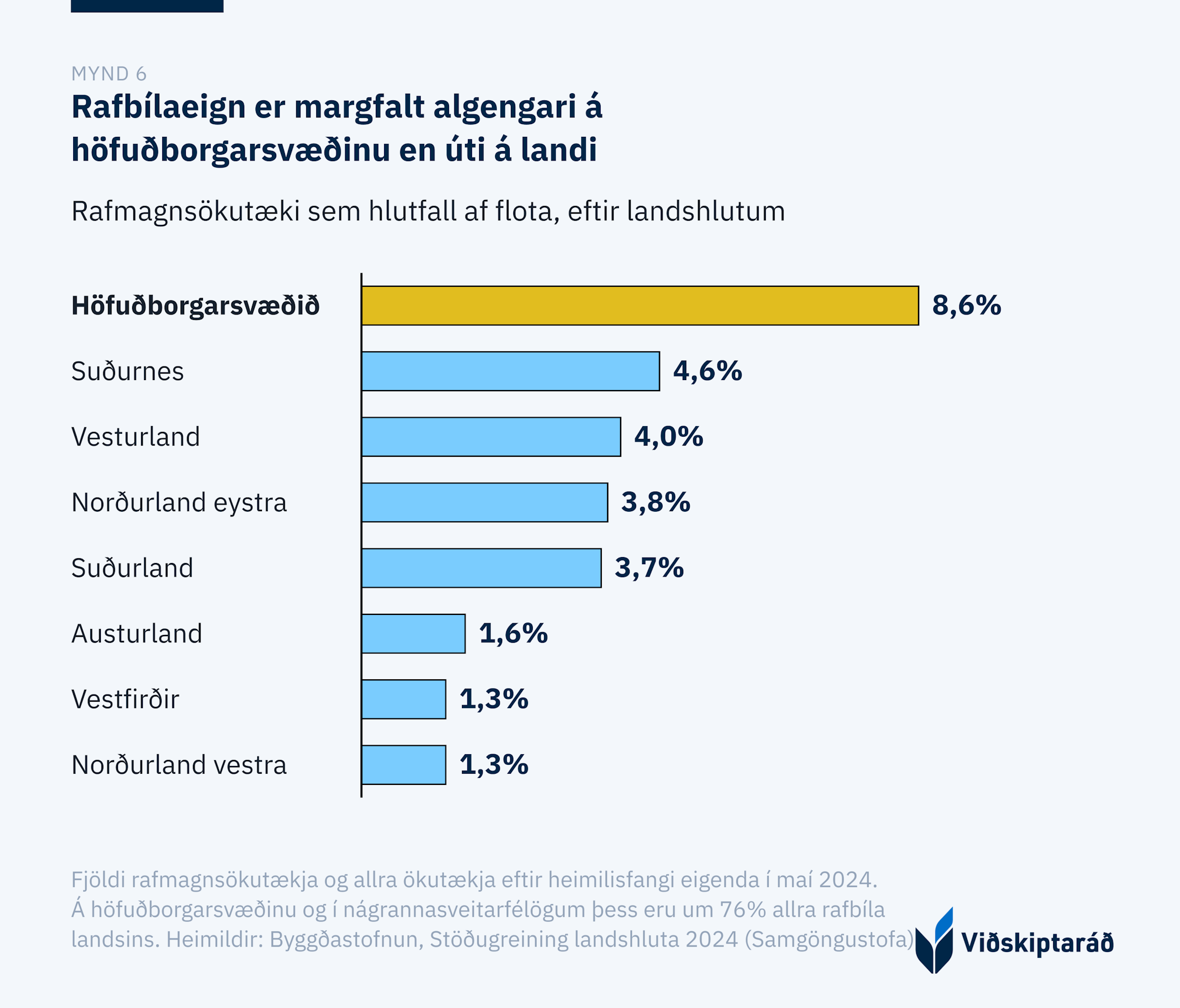
For a large part of rural Iceland a petrol or diesel car is therefore not a choice but a necessity. Charges that fall specifically on such cars are in effect a rural tax: the same krona amounts fall on a resident of the Westfjords who has no realistic alternative and on a resident of the city centre who does. The electric car grants deepen the distortion: in 2024 three quarters of them went to six municipalities in the southwest corner and proportionally most to the country's highest-income households.[32] The system thus transfers money from rural to urban areas and from lower to higher incomes, in the name of objectives it does not achieve.
A simple system instead of micromanagement
The right response is not to fine-tune the concessions once again but to abandon the micromanagement. General charging does not distort the choice between energy sources: a per-kilometre fee for use of the road network, value added tax as on any other good, and nothing beyond that. Electric cars retain their running-cost advantage on their own merits, given that electricity is many times cheaper than imported fuel. Viðskiptaráð proposes the following:
1. Abolish excise duties on new vehicles. New cars should carry general value added tax like any other good. This speeds up renewal of the fleet, which is one of the most effective air quality and safety measures available, and lowers the price of safe and fuel-efficient cars by up to a third.
2. Fold fuel charges into the per-kilometre fee. With a general per-kilometre fee, charging for driving is brought into one place. A carbon charge on top of a per-kilometre fee on top of a CO2-linked excise duty means that the same tonne of carbon dioxide carries multiple charges; whatever charging is justified should stand once. The carbon charge on fuel should be dropped and the revenue moved into the per-kilometre fee.
3. Withdraw special concessions on car purchases. The Energy Fund's electric car grants should run their course; experience with plug-in hybrids shows how poorly the state does at picking the right technology. The tax system should be technology-neutral; electric cars will still be better placed on running costs without special grants.
4. Raise the per-kilometre fee in their place and reverse the January increase. For the change to be revenue-neutral relative to the position before 1 January 2026, the per-kilometre fee for passenger cars would rise, roughly calculated, from ISK 6.95 to around 11. The new-year tax increase, ISK 10.8 billion according to the budget, would be reversed, given that it has already proved economically costly.[33]
5. Record vehicle age in the accident register. Neither the Transport Authority nor the transport accident investigation board currently records the age or model year of cars involved in accidents. It is an inexpensive change that would finally make it possible to assess the safety effects of the vehicle fleet in Iceland.
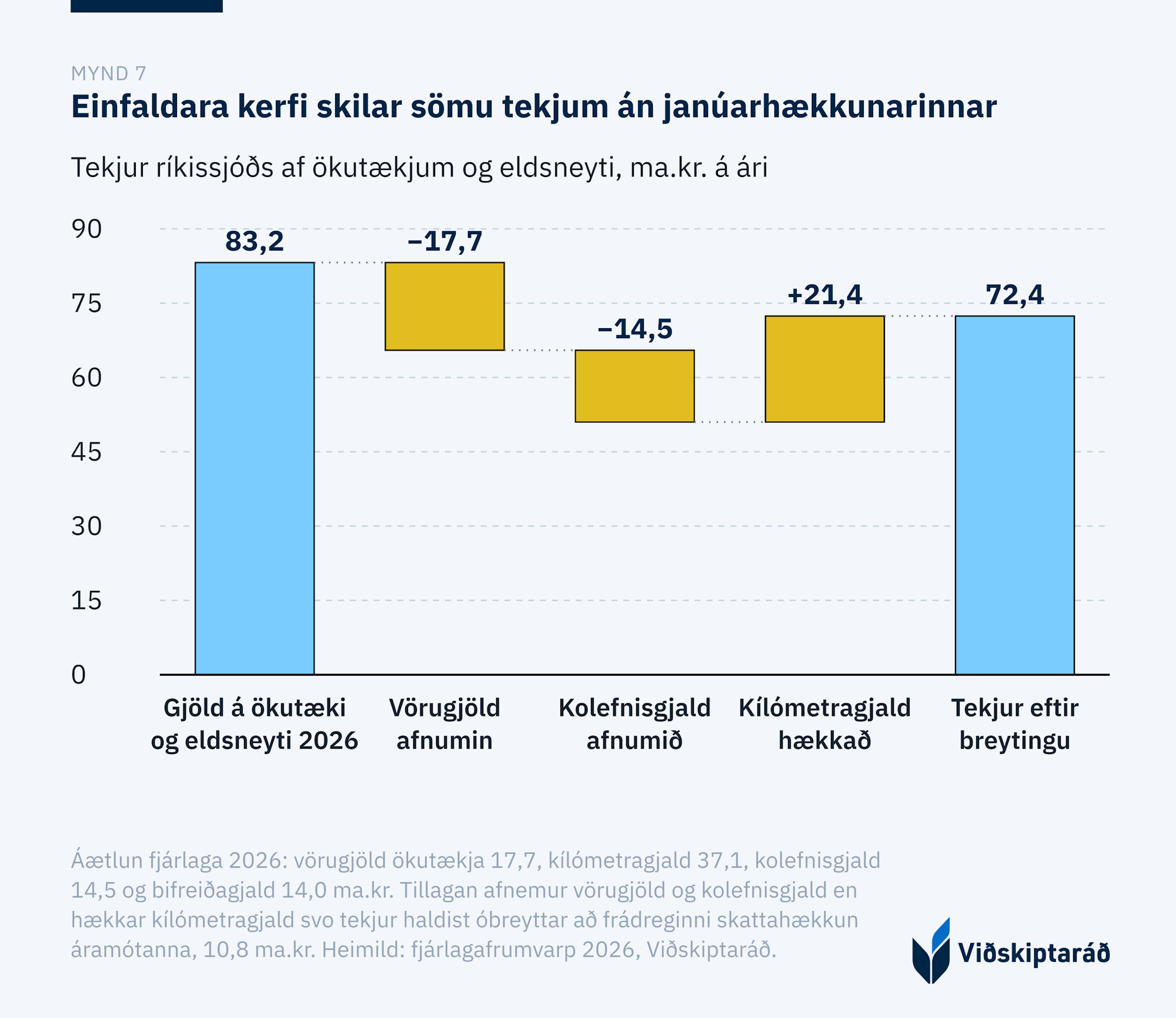
The Treasury would continue to receive the same revenue from traffic as it had before the increase, around ISK 72 billion a year, but through two charges instead of four. Charging would be transparent, technology-neutral and in proportion to use of the roads. What would disappear is a tax upon tax that keeps Icelanders longer in older, more polluting and more dangerous cars, fuels inflation and falls hardest on those who can least afford it. Reasoning that rusts should, just like rusted cars, give way to something new and better.
References
[1] Ministry of Finance and Economic Affairs, Tax changes in 2026 (23 December 2025): stjornarradid.is.
[2] Act No. 29/1993 on excise duty on vehicles, Articles 3 and 19, as amended by Act No. 99/2025: althingi.is/lagas/nuna/1993029. On VAT on top of excise duty: Article 34 of Act No. 50/1988: althingi.is/lagas/nuna/1988050.
[3] FÍB, Tax changes at the turn of the year (January 2026), effects on running costs by fuel consumption: fibfrettir.is.
[4] Viðskiptaráð's calculations based on each country's 2026 tariffs; see assumptions in figure 2. Denmark: motorst.dk; Norway: lovdata.no; Finland: vero.fi.
[5] De Økonomiske Råd, Økonomi og Miljø 2021, chapter I on the taxation of private cars: dors.dk.
[6] Brøns-Petersen, O., 100 år er nok: Registreringsafgiften er overflødig og bør afskaffes, CEPOS working paper 81 (2024): cepos.dk.
[7] ACEA, Vehicles on European Roads (January 2026), average age and car ownership by country: acea.auto.
[8] Moottori, Autoveron poisto liipaisimella (March 2026), report on the abolition of autovero and comments by transport minister Lulu Ranne: moottori.fi.
[9] Statistics Iceland, Consumer price index in January 2026: hagstofa.is.
[10] Landsbankinn, Higher inflation can be traced to public charges (2026): landsbankinn.is.
[11] SA, What are the review clauses of the wage agreements? (2 February 2026): sa.is.
[12] Vísir, It is entirely clear that the assumptions of the wage agreements have been breached (23 July 2026): visir.is.
[13] Central Bank of Iceland, Monetary Policy Committee statement, 18 March 2026: sedlabanki.is.
[14] Icelandic Automobile Trade Association, new passenger car registrations (monthly figures to June 2026); the second-quarter contraction is Viðskiptaráð's own calculation based on those: bgs.is. FÍB on the effect of accelerated importing on excise duty revenue (11 December 2025): fibfrettir.is.
[15] EMEP/EEA, Air Pollutant Emission Inventory Guidebook (2023, updated 2025), chapter 1.A.3.b, passenger car emission factors by Euro class: copert.emisia.com.
[16] CE Delft for the European Commission, Handbook on the External Costs of Transport (2019), damage assessment per kg of pollutant: publications.europa.eu.
[17] Jacobsen, M., Sallee, J., Shapiro, J. and van Benthem, A., „Regulating Untaxable Externalities“, Quarterly Journal of Economics 138(4) (2023): doi.org/10.1093/qje/qjad016.
[18] Eurostat, Average CO2 emissions per km from new passenger cars (sdg_13_31), Iceland 2023 and 2024: ec.europa.eu.
[19] ICCT, On the way to „real-world“ CO2 values? (June 2026), OBFCM measurement data from 8 million cars: theicct.org.
[20] European Commission, report COM(2024) 122 on real-world vehicle emissions (2024): climate.ec.europa.eu.
[21] Manufacturer data on the kerb weight of the same models with and without plug-in hybrid equipment (Škoda Superb, BMW X5, Volvo XC60, Hyundai Tucson, Toyota RAV4); see also ifeu/Öko-Institut/T&E, Plug-in hybrid electric cars (2020): oeko.de.
[22] Government of Iceland, Considerable success from government measures on the energy transition (6 January 2022), breakdown of VAT concessions: stjornarradid.is. The Ministry of Finance's assessment of plug-in hybrid concessions: visir.is.
[23] NHTSA, Passenger Vehicle Occupant Injury Severity by Vehicle Age and Model Year in Fatal Crashes, DOT HS 812 528 (2018): crashstats.nhtsa.dot.gov. Adjusted estimate: DOT HS 811 825 (2013): crashstats.nhtsa.dot.gov.
[24] Kullgren, A., Stigson, H. and Axelsson, A., „Developments in car crash safety since the 1980s“, IRCOBI Conference (2020): ircobi.org.
[25] Monash University Accident Research Centre, Used Car Safety Ratings 2025: bridges.monash.edu.
[26] Folksam, Hur säker är bilen? 2025, including on the effect of stability control in slippery conditions: folksam.se.
[27] Icelandic Transport Authority, Traffic accidents in Iceland 2025, annual accident registration report: island.is/arsskyrslur-slysaskraningar.
[28] European Commission, impact assessment of the General Safety Regulation (GSR2), SWD(2018) 190: eur-lex.europa.eu.
[29] Icelandic Regional Development Institute, Regional status analysis 2024, table 45 on the number of vehicles by owners' address (Transport Authority data, May 2024): byggdastofnun.is.
[30] Recurrent, Winter EV Range Loss (2025), real-world data from over 30,000 electric cars: recurrentauto.com.
[31] Climate and Energy Fund, Closing the gap: grants for building charging infrastructure (April 2026): stjornarradid.is.
[32] Vísir, State grants for electric car purchases ended up in the pockets of the highest earners (9 April 2025): visir.is.
[33] 2026 budget bill, breakdown of revenue and table 4.2 on the revenue effects of tax changes: stjornarradid.is.
This article was automatically translated from the Icelandic original.
Related Content

Carbon tariff an undesirable response to a flawed system

Increased regulation of the .is national domain needs explanation

A Supersized Pension System

An oversized piggy bank: the scale and agency problem of the pension system

New fund does not solve the problem