
New fund does not solve the problem
Viðskiptaráð believes that a new fund does not solve the root of the problem in the media market. RÚV is the only media company in the Nordic countries that both receives public funding and sells advertising. It would be better to correct that distortion than to increase the number of small and inefficient public funds.

Viðskiptaráð has submitted comments on the draft allocation rules for a new media innovation and development fund. The Chamber has been engaged with media issues in recent years and has expressed concern about the position of privately owned media in Iceland, alongside the growing role of the state in the media market.[1] The Chamber emphasises that the state should reduce its role in the media market, discontinue public grants to media, and instead focus on ensuring free media have an adequate competitive environment.
The draft proposes rules for allocations from a new public support fund intended to support innovation and development in the media. Allocations will take the form of project grants for establishing and developing new news outlets and innovation projects within existing news outlets. The proposals thus involve a further increase in public grants to free media, even though there is already dedicated operating support for privately owned outlets and dedicated additional support for media that provide public-interest news services.
Instead of increasing public grants to privately owned media, the government should correct the distortions that weaken their position. The most significant distortion is the position of the National Broadcasting Service (RÚV), which receives public funding while also competing with private companies for advertising sales. This arrangement is unique in the Nordic countries and means that free media are at a disadvantage in Iceland.
The fund does not solve the root of the problem in the media market
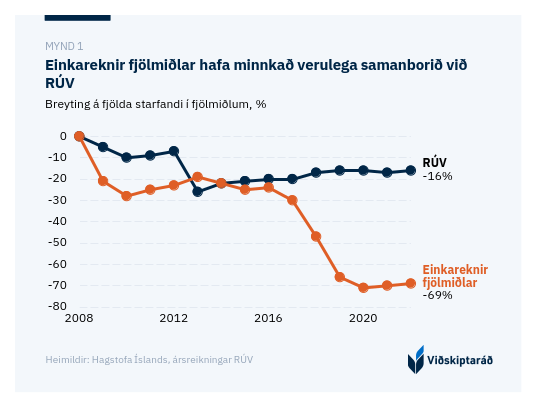
The number of employees at privately owned media has fallen by almost 70% over the past fifteen years, while the number of employees at RÚV has fallen by 16% (Figure 1). This has caused the state's market share in the media market to grow significantly in recent years. It is worth bearing in mind in this context the important oversight role that the media play in relation to government in democratic states.
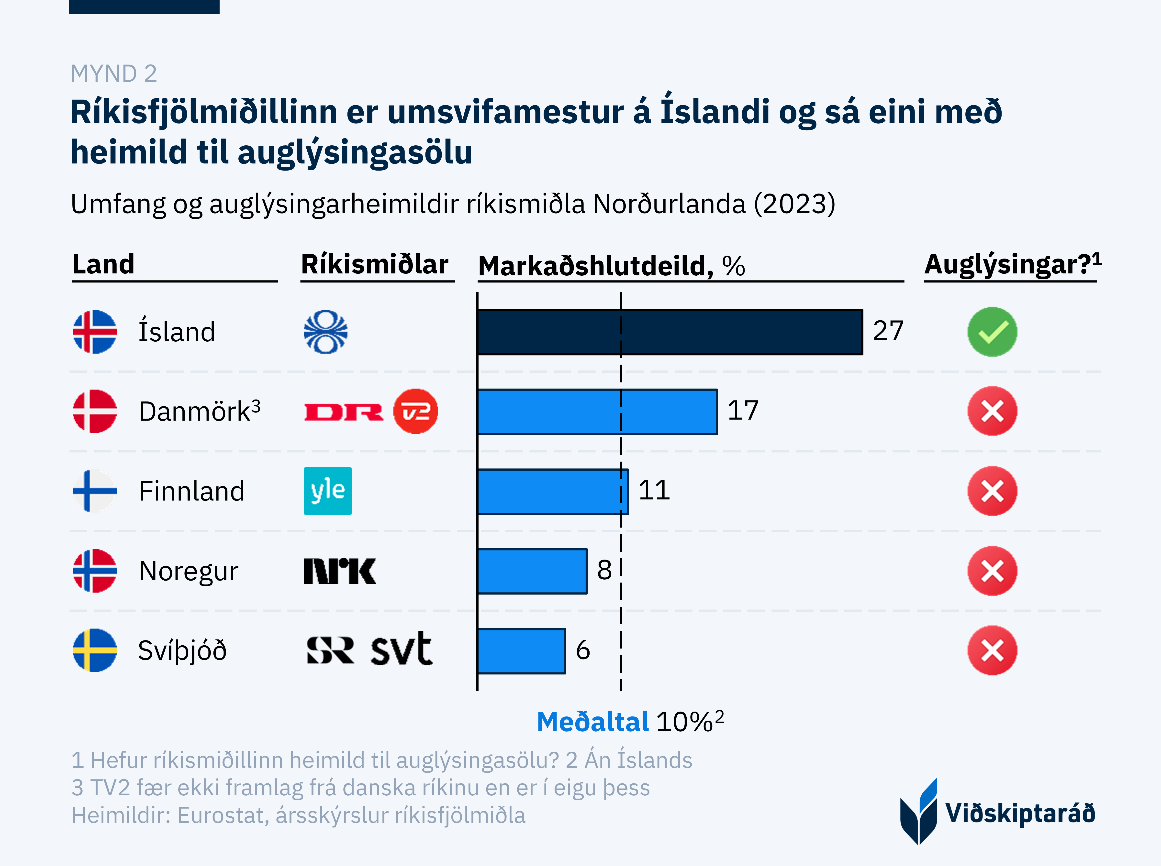
RÚV is the only Nordic state broadcaster that both receives public funding and is permitted to sell advertising (Figure 2). As a result, nowhere else in the Nordic countries is the state broadcaster's market share as large as it is in Iceland, with RÚV's share of total media market revenue standing at 27%, compared with an average of 10% across the Nordic countries.
The fund landscape is already complex and inefficient
In 2022, the Treasury operated almost 80 funds that together received around ISK 22.5 billion. The combined administrative cost of these funds was close to ISK 1 billion. Many of the funds are small in scale, and their administrative costs are therefore proportionally high.
Viðskiptaráð objects to the government further increasing the number of public funds. Allocating public funds through many small funds results in waste in the form of high administrative costs. As the fund's allocation will amount to ISK 40 million, it can be expected that its operating costs will be high relative to the grants it awards.
References
[1] See Viðskiptaráð's report (March 2025): ‘Excuse the Interruption: The Media Environment in Iceland’. Link: https://vi.is/skodanir/afsakid-hle
This article was automatically translated from the Icelandic original.
Related Content

Rent caps undermine tenants’ housing security

Increased regulation of the .is national domain needs explanation

Carbon tariff an undesirable response to a flawed system
State investments need clearer cost-benefit analysis

Intervention in pricing decisions can reduce competition