Power on the map: the path to doubling electricity generation
Mapped power project options could multiply Iceland’s electricity generation, yet output has stood still since 2017. The Master Plan, multiple avenues of appeal and a weak transmission system mean that it takes decades to bring a new power plant into operation. Viðskiptaráð proposes abolishing the Master Plan and more than doubling electricity generation by 2040.

Iceland can more than double its electricity generation by 2040. The power project options mapped in Iceland could multiply it, yet generation has stood still since 2017. The Master Plan, numerous avenues of appeal and delays in permitting processes mean that it takes decades to bring a new power plant into operation. Hvammur Power Station will be commissioned 32 years after it was first assessed. On top of that, the transmission system cannot handle additional load. Viðskiptaráð proposes abolishing the Master Plan so that power plants go through the same permitting process as other projects, building up the transmission system, and setting an official target of more than doubling electricity generation by 2040.
Summary
- Around 150 unused power project options have been mapped under the Master Plan, with combined potential output of over 80 terawatt hours a year, more than four times current electricity generation. Yet generation has stood still since 2017.
- The process from idea to power plant is long and unpredictable. Landsvirkjun estimates that it takes twelve years at best, but Hvammur Power Station will be commissioned 32 years after it was first assessed.
- There are many rights of appeal, which can delay projects for years. Hvammur’s permits have been revoked three times, and rulings repeatedly run past statutory deadlines.
- The transmission system is another bottleneck. In 2024, 18 of 26 delivery points could only take an additional 0–10 megawatts.
- Viðskiptaráð proposes repealing the Master Plan Act so that power plants go through the same general permitting process as other projects, with a single avenue of appeal. Rights to use state land should be put out to tender, the transmission system built ahead of demand, wind power near reservoirs given priority, and more than doubling electricity generation by 2040 made an official target.
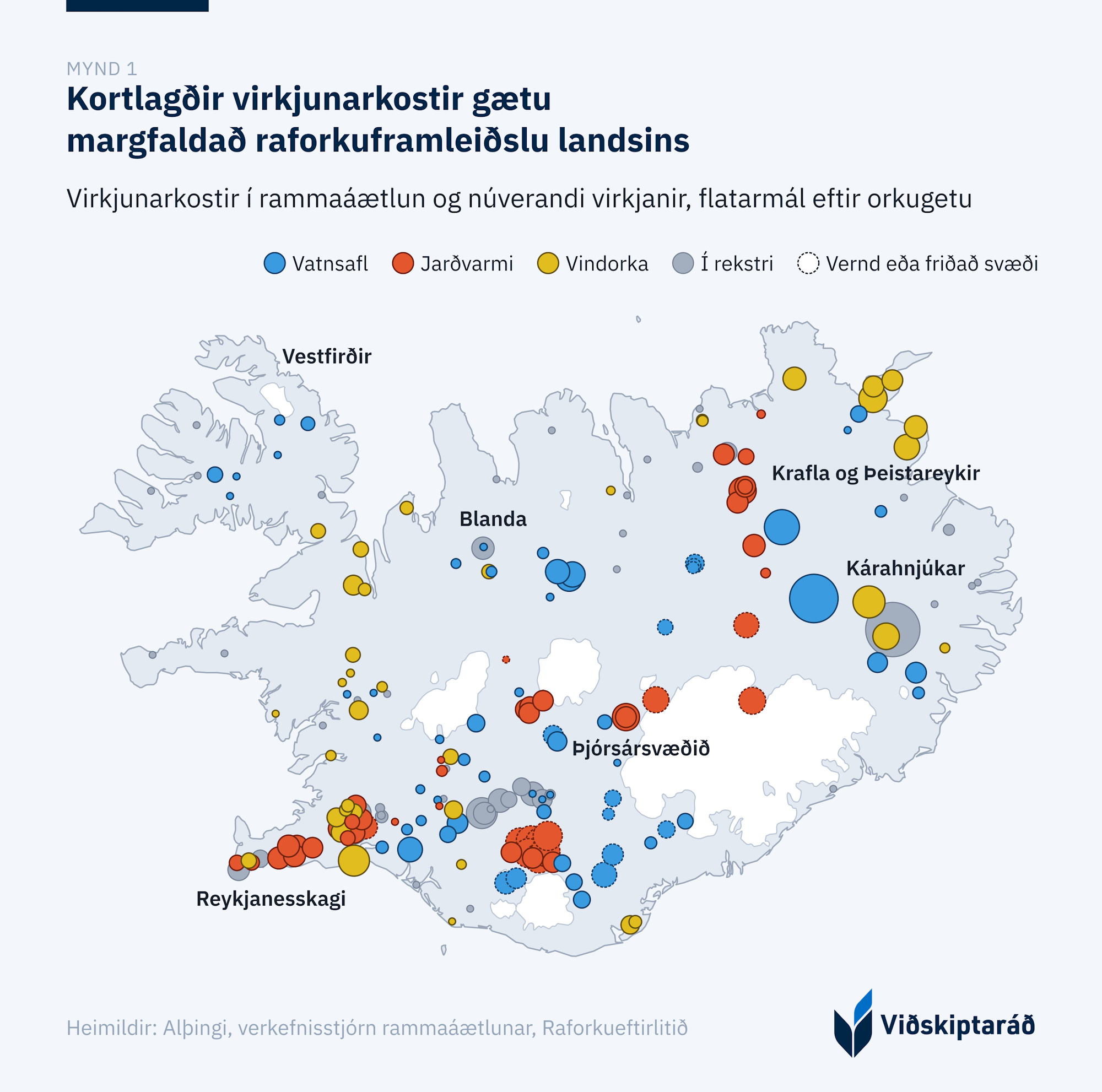
Iceland has a great deal of untapped energy. Just over 80 power plants are currently operating in Iceland, but in total close to 150 unused power project options have at some point been assessed under the Master Plan (Figure 1). In 2025, Iceland generated 18.8 terawatt hours of electricity, while the combined generating potential of unused options exceeds 80 terawatt hours a year, although not all of them could be used at the same time and some are in the protection category. Electricity generation in Iceland could thus be multiplied.[1, 2]
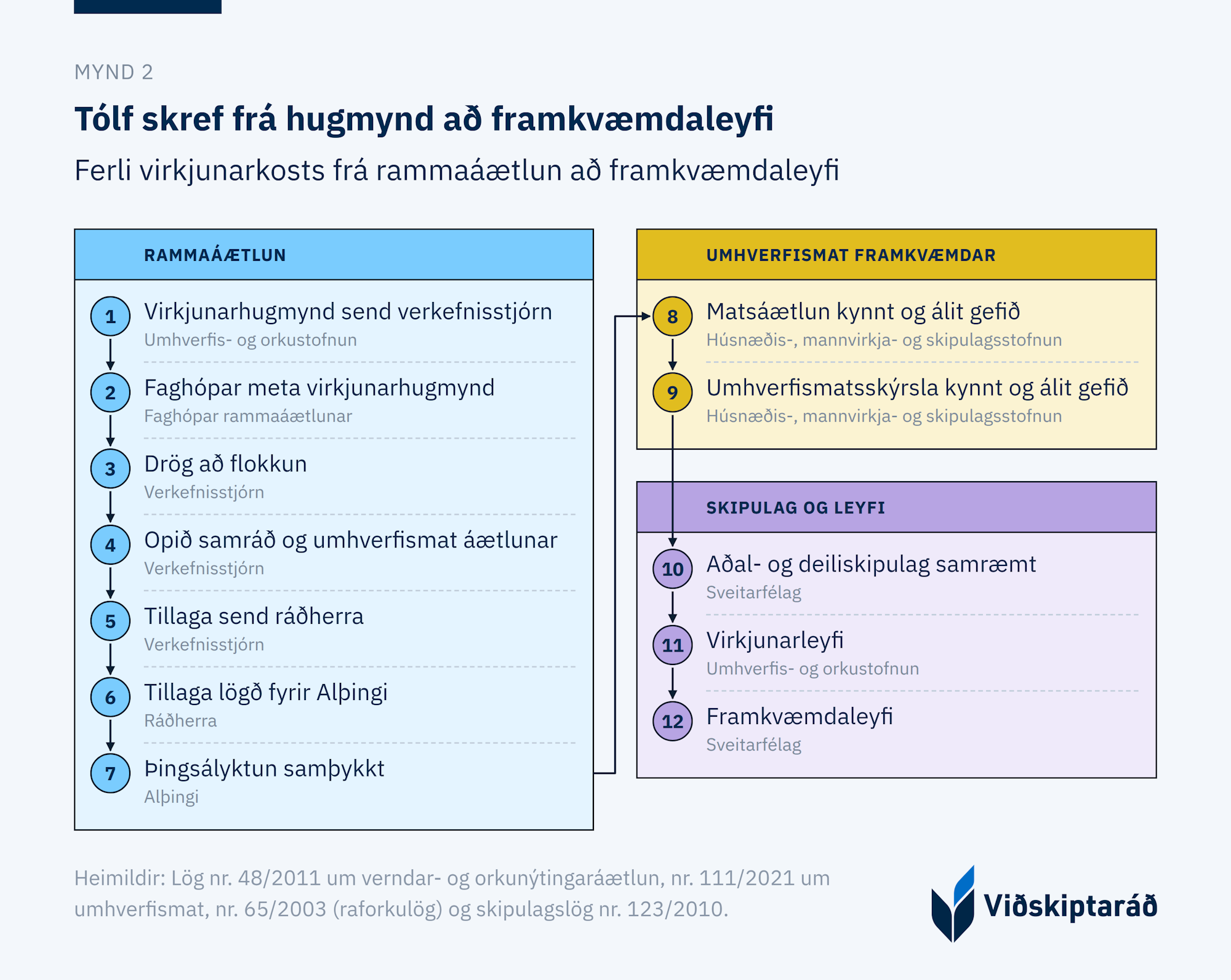
To make use of these options, the power project proposal must be submitted to the Environment and Energy Agency, which refers it to the Master Plan steering committee. The steering committee and expert groups assess it, and a proposed categorisation is sent to the minister, who submits it to Althingi. If it is approved, the project must go through an environmental impact assessment and the municipal planning process before a generation licence and development permit are granted (Figure 2).[3]
Of these unused options, 20 have been placed in the Master Plan’s utilisation category. Vaðölduver (formerly Búrfellslundur) started generating in September and construction is under way at Hvammur Power Station, but construction has not begun on any other options in the utilisation category.[1, 4, 5]
The Master Plan has proved a drag
The framework for energy utilisation set out in the Master Plan has proved cumbersome in practice. The aim of the Act on the Master Plan for Nature Protection and Energy Utilisation, on which the Master Plan rests, is to identify and protect the areas of the country that should be excluded from energy production, and to ensure that the use of areas containing power project proposals is based on long-term considerations and an overall assessment of interests. Expert groups have assessed power project options, covering among other things natural and cultural heritage and the social and economic impact of power plants. The steering committee proposes placing each option in the utilisation, on-hold or protection category, and the minister submits the proposed categorisation to Althingi as a parliamentary resolution. The steering committee is in effect advisory, since the minister can, after a new consultation process, move individual options between categories before the proposal is put to parliament.[3, 6]
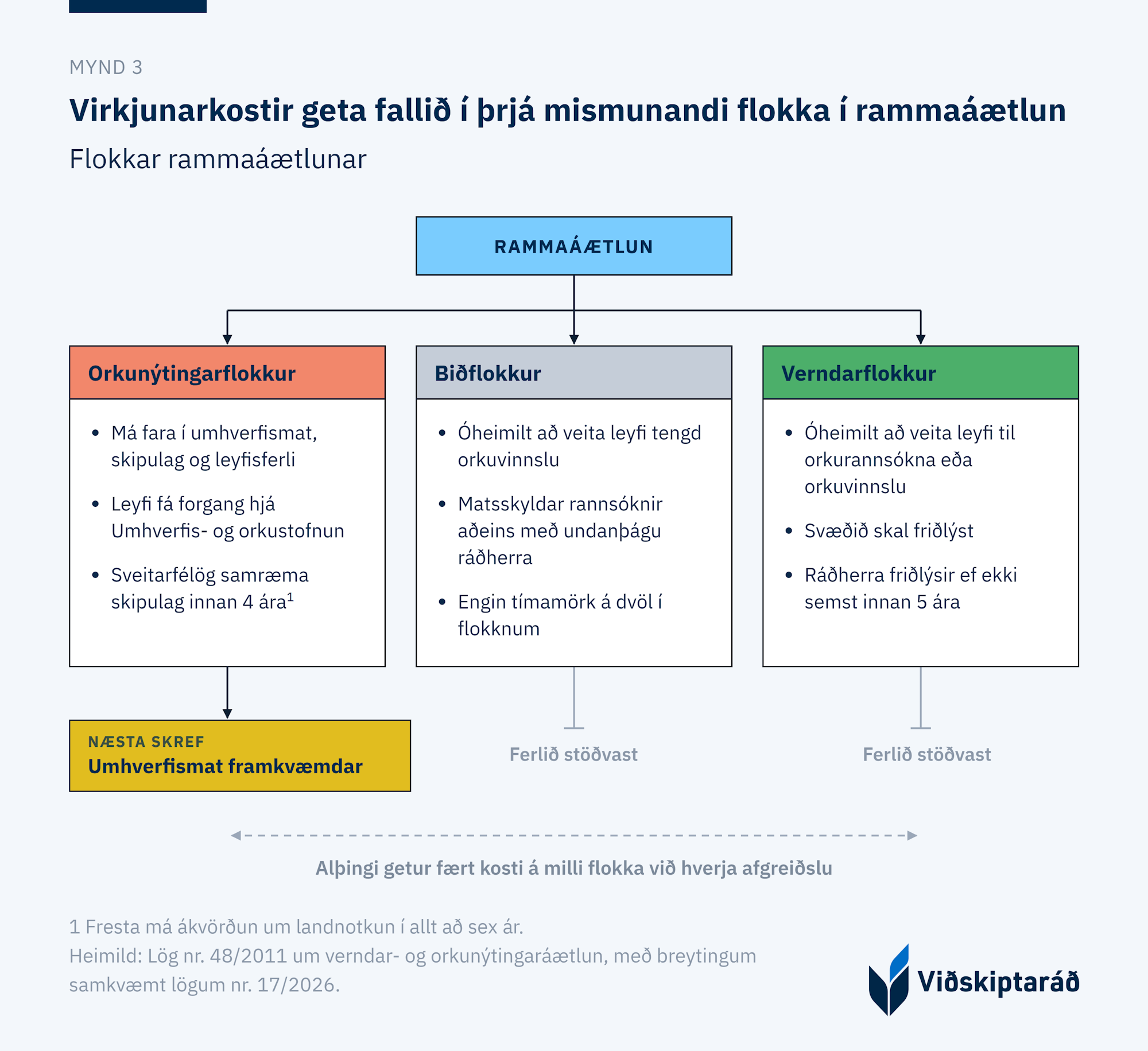
Power project options that have been judged suitable for use are placed in the utilisation category. Options requiring further information before deciding whether they belong in the utilisation or protection category go into the on-hold category. Options that are not considered appropriate to develop, or areas that warrant protection, are placed in the protection category (Figure 3).[3]
The steering committee and expert groups do not take administrative decisions, so the categorisation itself cannot be appealed. This limits stakeholders’ ability to challenge the procedure and the impartiality of those involved in the decisions. Even so, they wield considerable power in assessing and categorising power project options.[7]
Politics a bottleneck in adopting the Master Plan
Getting the Master Plan through the political process has proved difficult. When the third phase of the Master Plan was adopted by Althingi in 2022, nine years had passed since the steering committee began work on it and six years since it delivered its final report.[8, 6]
Nor has the Master Plan succeeded in creating predictability or a clear framework for energy utilisation. Some power project options have remained in the on-hold category for a long time, even more than a decade. Villinganes and Skatastaðir power projects in Héraðsvötn, for example, were assessed in the very first phase of the Master Plan, completed in 2003, and have been on hold since 2013. Althingi has also placed in the on-hold category options that the steering committee recommended for the utilisation category. Holt and Skrokkalda power projects, for instance, were not moved to the utilisation category until February 2026, having been on hold since 2013, even though the steering committee had repeatedly recommended utilisation. Urriðafoss power project remains on hold despite the steering committee recommending utilisation.[9, 10, 4]
The Master Plan arrangement is also unique. It was modelled on a similar system in Norway, but that was abolished in 2016. No comparable system, categorising power project options for both utilisation and protection, exists in the countries Iceland usually compares itself with. Nature conservation is already ensured by the laws on environmental impact assessment and planning and the Nature Conservation Act, which apply to all other projects. The Master Plan thus adds a separate political layer on top of a regulatory framework that already safeguards nature and local communities.[11, 12]
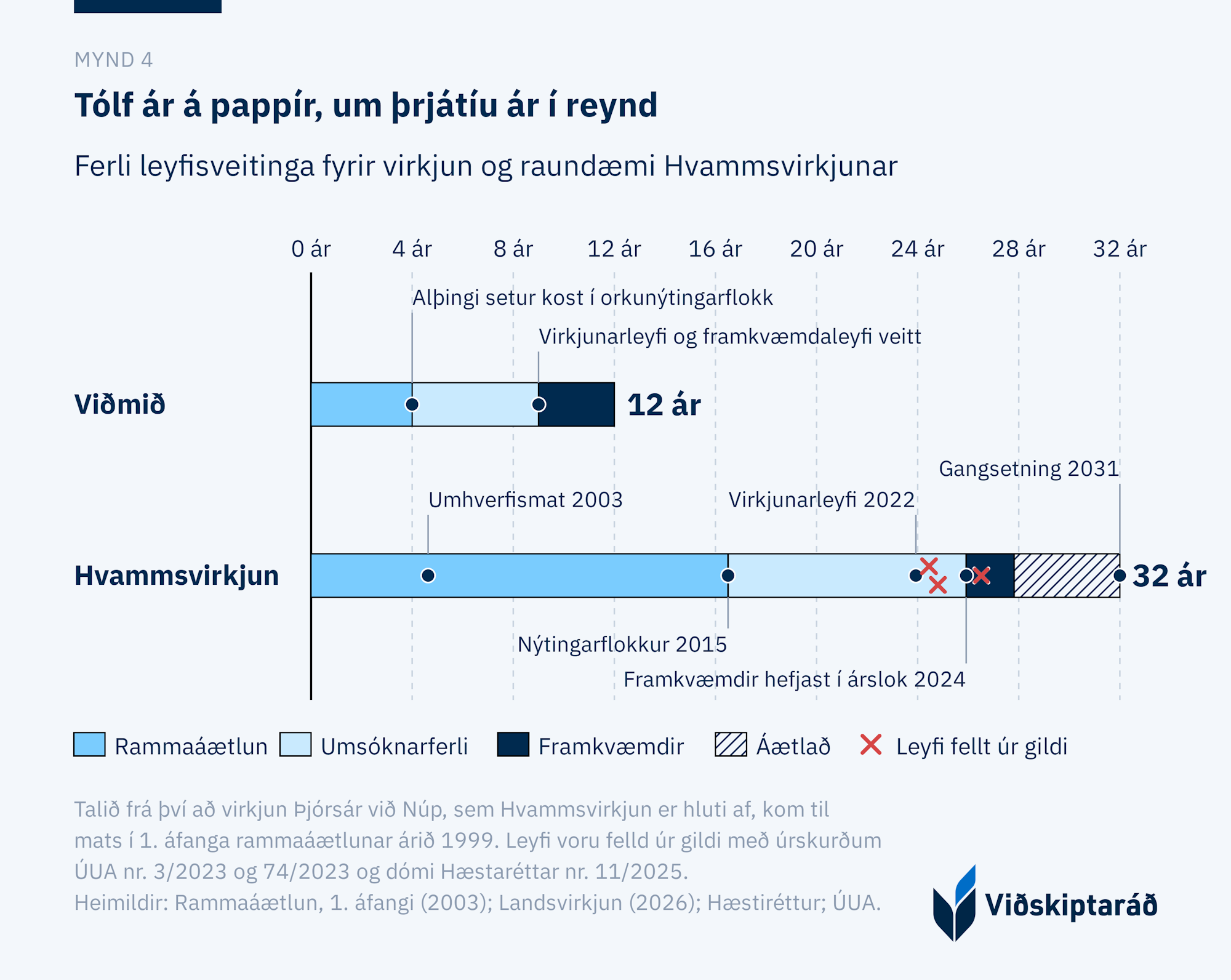
This additional layer means it takes a long time to get new projects off the ground. Landsvirkjun estimates that the process takes twelve years from the submission of a power project option until a plant is commissioned.[13] Hvammur Power Station tells a different story, however (Figure 4). It was first assessed as part of the Núpur project in the first phase of the Master Plan, which began in 1999, placed on hold in the second phase in 2013 and moved to the utilisation category in 2015. Around nine years passed from its placement in the utilisation category until construction started, and construction is expected to take about seven years. In all, 32 years will have passed from Hvammur’s first assessment under the Master Plan until its planned commissioning.[9, 14, 15, 16]
Many avenues of appeal and generous deadlines
There are many avenues of appeal against the main decisions on power plants, so numerous appeal processes can be launched in the run-up to construction. In the preparation and permitting process there are four decisions that can be appealed to the Environmental and Natural Resources Board of Appeal (Figure 5). In our neighbouring countries there are only one or two.[7] The deadline for appealing to the board is one month, and the board is generally required to rule within three to six months. If the appellant does not accept the board’s ruling, the case can be taken to court. These extensive rights of appeal at many stages can significantly delay projects.[17, 7]
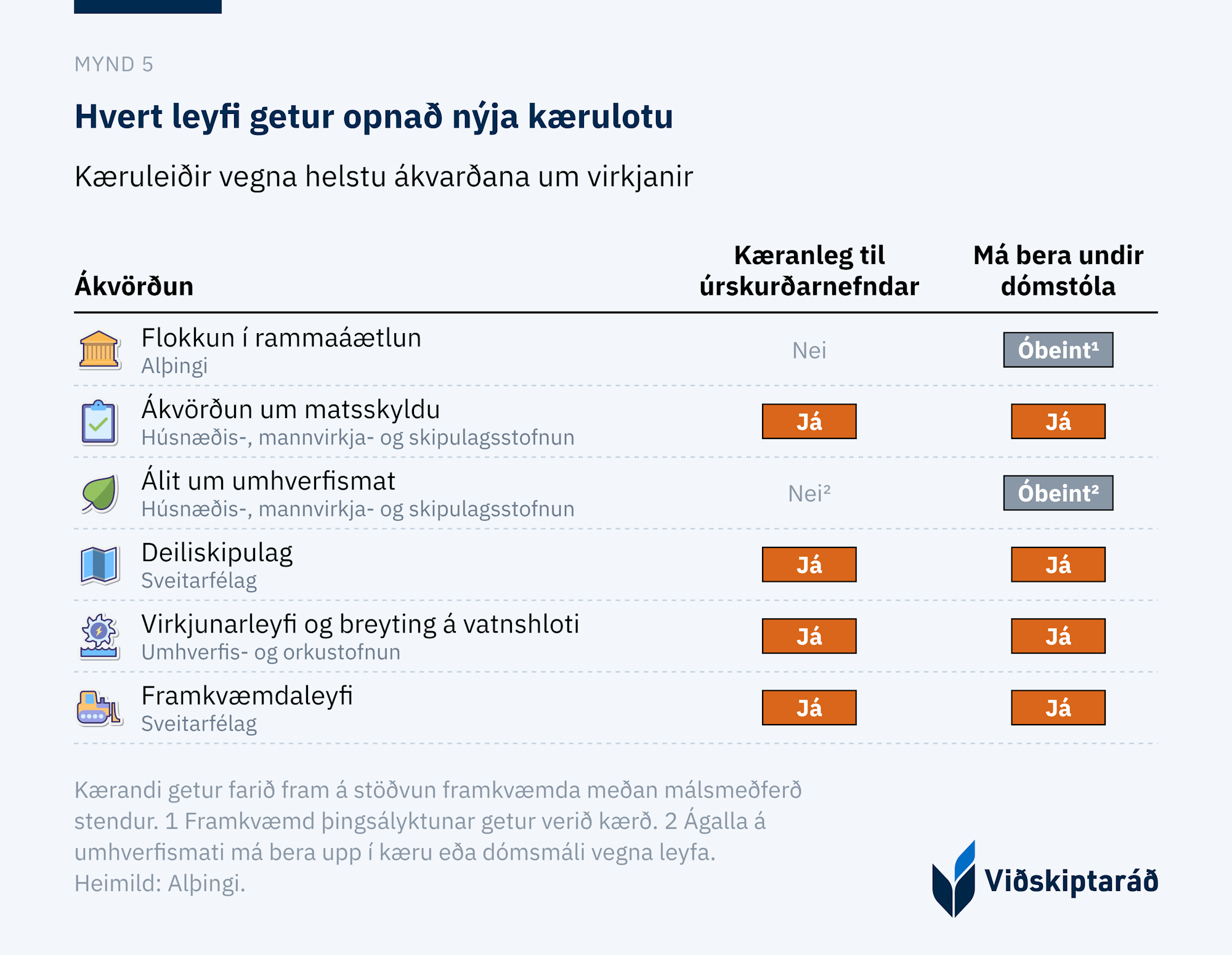
The permitting process for Hvammur Power Station clearly shows how burdensome these rights of appeal can be. The National Planning Agency’s environmental impact assessment ruling from 2003 was appealed to the Minister for the Environment, who upheld it in April 2004. The agency’s 2015 decision to revise the assessment only in part was appealed to the Environmental and Natural Resources Board of Appeal in January 2016. The board rejected the claims in February 2018, more than two years after receiving the appeal, or about a year and a half after the statutory deadline had passed.[15, 18]
The National Energy Authority’s generation licence from December 2022 was appealed in January 2023 and revoked in June that year. Skeiða- og Gnúpverjahreppur municipality’s development permit from June 2023 was revoked in October. Landowners then sued the state and Landsvirkjun over a new permit to modify a body of water and a new generation licence from 2024. The District Court annulled both in January 2025, and the Supreme Court upheld that ruling in July the same year.[19, 20, 15]
A provisional generation licence issued by the Environment and Energy Agency in August 2025 was appealed the day after it was issued, but the Board of Appeal rejected the request to annul it. A development permit for preparatory works was also appealed, and the board likewise rejected the request to annul it. Landowners then sued the Icelandic state, Landsvirkjun and others over the renewed generation licence issued in December 2025, but the District Court ruled in the defendants’ favour in June 2026. The municipality’s development permit was also appealed.[21, 22, 23]
It is clear from this that the rights of appeal in the permitting process are too extensive. The most reasonable approach would be to give parties a single opportunity to appeal projects such as these. This is especially pressing given that, for example, the broadened right to appeal to the board is not conducive to reducing the number of disputes and thereby shortening delays at the administrative level. The broadened right of appeal refers to the statutory right of environmental, outdoor recreation and interest groups with at least 30 members to appeal to the Environmental and Natural Resources Board of Appeal in respect of certain administrative decisions and alleged breaches of the right to participate. These include HMS decisions on whether an assessment is required and permitting decisions for projects covered by the Act on Environmental Assessment of Plans and Projects.[17]
This would ensure that cases are resolved within a reasonable time and that projects could go ahead without new avenues of appeal opening up, along with the uncertainty that comes with them.
Delays in permitting are common
Deadlines have also been a problem in energy projects, both in building power plants and in developing the transmission system. When statutory deadlines are not met, whether in the permitting process or the appeal process, projects can be delayed considerably, even by several years.
The appeal against Hvammur’s environmental impact assessment received by the Board of Appeal in January 2016 was discussed above; its handling ran a year and a half past the statutory deadline. That is not an isolated case. Construction of the Krafla Line 3 transmission line was significantly delayed because statutory deadlines for processing permits were not met. Including an appeal, the assessment plan stage of the project took over two years, when it should have taken about four months had the deadlines been met. The same applied to Hólasandur Line 3, where part of the assessment process, which by law should take ten weeks, took more than a year.[24]
Delays like these in meeting statutory deadlines are extremely costly, as they leave major projects on the back burner.
Standstill in energy supply since 2017
The cumbersome Master Plan process, extensive rights of appeal and disregard for statutory deadlines have contributed significantly to stagnation in energy supply. Generation has stood still at around 19 terawatt hours since 2017, and electricity per person has fallen while the population has grown. Installed capacity in Iceland has also increased little over the past decade, especially compared with the first decade of the 21st century (Figure 6).[25]
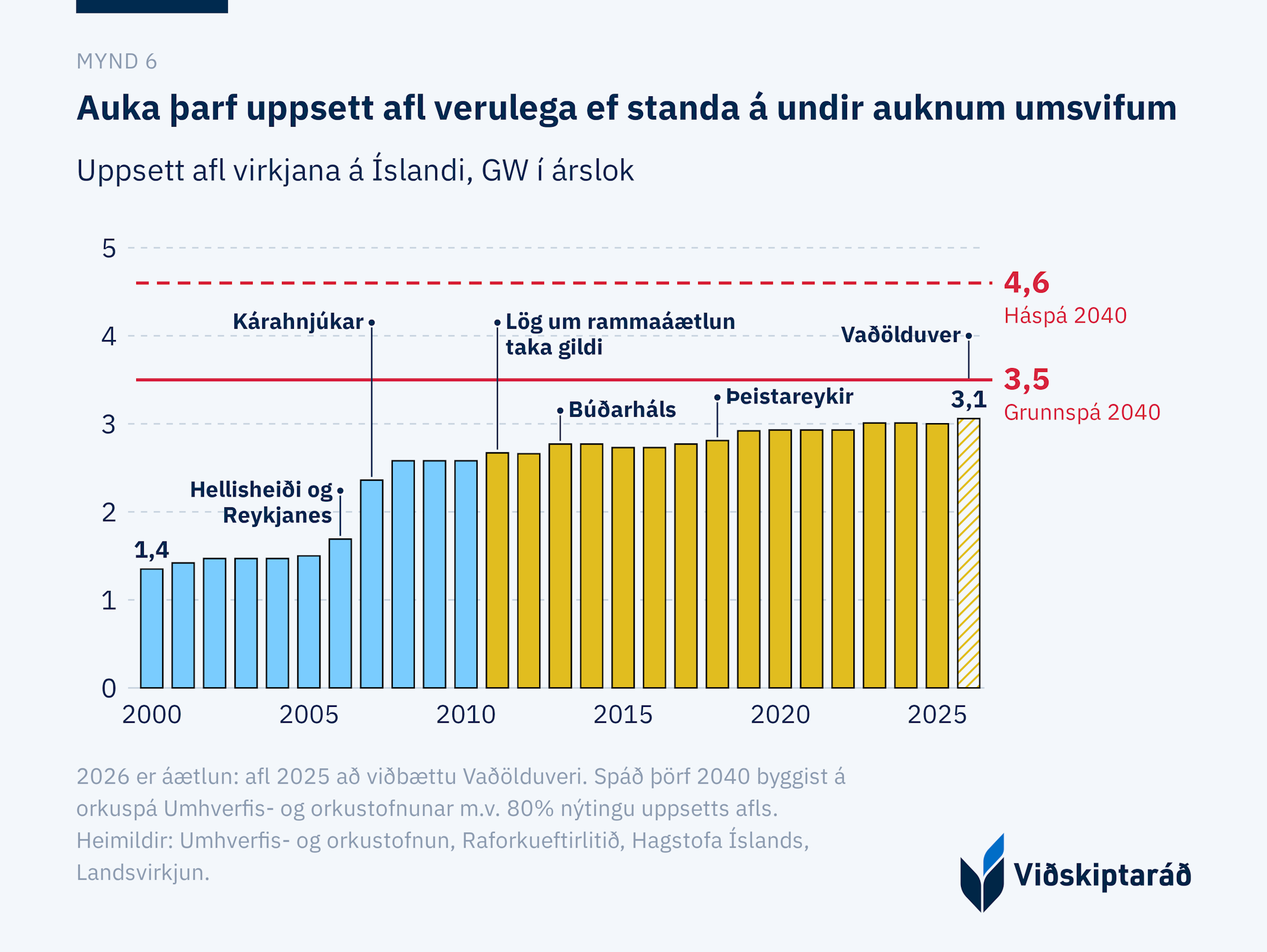
This stagnation has already had consequences. In the winter of 2023 to 2024, Landsvirkjun had to curtail deliveries by almost 500 gigawatt hours.[26]
The Environment and Energy Agency’s baseline forecast assumes moderate growth in activity and the current pace of the energy transition. The high forecast, by contrast, assumes more activity by large-scale users and a faster energy transition. Whether one looks at the baseline or the high forecast, growth in energy supply needs to be faster in the coming years than it has been over the past decade.[27]
Positive steps have been taken towards simpler and more efficient regulation of energy supply. In 2026, amendments were adopted to the Master Plan Act and the Electricity Act, aimed among other things at more efficient energy development. An act simplifying and harmonising permitting processes in the environmental and energy field was also passed. In addition, five new options, totalling almost two terawatt hours, have been moved to the utilisation category, and the country’s first large wind farm, Vaðölduver, started generating in September. But that is less than a tenth of the options waiting in the utilisation and on-hold categories, and placement in the utilisation category is only the first of many steps, as the story of Hvammur Power Station shows. The process therefore remains cumbersome, and the road to construction is long.[28, 29, 4, 5]
Limited spare capacity in the transmission system holds back further energy development
Launching a new era of energy development requires more than power plants: the transmission system must also be able to carry more electricity.
There is already little room to add load at delivery points. In 2024, 18 of 26 delivery points could only take an additional 0–10 megawatts (Figure 7). The main bottlenecks are ageing transmission lines. The regional grid (Byggðalína) was nearly half a century old in 2021, and electricity use has multiplied since it was built. It is therefore important that the transmission system is built up alongside increased energy supply.[30, 31]
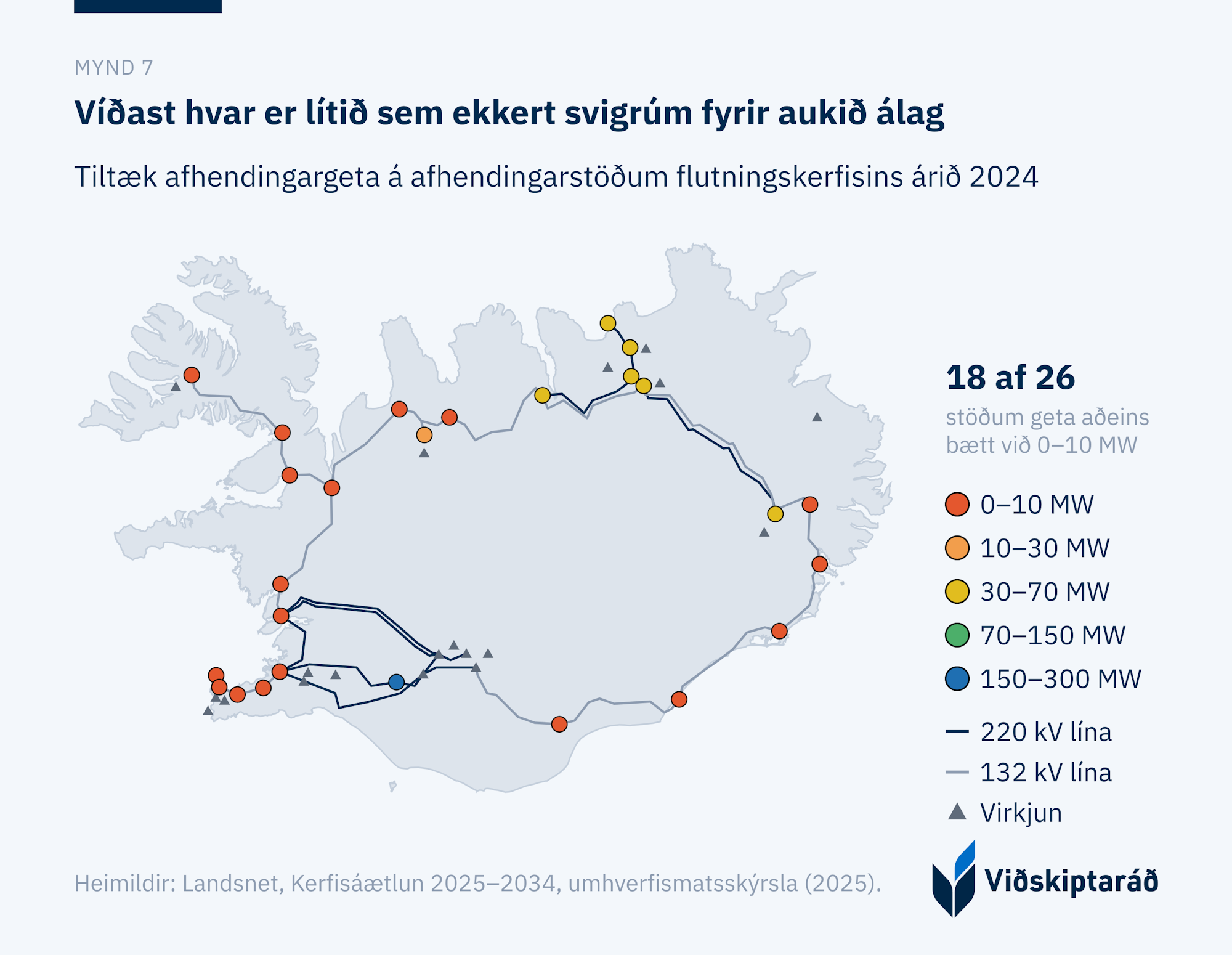
It is enormously costly for society as a whole when electricity cannot reach where it is needed. Both direct revenue from electricity sales and the jobs that a stronger business sector would have created are lost. Landsnet estimates that transmission constraints have cost Iceland around ISK 11–15 billion a year in recent years, without accounting for lost opportunities for business development.[32] Landsnet had to turn down 100 formal connection requests between 2018 and 2021, for example. The economy’s capacity to grow is thus weakened when the transmission system has limited capacity.[33]
It is therefore vital that the transmission system is built for the future and that Landsnet’s plan for no delivery point to have less than 30 MW of available capacity by 2030 is delivered. That change would support business development across the country and lay the foundation for future economic growth.
Wind power a good complement to a hydro-based energy system
Wind power fits well with the hydropower system. Onshore wind is the cheapest source of new renewable electricity in the world, and many new, high-capacity wind projects have already entered the Master Plan and await assessment. Building wind farms near hydropower reservoirs can bring major benefits. Water could be stored in the reservoirs when the wind blows and then drawn down when the turbines are not generating.[34]
Areas around reservoirs have already been disturbed by dams, roads and power lines, so a wind farm by a reservoir has little impact on untouched nature. Substations and high-voltage lines are also already in place, with no need to wait for new lines or grid connections.
Vaðölduver, now rising near the Sultartangi power station, is a good example of such a project. It will have around 120 megawatts of installed capacity close to other energy infrastructure, high-voltage lines and power stations.[35]
No rich country uses little energy
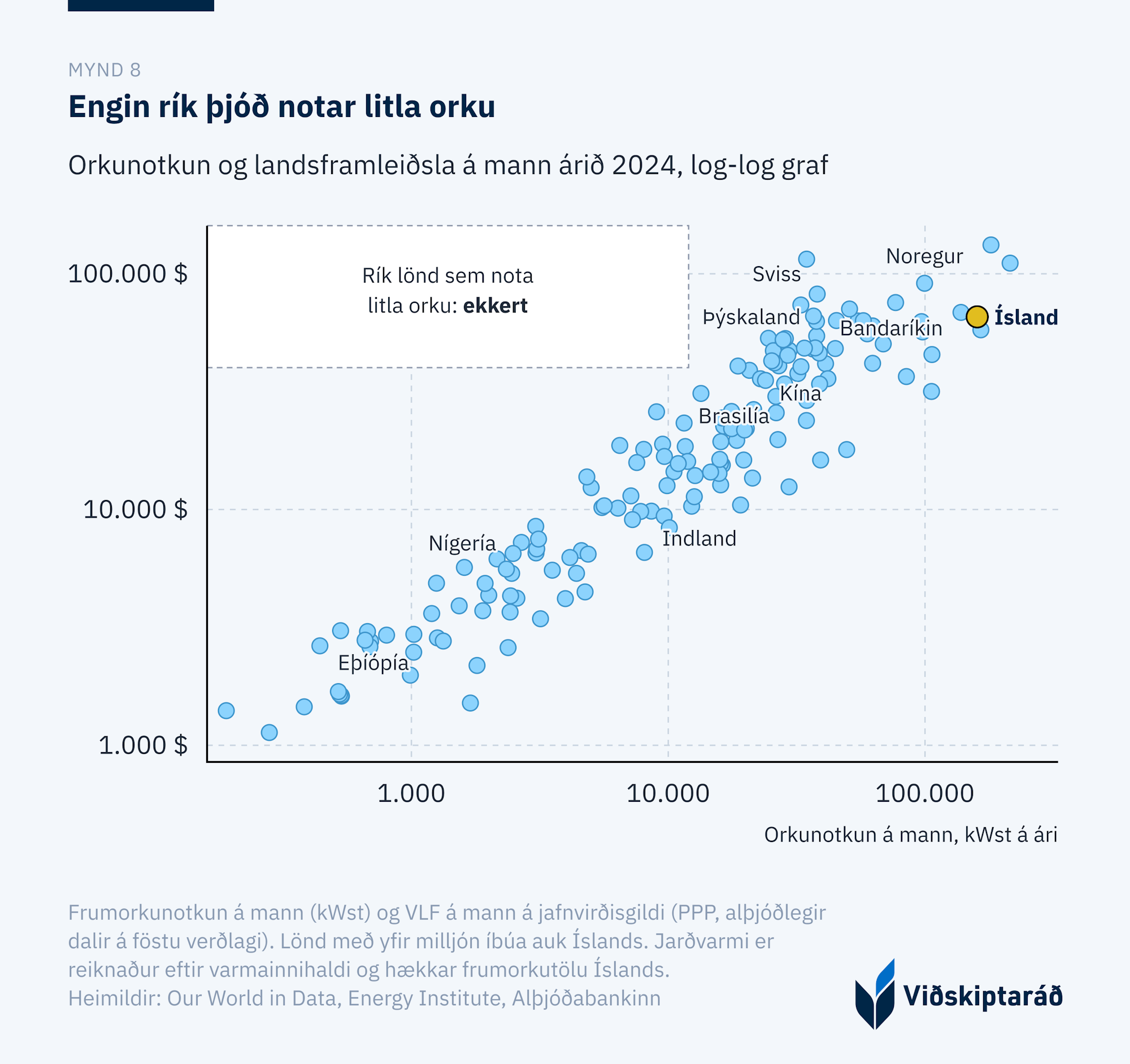
The link between energy and living standards is one of the clearest in global economic statistics. Of the 19 countries with over one million inhabitants where gross domestic product (GDP) per capita is below USD 3,000, none uses more than around 1,800 kWh per person. That is less than 1% of Iceland’s consumption. The richest quarter of countries uses a median of around 38,000 kWh per person and the poorest around 1,200 kWh, more than thirty times less (Figure 8). No country with high living standards has low energy use.[36, 7]
Demand for energy is growing fast
Demand for clean and stable energy is growing from many directions. In the highest scenario of the government’s 2022 green paper on energy, a full energy transition together with forecast growth among large-scale users would require around 23.7 additional terawatt hours by 2040, more than doubling generation.[37]
A new and rapidly growing driver of global electricity demand is the build-out of data centres. The International Energy Agency estimates that electricity use by data centres worldwide rose by 17% in 2025 and forecasts that it will double by 2030. In the United States, new power plants wait around five years for a grid connection. Iceland can offer stable power based on renewable energy and should use that competitive advantage to attract further investment.[38, 39, 40]
It should be noted, however, that the proposal is not to reserve energy for particular industries. The task is to increase supply so that everyone who wants to buy energy at market prices can obtain it.
Electricity generation should be doubled and the Master Plan abolished
Iceland is a leader in green energy supply. The development of hydropower in the 20th and early 21st centuries put us at the forefront of clean energy use, and since the early 1970s renewable energy has made up the majority of the country’s energy use.[41]
Yet Iceland still has a great deal of untapped energy potential. Given that energy supply is a basic prerequisite for further business growth, and given the clear link between energy use and quality of life, it is important that the government promotes greater energy development.
The cumbersome administrative process surrounding the Master Plan prevents a push in energy development in the coming years. Processing times are too long, there are too many opportunities to stop or slow down projects, and the process as a whole is too heavily controlled by the state. This is most clearly seen in the fact that since the Master Plan Act was passed in 2011, only two new power plants have been built, in addition to Vaðölduver, which started generating in September.[42]
Viðskiptaráð believes that fundamental changes to the legal framework for energy development are needed to facilitate further business development in the future. In this context, Viðskiptaráð proposes the following:
- Repeal the Master Plan Act and reduce avenues of appeal. The Master Plan has proved an obstacle to greater energy development rather than a tool for creating a framework for using energy options. The process is too long, it contains too many avenues of appeal, and it has failed to create predictability about the use of energy options. Viðskiptaráð therefore proposes repealing the Master Plan Act and reducing avenues of appeal to one.
- Build the transmission system ahead of demand. Ensure that Landsnet’s plan for no delivery point to have less than 30 MW of available capacity by 2030 is achieved. This would ensure that the transmission system does not become a bottleneck in using additional energy.
- Give wind power near reservoirs priority in permitting. Wind farms in already disturbed areas near existing power plants and reservoirs should be given priority. This would lighten the environmental assessment and ensure swift handling in permitting processes when such plants are built in already disturbed areas.
- Make more than doubling electricity generation by 2040 an official target. The government should set a policy of reaching 43 terawatt hours of generation by 2040, in line with the estimated energy needs in the government’s 2022 green paper, and monitor progress towards that target. The mapping of energy options carried out through the Master Plan process can serve as a source of information for a further push in energy development.
Three approaches could be considered. Viðskiptaráð considers the general approach preferable:
- General approach: Energy production would be subject to the same general rules as other business activity, going through environmental assessment and planning and complying with the Nature Conservation Act. This would take political involvement out of the process and ensure that energy production is treated equally with other industries. Protected areas and national parks would remain protected under the Nature Conservation Act. Only the largest power projects, so-called megaprojects, would require the approval of Althingi. Two conditions would have to be met at the same time: installed capacity would exceed a certain threshold, e.g. 600 MW, and the project would be of major significance for the national economy and have irreversible effects on the country’s nature. Althingi’s involvement would thus be limited to particularly large projects with such an impact on society and the environment that special democratic scrutiny would be justified.
- Zoning approach: The country would be divided into three zones: energy use not permitted, energy use permitted, and energy production zones. Such a plan could be adopted by parliamentary resolution. Certain zones would be defined where energy use is permitted, and power projects there would go through the same general process as other projects. Energy production zones would cover areas already disturbed by power development. Expansions of power plants or new plants in those areas, e.g. wind farms near hydropower plants, would get priority in permitting processes and a lighter environmental assessment.
- Tender approach: The Environment and Energy Agency would put out to tender the rights to develop power project options on public lands and state-owned land when there is interest. This would allow cost-effective options to be prioritised and ensure that the best bidder is awarded the option.
References
[1] Alþingi (2022). Þingsályktun um áætlun um vernd og orkunýtingu landsvæða (3. áfangi), as amended: althingi.is.
[2] Raforkueftirlitið (2026). Uppsett rafafl og raforkuvinnsla í virkjunum á Íslandi 2025: vefskrar.orkustofnun.is.
[3] Alþingi (2026). Lög um verndar- og orkunýtingaráætlun nr. 48/2011: althingi.is.
[4] Stjórnarráðið (2026). Holtavirkjun og Skrokkölduvirkjun samþykktar í orkunýtingarflokk: stjornarradid.is.
[5] Stjórnarráðið (2026). Þrjár virkjanir samþykktar í orkunýtingarflokk rammaáætlunar: stjornarradid.is.
[6] Verkefnisstjórn 3. áfanga rammaáætlunar (2016). Lokaskýrsla verkefnisstjórnar 3. áfanga verndar- og orkunýtingaráætlunar: ramma.is.
[7] Viðskiptaráð Íslands (2023). Orkulausnir: Skýrsla Viðskiptaþings 2023: vi.is.
[8] Samorka (2022). Rammaáætlun afgreidd eftir níu ára bið: samorka.is.
[9] Verkefnisstjórn um gerð rammaáætlunar (2003). Niðurstöður 1. áfanga rammaáætlunar: os.is.
[10] Alþingi (2013). Nefndarálit um tillögu til þingsályktunar um áætlun um vernd og orkunýtingu landsvæða, doc. no. 526, 141. legislative session: althingi.is.
[11] Store norske leksikon (n.d.). Samlet plan for vassdrag: snl.no.
[12] Viðskiptaráð Íslands (2025). Rammaáætlun reynst dragbítur á framgang nauðsynlegra orkuskipta: vi.is.
[13] Landsvirkjun (2023). Leyfin og tíminn: landsvirkjun.is.
[14] Landsvirkjun (2009). Hvammsvirkjun, Holtavirkjun og Urriðafossvirkjun: Rammaáætlun II: ramma.is.
[15] Hæstiréttur Íslands (2025). Case no. 11/2025: island.is.
[16] Landsvirkjun (2026). Bygging Hvammsvirkjunar boðin út: landsvirkjun.is.
[17] Alþingi (2026). Lög um úrskurðarnefnd umhverfis- og auðlindamála nr. 130/2011: althingi.is.
[18] Úrskurðarnefnd umhverfis- og auðlindamála (2018). Case no. 10, 11 og 15/2016, Hvammsvirkjun: uua.is.
[19] Úrskurðarnefnd umhverfis- og auðlindamála (2023). Case no. 3/2023, Hvammsvirkjun: uua.is.
[20] Úrskurðarnefnd umhverfis- og auðlindamála (2023). Case no. 74/2023, Framkvæmdaleyfi Hvammsvirkjunar: uua.is.
[21] Úrskurðarnefnd umhverfis- og auðlindamála (2025). Case no. 128/2025, Hvammsvirkjun: uua.is.
[22] Úrskurðarnefnd umhverfis- og auðlindamála (2025). Case no. 130/2025, Hvammsvirkjun: uua.is.
[23] Landvernd (2026). Hvammsvirkjun hleypt í gegn í héraðsdómi: landvernd.is.
[24] Landsnet (2020). Greinargerð um tillögur til úrbóta í kjölfar truflana í norðanseltuóveðri í desember 2019: stjornarradid.is.
[25] Ember (2026). Yearly Electricity Data: ember-energy.org.
[26] Landsvirkjun (2025). Annual Report 2024: landsvirkjun.com.
[27] Umhverfis- og orkustofnun (2026). Orkuspá Íslands 2025–2050: uos.is.
[28] Stjórnarráðið (2026). Ferli rammaáætlunar gert að samfellu og tímatakmörk sett á virkjanaferli: stjornarradid.is.
[29] Stjórnarráðið (2026). Alþingi samþykkti breytingar á tólf lagabálkum til þess að einfalda regluverk orkumála: stjornarradid.is.
[30] Landsnet (2025). Kerfisáætlun 2025–2034: Umhverfismatsskýrsla: landsnet.is.
[31] Bændablaðið (2021). Spennu hleypt á fyrstu línu í nýrri kynslóð byggðalínu: bbl.is.
[32] Landsnet (2025). Kerfisáætlun 2025–2034: Langtímaáætlun: landsnet.is.
[33] Landsnet (2022). Tafir og töpuð tækifæri: landsnet.is.
[34] IRENA (2025). Renewable Power Generation Costs in 2024: irena.org.
[35] Landsvirkjun (2026). Fyrsta vindorkuver landsins komið í gang: landsvirkjun.is.
[36] Our World in Data (2026). Energy use per person vs. GDP per capita: ourworldindata.org.
[37] Umhverfis-, orku- og loftslagsráðuneytið (2022). Staða og áskoranir í orkumálum (grænbók): stjornarradid.is.
[38] IEA (2026). Data centre electricity use surged in 2025: iea.org.
[39] IEA (2026). Key Questions on Energy and AI: iea.org.
[40] Lawrence Berkeley National Laboratory (2026). Queued Up: 2026 Edition: emp.lbl.gov.
[41] Orkustofnun (2023). Frumorkunotkun 1940–2022: orkustofnun.is.
[42] Alþingi (2024). Svar umhverfis-, orku- og loftslagsráðherra við fyrirspurn um virkjunarkosti, doc. no. 1868, 154. legislative session: althingi.is.
This article was automatically translated from the Icelandic Original.
Related Content
An oversized piggy bank: the scale and agency problem of the pension system